500 documents vanished from the foreign ministry. Nepal never followed the trail
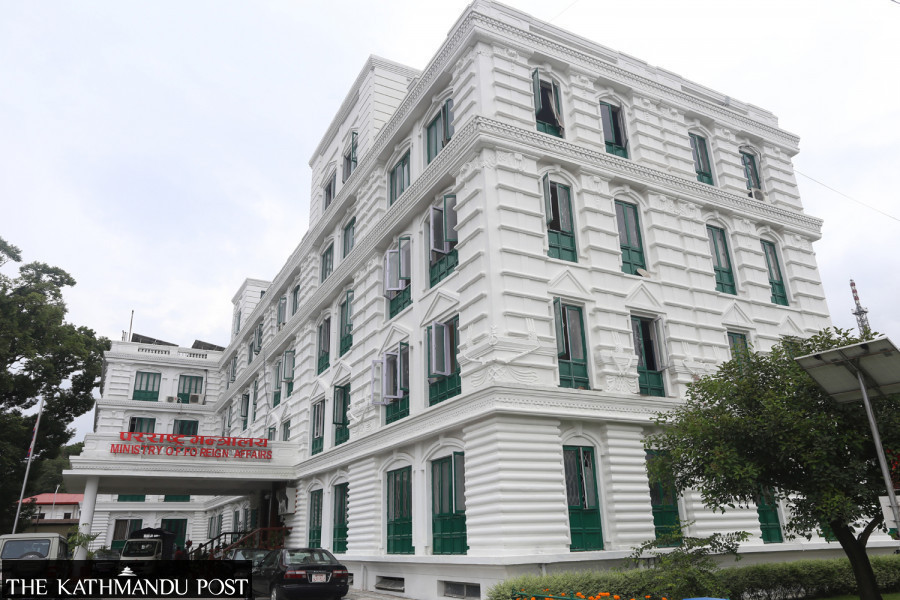
In 2009, half a thousand blank travel documents disappeared from the ministry’s store section. Fifteen years later, a chargesheet over Tibetan refugees' travel papers has forced investigators back to a case they left unfinished. File Photo
Fifteen years after 500 blank travel documents disappeared from the Foreign Ministry’s store section, a chargesheet filed at the Kathmandu District Court has forced investigators to reopen a case they had left unresolved.
Last month, the District Attorney’s Office in Kathmandu filed a case against Pushpa Raj Bhattarai, a joint secretary at the Ministry of Foreign Affairs, over the illegal issuance of travel documents to five Tibetan refugees back in 2009. The case followed a years-long investigation by the Central Bureau of Investigation (CIB), which the foreign ministry had asked to look into the matter in October 2011 — after a German Embassy official flagged, in 2010, that recently arrived Tibetan refugees appeared to be travelling on Nepali travel documents they should not have been able to obtain.
But buried inside Bhattarai’s chargesheet is a second, larger story: three of the five travel documents in question — bearing serial numbers A-026225, A-026226 and A-026227 — belong to a batch of 500 travel documents, numbered A-026001 to A-026500, that went missing from the Store Section in 2009 and were never accounted for. The other 497 have never been traced.
AIG Uma Prasad Chaturvedi, chief of the CIB, confirmed that a supplementary investigation into the remaining documents has now begun.
“The CIB has begun a supplementary investigation into who was involved in the other travel documents that went missing from the ministry at the time and where the misuse took place,” Chaturvedi told Kantipur. “The remaining matters will become clear only after the investigation.”
The missing documents first surfaced during an unrelated investigation in January 2010, when the CIB arrested Bachchuram KC, a non-gazetted officer in the Passport Section, for helping 30 foreign nationals — including five Afghans — obtain Nepali passports using forged documents. KC disclosed information about a wider network, and it was in the course of that inquiry that investigators discovered 500 travel documents had left the Store Section without ever reaching their stated destination.
According to a former joint secretary at the ministry who recalled the case, storekeeper Anil Lamsal released 250 documents intended for Nepal’s mission in Cairo and another 250 for its mission in Bangkok; KC received them for dispatch. But an internal check found that neither mission had actually requested the documents.
“How did the Cairo mission, the Passport Section and the Store Section fail to match up? A recommendation from the Ministry of Home Affairs is mandatory for issuing travel documents to refugees,” the former joint secretary told Kantipur. “Why was that requirement not considered necessary in this case? Why were documents that had not been requested released? These questions never became part of the investigation.”
KC told investigators that people in Nepal and India were involved in obtaining Nepali citizenship certificates for foreign nationals — for as much as $5,000 each — which were then used to secure Nepali passports. Despite being at the centre of the case, KC was never chargesheeted. He was transferred to the National Planning Commission and died on August 21, 2019.
A police officer involved in the original investigation, now an SSP, said the missing documents never got the scrutiny they warranted. “The investigation that should have taken place did not happen for reasons I am not aware of,” the officer told Kantipur, speaking on condition of anonymity.
An investigating officer from that period was more blunt about the outcome. “The documents never reached, or were never taken to, the two missions,” he said. “It has become mysterious as to why no investigation was carried out.” He believes the people responsible could still be identified if an impartial investigation were conducted now.
The CIB’s questioning of Bhattarai, along with two other former Passport Section officials — Ram Prasad Subedi and Anil Lamsal — is what eventually reconnected the two episodes. All three now hold senior diplomatic postings: Subedi is Nepal’s permanent representative to the United Nations in Geneva; Lamsal is first secretary at the Embassy of Nepal in Vienna.
In his statement to the CIB, recorded in the chargesheet, Subedi said he verified applicants and signed off on travel documents and passports that had come through proper channels, and denied any knowledge that KC had received 500 documents from the Store Section. “I had no knowledge that KC had received 500 travel documents from the Store Section and misused them,” he said.
Lamsal similarly denied involvement. “Travel documents released from the store section were entered in the register there and then sent to the dispatch section... to be forwarded to the concerned missions and embassies,” he told investigators. “I do not know where those travel documents went or where they were delivered afterwards.”
Surendra Thapa, now acting ambassador to India, told investigators he had occasionally signed and issued passports and travel documents in the Passport Section when Subedi was on leave or workload was high, but said he had no knowledge of the missing batch. Thapa was transferred to the ministry’s contact office in Birgunj on February 1, 2010.
Lok Bahadur Paudel Chhetri, spokesperson for the Ministry of Foreign Affairs, said the ministry’s hands are tied while the case is before the court. “The issue is very old, and since a related issue is sub judice, there is no particular information I can provide at this time,” he told Kantipur. “The concerned section must have looked into it as well; beyond that, I cannot say anything.”
The vulnerability the missing documents exposed was not new. A year earlier, in August 2008, two passengers were stopped at Tribhuvan International Airport before boarding a Gulf Air flight to Bahrain, en route to the United States on valid-looking US visas.
Their Nepali passports had been issued based on citizenship certificates that, on closer inspection, did not hold up. The two told immigration officials they were siblings travelling to meet their parents in Boston, and both named Dal Bahadur Lama as their father. But investigators found that Shekhar Kumar Adhikari, whose signature appeared on the citizenship certificates as the issuing officer, had never worked at the Kathmandu District Administration Office where the certificates were purportedly issued. The certificates were also dated November 9, 2007 — a public holiday for Tihar.
The Ministry of Foreign Affairs confirmed the passports themselves were genuine, issued on January 22, 2008. The two individuals were prosecuted for forging government seals and signatures, and subsequently released on a Rs 9,000 bail. The trail stopped there. No one established where they went afterwards, who Dal Bahadur Lama was, or who had produced certificates that did not exist in government records but were nonetheless accepted as the basis for real passports.
Taken together with the 500 missing documents a year later, the case illustrates a recurring gap: Nepal’s passport-issuing system has repeatedly been shown capable of accepting fraudulent underlying documents without an agency ever establishing where those documents came from — and, in at least one case, without ever fully investigating where the resulting passports and travel documents went.
It is unclear how long the CIB’s supplementary investigation to look into the missing travel documents will take. “The remaining matters will become clear only after the investigation,” CIB chief Chaturvedi said.




 14.7°C Kathmandu