Monsoon yet to set in, but Karnali is already seeing rain losses
Heavy rain, glacial lake outbursts and weak geology are driving repeated disasters across Himalayan districts. Experts warn hundreds of settlements remain highly vulnerable. Post file photo
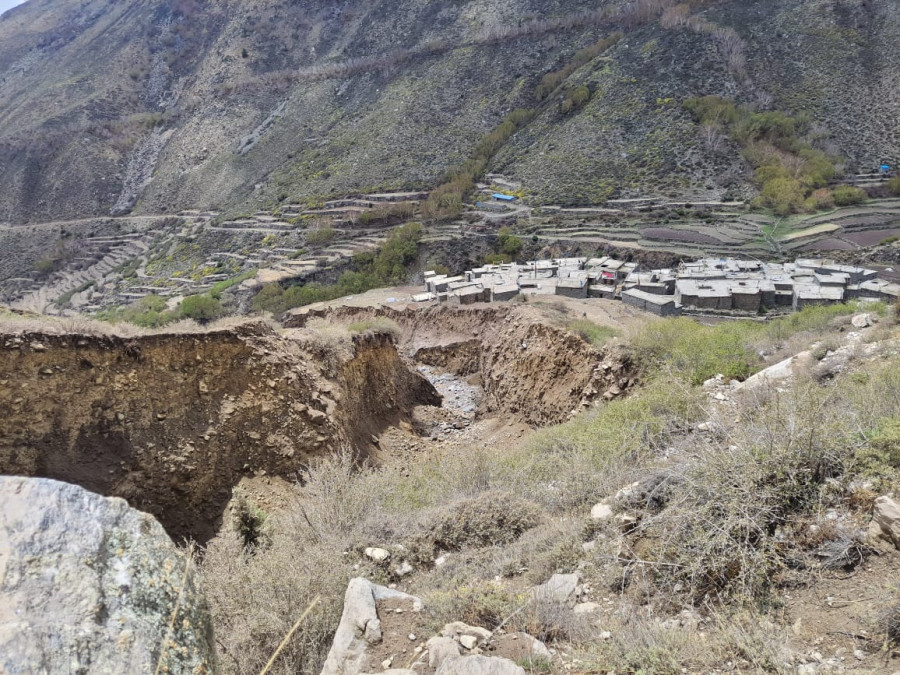
Floods triggered by a severe rainstorm accompanied by hail on Tuesday night in Nepka, ward 5 of Chankheli Rural Municipality in Humla, swept away the Danfe Basic School along with homes, livestock sheds and farmland.
The flood buried houses and livestock sheds belonging to ward chair Harkadhan Tamang and resident Dhan Singh Tamang, among others, and destroyed crop fields belonging to 67 households.
“All the houses in the village are at risk,” ward chair Tamang said. “The flood has devastated the entire village before the monsoon has even started. We don’t know what will happen once the rainy season fully sets in.”
Last year, on April 17, heavy rainfall triggered flooding in the Shreenagar market in ward 3 of Adanchuli Rural Municipality in Humla, damaging 23 houses. The flood also damaged the rural municipality office, a food depot and structures of Sunrise Secondary School in Shreenagar, the municipal centre. Nearly 100 livestock were buried in the disaster.
The area remains highly vulnerable, rural municipality chair Mohan Bikram Singh said.
“Continuous rainfall brought a large debris-laden flood into the market and caused huge damage,” he said. “We have repaired the damaged structures temporarily. It will be extremely difficult to save the market if hit by a flood again.”
On May 15 last year, a mudslide and flash flood in Tilgaun of ward 6 in Namkha Rural Municipality destroyed two houses and caused partial damage to 18 others. As many as 32 families were temporarily relocated to safer areas.
The village remains at high risk of floods and landslides, ward chair Paljor Tamang said.
According to him, the flood washed away five wooden bridges over the Tilchung stream and destroyed a micro-hydropower project.
“The flash flood occurred after two glacial lakes in the upper Thakra area burst. Those lakes still pose a risk,” Tamang said. “The rural municipality does not have the budget to mitigate the risk of glacial lakes, and the federal government has not paid heed.”
He said that erosion from three sides due to the flood caused by the outburst has left Tilgaun highly vulnerable. Nineteen families currently live in the village.
“The risk keeps rising. If evacuations are not carried out in time, the situation could turn serious,” he said. “Snow has accumulated above the two glacial lakes, and seepage has begun.
Humla, a Himalayan district, faces increasing flood risks every year.
“People used to think floods only occurred in the Tarai, but now settlements in Himalayan districts are being put at risk every year,” said Prem Bahadur Lama, chair ofNamkha Rural Municipality.“We don’t even have large rivers in these areas, yet floods are making it difficult to protect villages.”
Chief District Officer Tek Kumar Regmi said the floods in Humla over the past two years have occurred in areas without major rivers, mainly in seasonal streams that remain dry in winter.
“The main reason for floods in Himalayan districts is the bursting of glacial lakes,” he said. “The soil remains frozen and becomes loose during the winter. So even moderate rainfall triggers landslides and floods.”
Climate change expert Laxman Sharma said rising temperatures, glacial lake outbursts, above-average rainfall and fragile geology are increasing flood risks in Himalayan districts.
“In winter, even when it rains, the precipitation freezes. When snow remains for a long period, the soil underneath becomes loose and unstable. It can trigger floods and landslides when monsoon rain falls on it. ”
He added that faster melting of glaciers due to rising temperatures and unstable mountain terrain is increasing the risk of glacial avalanches and flash floods.
Surendra Khatri, who has worked on climate change research in Karnali, said increasing soil acidity in Himalayan regions is weakening land stability. He added that intense monsoon rainfall, steep terrain and unplanned infrastructure development are increasing landslides.
“In Humla, which is a rain-shadow area, sudden heavy rainfall means the land cannot absorb water, increasing flood risk,” he said. “The unstable geography cannot retain rainfall properly. Small landslides block rivers and streams, which then lead to major floods.”
He added that similar patterns were seen in last year’s floods in Uttarakhand, India.
Flood and landslide high risk in Karnali
As the monsoon season looms, settlements in Karnali province are increasingly exposed to floods and landslides.
According to the Karnali Province Planning Commission, 57 percent of the province’s 27,984 square kilometres of land is steep terrain. The commission said 3,671 landslides occurred across the province’s ten districts last year.
“The entire province is highly vulnerable to landslides due to steep terrain and weak geology, ” commission member Ashok Nath Yogi said. “Unplanned road construction, climate change impacts, erratic rainfall, lack of preparedness, settlement in high-risk areas and human negligence are increasing the risk.”
A 2023 study by the commission found that nearly 900 settlements in Karnali are highly vulnerable to floods and landslides.
Areas along the Karnali and Bheri rivers are also at risk.
In the past 10 years, since fiscal year 2015-16, floods and landslides have caused losses of nearly Rs10.94 billion in Karnali and claimed 617 lives.
According to provincial police data covering three years, 54 people died in 2020-21, 63 in 2021-22 and 52 in 2022-23 due to floods and landslides. During the same period, 492 people were injured and 17 are still unaccounted for. Property damage during this period is estimated at around Rs330 million.
The Karnali provincial government has been preparing a monsoon preparedness action plan since 2019. However, activist Suraj Pariyar said the lack of implementation has increased disaster losses.
“Plans are made, but implementing agencies become inactive during disasters,” he said. “That is why we continue to suffer losses every year.”
He added that poor risk mapping, insufficient manpower and budget, weak coordination between agencies and delays in rescue and relief operations are major challenges.
The provincial government has spent nearly Rs390 million on disaster management in the past three years. Minister for Economic Affairs and Planning Rajeev Bikram Shah said around Rs150 million has been allocated this fiscal year for disaster risk reduction.
He said the plan includes awareness campaigns, risk mapping of vulnerable settlements, improved information management, search and rescue operations and relief distribution. The plan estimates that around 11,000 households and 60,000 people in Karnali are affected by monsoon-related disasters every year.
Landslide risk in earthquake-affected settlements
On July 16 last year, three children died when a flood in the Gijagar stream swept away temporary shelters in Jhynchaur of ward 12 in Aathbiskot Municipality, Rukum West. Their family of seven had been living in a temporary shelter after their house was destroyed by the November 2023 Jajarkot earthquake. The flood also swept away three more temporary shelters and two huts.
Similarly, on August 19 last year, a landslide buried a temporary shelter in ward 2 of Nalgad Municipality in Jajarkot, killing 42-year-old Lal Bahadur Pariyar, his 35-year-old wife Manisha and their two-year-old son.
Last year alone, nine earthquake-affected people died in floods and landslides in Jajarkot and Rukum West.
Locals say settlements weakened by the earthquake face a high risk of landslides.
“Even light rainfall now triggers landslides,” said Ram Bahadur Mahar from ward 1 of Bheri Municipality. “We somehow survived the earthquake, but now we live in fear of landslides every time it rains.”
District disaster management committees in both districts recommended relocating 28 earthquake-affected settlements last year. The National Disaster Risk Reduction and Management Authority also studied these settlements.
The study identified several high-risk settlements, including Sagachaur, Libal, Detkule in Chhedagad; Tolkhana and Laikham in Bheri Municipality; Chaur, Chaupani and Maide in Nalgad; and Dunagara, Lupakhla and Bhiyus in Shivalaya. In Rukum West, Kalaphira and Kuridhara in Aathbiskot and Chinabagar and Gajetakuri in Sani Bheri are also at high risk.
Most earthquake-affected families have built temporary shelters near forests, riverbanks, farmland edges and steep slopes, increasing their vulnerability to floods and landslides, said Lilaram Subedi, chair of the Nepal Red Cross Society Karnali Province.
“The land around earthquake-affected settlements has developed cracks,” he said. “Even light rainfall weakens the soil further, increasing landslide risks.”
Geologist Chandan Giri said landslide risk increases by nearly 80 per cent in post-earthquake conditions.
“Although the ground may look stable from outside, it is fractured internally,” he said. “Landslides are influenced by slope, drainage patterns, rainfall intensity and land use practices.”




 14.83°C Kathmandu