Madhesh government halts grants to 25 local units over revenue dues
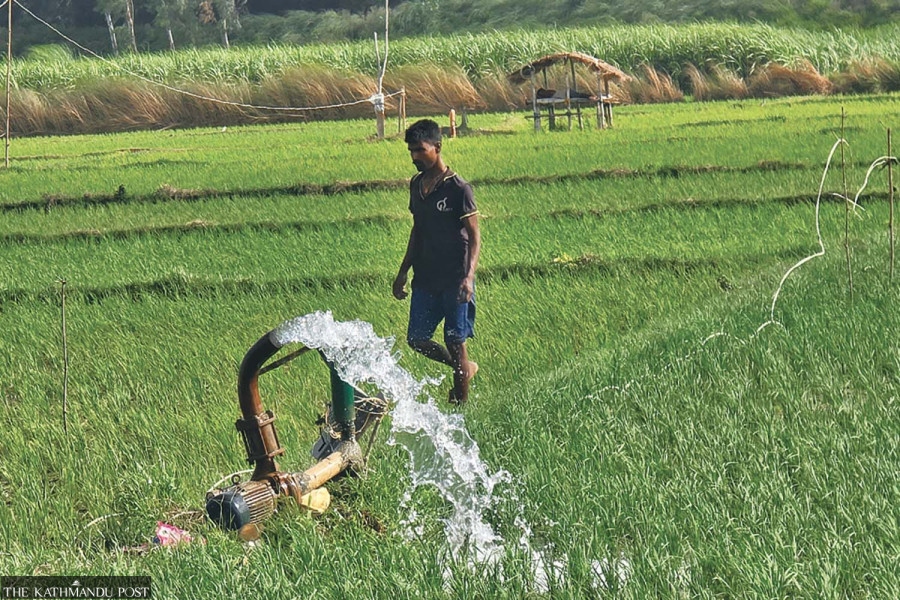
Law requires local units to transfer 40 percent of royalties and taxes to the province, but many have withheld and spent the funds. A farmer in Rautahat irrigates his paddy using a pump connected to a borewell in this undated photo. Post file photo
The Madhesh provincial government has suspended conditional, special and complementary grants to 25 local units that have failed to transfer the province’s share of revenue collected under existing laws. The move could disrupt development projects and delay salaries for teachers, health workers and other public employees.
The provincial finance ministry said the local units collectively owe Rs622.9 million to the provincial treasury. Officials say repeated requests and warnings over the past two years have been ignored, forcing the government to take action at the end of the fiscal year.
“We repeatedly wrote to the local units and asked them to deposit the revenue, but they continued to ignore the requests,” said Finance Minister of Madhesh Province Yubaraj Bhattarai. “Such behaviour raises questions about the functioning of the federal system itself. Local governments are autonomous, but they are neither sovereign nor above the law.”
According to the minister, withholding grants became necessary to enforce financial discipline and ensure compliance with constitutional and legal provisions governing revenue sharing.
Madhesh province, which spans eight Tarai districts, has 136 local bodies. Under the constitution and the Local Government Operation Act, 2017, local units are required to deposit 40 percent of revenue collected from sources such as sand, gravel and stone extraction royalties, as well as advertisement and entertainment taxes, into the provincial consolidated fund. Provincial officials say many local governments have instead retained and spent the money themselves.
The issue gained urgency after the Office of the Auditor General flagged the outstanding amounts as unsettled accounts in its eighth annual report. The report increased legal and moral pressure on the provincial government to recover the dues.
The provincial government provides four types of grants to local governments. While fiscal equalisation grants are constitutionally guaranteed and cannot be withheld, the provincial government has frozen the other three categories that are funded through its own budget.
“This was not a sudden decision,” said Minister Bhattarai. “The ministry has been writing letters, issuing reminders and raising the matter in meetings of the provincial coordination council for two years. Some local governments continued to defy the directives. Once the Auditor General identified the issue as an irregularity, we had no option but to stop the grants.”
He said the grants would not be released until the outstanding revenue was paid. Among the defaulters, Nijgadh Municipality in Bara owes the largest amount. According to ministry records, it has failed to transfer Rs239.27 million collected from stone, gravel and sand royalties and advertisement taxes since the fiscal year of 2017-18.
Surya Prasad Gautam, chief administrative officer of Nijgadh, said the municipality had already transferred Rs26.4 million around two weeks ago, although the payment had not yet been reflected in provincial records by Wednesday.
“The provincial government did not seriously pursue the matter for a long time, which is why the amount accumulated. We cannot pay such a large sum all at once. We have proposed settling it in installments and will now regularly transfer the province’s share,” said Gautam. He said part of the revenue had been spent on irrigation canals, drainage systems and culverts within the municipality.
Several other local governments also owe substantial amounts. Ganeshman Charnath Municipality in Dhanusha has outstanding dues of Rs38.23 million, while Mithila Municipality owes Rs13.54 million and Dhanushadham Municipality Rs1.68 million.
In Mahottari, Bardibas Municipality owes Rs28.53 million, Bhangaha Municipality Rs10.78 million and Gaushala Municipality Rs6.46 million. Birgunj Metropolitan City in Parsa has yet to transfer Rs23.53 million, while Kolhabi Municipality in Bara owes Rs58.38 million to the provincial government.
Other local governments in Sarlahi, Siraha, Rautahat and Parsa also appear on the list of defaulters, according to ministry data.
Chandani Dalami, revenue officer at the ministry, said evidence suggested that some local governments had intentionally withheld the province’s share despite collecting the revenue.
“Some municipalities and rural municipalities have been collecting revenue since 2017-18 but have not transferred the provincial portion,” she said. “The law is clear, yet they have continued to avoid payment. We have been pressing them to settle the dues.” Provincial officials also suspect that some local governments underreported revenue figures and retained the collections.
Local officials, however, warn that the suspension of grants could have immediate consequences. Mishrilal Sah, a section officer at Chandrapur Municipality in Rautahat, said withholding grants would affect both staff salaries and development works planned for the final weeks of the fiscal year. “We have already cleared all previous dues,” said Sah. “Only this year’s amount remains to be settled.”
The dispute shows a longstanding challenge in the country’s federal system. Tensions between provincial and local governments over revenue sharing, fiscal accountability and overlapping authority are frequently reported.
With the fiscal year drawing to a close, the standoff threatens to affect public services, infrastructure projects and budget execution across parts of Madhesh unless the two sides reach a settlement soon.




 14.7°C Kathmandu