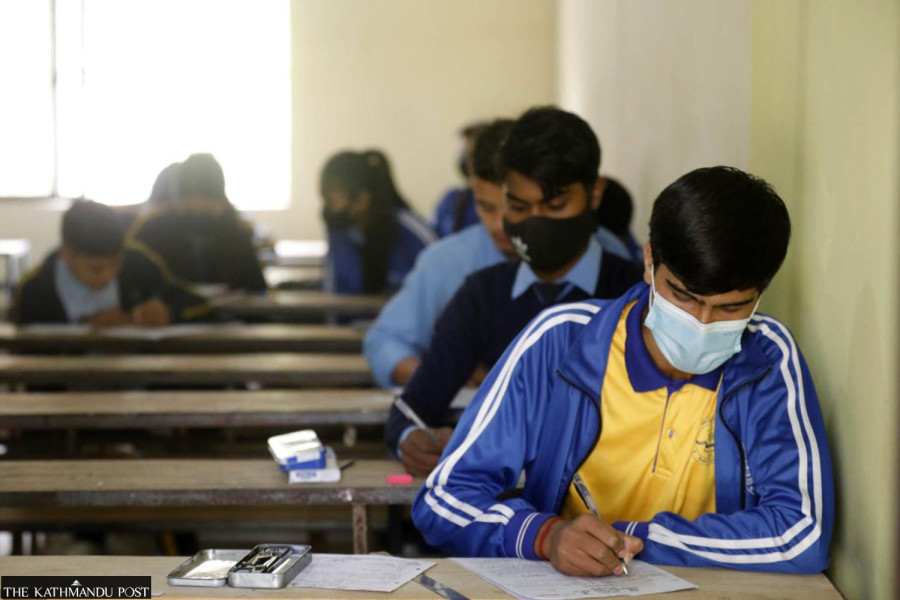
Sheer negligence by examiners and data entry operators has severely impacted the integrity of the Secondary Education Examination (SEE) results. A mandatory recounting process has forced a grade revision for over five percent of applicants, exposing systematic flaws within the National Examination Board (NEB).
Following widespread dissatisfaction with the initial results published on May 12, a total of 33,851 students applied for a recount by paying a processing fee of Rs500 each. By Wednesday, the board had processed 27,654 of these applications, discovering that 1,559 students—equivalent to 5.63 percent—had received incorrect marks initially.
This year, the SEE results were published within a month of the examinations, bringing students’ waiting time drastically down from about three months previously.
In past years, the margin of error hovered around three to four percent. Officials attribute this year's spike to the decision to evaluate answer sheets directly within exam centres, which compromised standard auditing practices.
The discrepancies revealed shocking administrative carelessness. For instance, a student with symbol number ‘02910767 O’ initially received a 3.6 GPA in Science and a 2.4 GPA in Social Studies. Upon recounting, both scores were upgraded to a perfect 4.0 GPA. Another candidate with symbol number ‘00404772 D’, saw their English score jump from 2.4 to 4.0 GPA. Most alarmingly, a student marked as ‘non-graded’ with zero marks in English was upgraded to a 2.0 GPA after the review.
"Teachers repeatedly failed to tally the marks scored inside the answer booklets onto the cover sheets," admitted Controller of Examinations Tuk Raj Adhikari. "We encountered some egregious instances where a student who had scored 70 marks was credited with only 7 marks in the computer system due to a data entry error."
An official involved in the recounting process, speaking on condition of anonymity, revealed further systemic blunders. "We found cases where students had scored 68 marks inside the booklet, but due to computational errors, only 32 marks were recorded on the exterior script. Some students were handed a failing grade simply because their actual marks were entered as zero."
The administrative chaos has sparked fury among students and guardians. According to the guardians, their wards were devastated when they saw initial grades due to the board's carelessness. They blame the board as well as the teachers found guilty stating that their carelessness seriously affects the psychological well-being of young children.
Compounding the crisis, the board has been unable to locate over 1,000 answer sheets belonging to applicants. Board officials explained that the retrieval process has become a logistical nightmare because several students changed their examination centres, or their scripts were accidentally bundled into the packages of other centres.
There are recurring vulnerabilities of the NEB’s digital ledger system and the inadequate training provided to answer-sheet evaluators. Despite the presence of an official vetting mechanism designed to double-check evaluations, the system has routinely failed to catch glaring mistakes.
The examination board has been releasing the recounting results in staggered phases, revealing widespread data discrepancies across thousands of reviewed applications. In the first phase, 307 students saw their results alter out of 5,406 applications reviewed. This trend of errors continued into the second phase, where an evaluation of 4,306 cases revealed 232 grades that required rectification. When the board processed 5,175 applications in the third phase, another 262 grades were revised. The fourth phase, which handled the largest batch of 9,156 applications, yielded 522 altered results. Finally, the fifth phase saw a review of 3,611 applications, which resulted in changes to 236 grades.
Among the 430,667 regular students who appeared for the examinations held from April 2 to April 12, 65.98 percent secured grades and qualified for further studies, a marginal rise from last year’s 61.81 percent. According to the board, 284,160 students passed the examination, while 146,507 were placed in the non-graded category.
For students who remain dissatisfied with the current recounting outcome, the board provides further measures to physically view their answer sheets or request a complete re-evaluation.




 19.27°C Kathmandu