Ancient Arabic, Persian script coins recovered in Kapilvastu
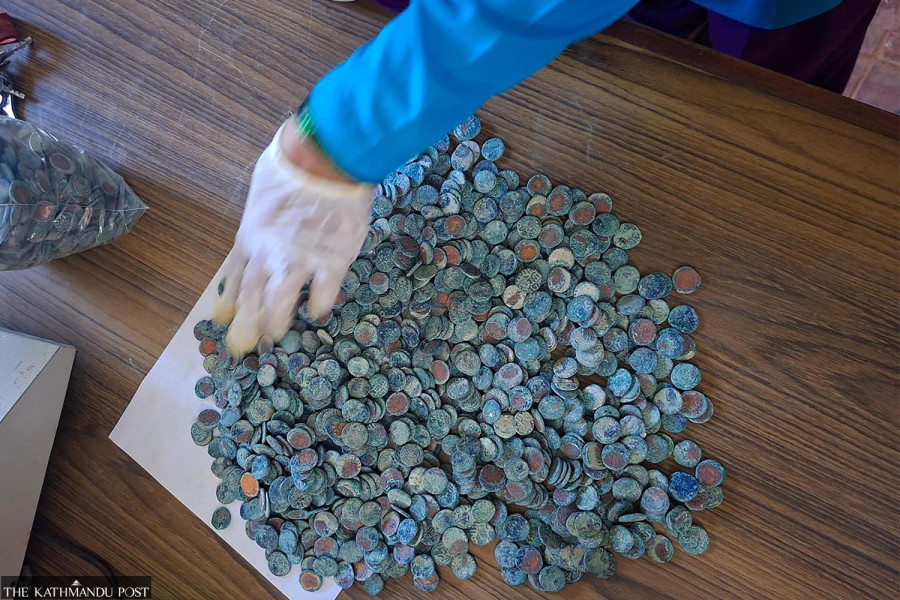
A total of 2,314 coins were found near a pond inside a water pot called karuwa. The discovery was initially made by local farmer Ramraj Yadav while ploughing his field. Unaware of the artefact's historical value, Yadav handed the pot and its contents to a neighbour, Rohit Kori. Manoj Poudel/TKP
Ancient copper coins featuring Arabic and Persian scripts have been discovered inside a traditional metal water pot, locally known as karuwa, in Kapilvastu district. A total of 2,314 coins were found inside the water pot. The historical relics were found along the edge of a pond in Babhani, located in ward 5 of Kapilvastu Municipality.
The discovery was initially made by local farmer Ramraj Yadav while ploughing his field. Unaware of the artefact's historical value, Yadav handed the pot and its contents to a neighbour, Rohit Kori.
Kori kept the items at home for a week until rumours circulated that possessing unregistered archaeological artefacts could lead to government action. Panicked, Kori left the pot near a local pond, prompting Ward Chairman Direp Kumar Chaudhary to notify the police.
Police officers retrieved the artefact on July 20 and transported it to the District Police Office. According to Inspector Deepak Kunwar, extracting the coins from the water pot proved difficult as they had fused due to centuries of corrosion and moisture.
“The coins had oxidised significantly over time, altering their appearance,” said Kunwar. “We had to seek assistance from technical staff at the Kapilvastu Museum to safely extract them from the vessel.”
The police handed the collection over to the Kapilvastu Museum on July 21 for examination and preservation. According to initial measurements, the total weight of the coins stands at 7.034 kilograms. Individual coins measure between 1.4 and 1.8 centimetres in diameter, weighing between 3.13 and 3.26 grams each. The karuwa measures 52 centimetres in height with a diameter of 23 centimetres.
Preliminary evaluations of the inscriptions suggest the currency dates back to the reign of Sultan Alauddin Khalji, who ruled the Delhi Sultanate from 1296 to 1316 AD. Shanti Sherma, chief of Kapilvastu Museum, confirmed that the inscriptions point toward the 13th or 14th century.
“We have informed the Department of Archaeology and initiated further detailed study,” said Sherma. “The artefacts are currently kept under secure conditions at the museum and will be put on display after consultation with national authorities.”
Senior archaeologist Basanta Bidari explained that ancient Kapilvastu was a crucial hub along the Uttarapatha, an ancient trans-regional trade route linking major commercial centres across northern South Asia. The route connected historical sites such as Devdaha, Lumbini, Tilaurakot, Baisali, Kushinagar, Sravasti, and Takshashila.
“Traders used to travel along this route in bullock carts for commerce,” said Bidari. “Given that Tilaurakot served as an important trade hub during the ancient period, these coins were likely brought by merchants passing through the region.”
The site of the discovery lies approximately 700 metres south of Babhanikot, an ancient mound spread across 450 bighas of land containing scattered brick remnants. Local residents have encroached upon portions of the land for agricultural activities despite the marking by the Department of Archaeology as a protected historic zone.
“Although the government has placed a notice board identifying it as a historical site, no substantive measures have been taken to preserve it,” said ward chair Chaudhary, expressing concern over ongoing encroachment.
Himal Upreti, chief archaeologist at the Lumbini Development Trust, said that 136 historical and archaeological sites have been identified west of the Banaganga river in Kapilvastu alone.
“Many undiscovered sites remain across the region,” said Upreti. “The location where these coins were unearthed could yield further historical evidence if systematic excavations are conducted in the future.”




 16.45°C Kathmandu