Speaker Aryal pushes House proceedings amid opposition uproar over PM’s absence
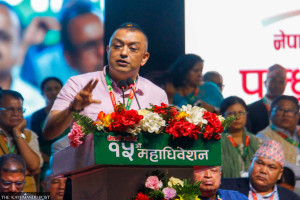
Despite protests and sloganeering demanding Prime Minister Balendra Shah answer lawmakers under Rule 56, Speaker DP Aryal proceeds with House business and endorses a bill. Lawmakers protest during the House of Representatives session on Thursday. Angad Dhakal/TKP
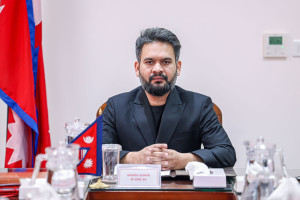
Speaker DP Aryal on Thursday pushed ahead with proceedings in the House of Representatives despite continuous obstruction, sloganeering and protests by opposition parties demanding that Prime Minister Balendra Shah appear before Parliament and respond to lawmakers’ questions.
The session witnessed chaotic scenes as lawmakers from opposition parties surrounded the well of the House while members of the main opposition Nepali Congress stood from their seats in protest. Despite the disruption, the Speaker moved forward with legislative business and endorsed a bill without allowing discussion from lawmakers who had registered amendments.
The leaders of opposition parties accused Aryal of failing to implement Rule 56 of the House of Representatives Regulations, which requires the prime minister to answer direct questions from lawmakers during a designated parliamentary session each month.
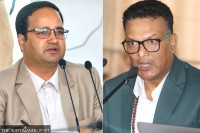
Nishcal Rai, whip of the Nepali Congress, said the Speaker had compromised the dignity of Parliament by continuing proceedings after opposition lawmakers entered the well of the House.
“The Speaker should not have proceeded with the meeting after opposition parties obstructed the House,” Rai said. “He should have directed the prime minister to appear in Parliament under Rule 56, but he failed to do so. Questions are now being raised about why he could not issue such a ruling.”
Rule 56 of the parliamentary regulations provides for a direct question-answer session with the prime minister. The provision states that the Speaker must allocate one hour during the first week of every month for lawmakers to question the prime minister on issues directly related to his responsibilities.
Rule 56 (1) further states that if the House cannot convene on the scheduled date, the question-answer session must take place during the first hour of the next sitting.
Opposition lawmakers argued that the rule made the session mandatory and that the prime minister’s absence violated parliamentary norms. Yubaraj Dulal, chief whip of the Nepali Communist Party, accused the Speaker of disregarding parliamentary procedure.
“The rules were violated from the Speaker’s chair,” Dulal said. “After the prime minister refused to attend and opposition lawmakers moved into the well, the House meeting could have been adjourned. Instead, the Speaker allowed proceedings to continue.”
He also accused the Speaker of curtailing lawmakers’ rights to participate in deliberation.
“Members had registered amendments to the bill, but they were not given an opportunity to speak,” said Dulal. “The House appeared to function under the shadow of the government.”
Rastriya Prajatantra Party whip Khusbu Oli said opposition parties had earlier requested the Speaker to schedule the prime minister’s question-answer session before the presentation of the annual budget on May 29, but the request was ignored.
“We repeatedly requested the Speaker to fix a date before the budget speech but we were told the prime minister had not given time,” Oli said. “We had also listed our names to participate in the theoretical discussion on the bill, but we were denied that opportunity.”
As tensions escalated inside Parliament, Speaker Aryal temporarily suspended the House meeting and went to meet Prime Minister Shah personally to persuade him to attend the session.
According to opposition leaders, the prime minister declined the request and only said he would answer lawmakers ‘at an appropriate time’ without specifying any date.
After returning from the meeting, Aryal briefed party whips about his conversation with the prime minister.
Dulal said the Speaker failed to answer opposition questions during the discussion.
“The Speaker told us that the prime minister had agreed to come at some point in the future, but he also said he could not direct the prime minister or fix a date without the prime minister’s consent,” he said.
Amid continued obstruction, Finance Minister Swarnim Wagle tabled a proposal seeking endorsement of the Alternative Development Finance Mobilisation Bill. The bill was endorsed by a majority vote despite loud protests and slogans from opposition benches.
Lawmakers who had proposed amendments to the bill were unable to present their arguments before the endorsement.
The House agenda also included proposals related to three separate bills that were originally scheduled to be tabled by Prime Minister Shah. In his absence, Minister for Law, Justice and Parliamentary Affairs Sobita Gautam presented the proposals on his behalf.
The bills included the House of Representatives Members Election (First Amendment) Bill, the Voter List (First Amendment) Bill and the National Forensic Science Laboratory Establishment and Operation Bill. Although time had been allocated for theoretical discussion on the bills, no lawmakers were able to participate because of the obstruction.
Throughout the session, opposition lawmakers shouted slogans including “Protect parliamentary dignity” and “Implement the parliamentary regulations”.
The demand for the prime minister’s presence has been repeatedly raised in recent parliamentary meetings by lawmakers from the Shram Sanskriti Party led by Harkaraj Rai.
During Wednesday’s meeting, Speaker Aryal had warned Rai and other lawmakers from the party for carrying placards into the House and displaying slogans demanding the prime minister’s attendance.
Citing Rule 30 of the parliamentary regulations, the Speaker accused them of behaviour unbecoming of lawmakers and warned them to maintain decorum inside Parliament.
Rule 30 authorises the Speaker to caution lawmakers for disorderly conduct during House proceedings.
On Thursday, Rai said he had intended to question the prime minister regarding matters related to the Home and Defence ministries, both of which are currently under Shah’s responsibility.
The dispute follows earlier controversy during the presentation of the government’s policies and programmes by President Ramchandra Paudel, when Prime Minister Shah left the House before lawmakers’ queries were answered. At that time, Shah delegated Finance Minister Wagle to respond on his behalf, prompting protests and a brief boycott by opposition parties.




 14.4°C Kathmandu