After India outreach, RSP chief moves to defuse House deadlock
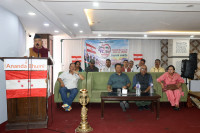
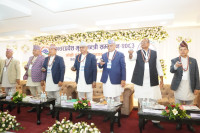
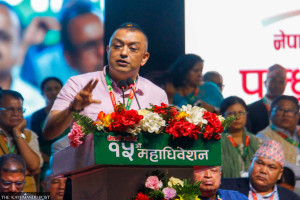
Rabi Lamichhane held consultations with PM Shah Sunday, and convened an all-party meeting Monday in a bid to end parliamentary standoff. Lamichhane (C) at all-party meeting on Monday. Deepak KC/TKP
Rabi Lamichhane, chairman of the ruling Rastriya Swatantra Party (RSP), has taken the initiative to address two of the country's most pressing challenges: mending ties with India and ending the prolonged parliamentary deadlock.
Lamichhane’s visit to India came at a time when New Delhi had expressed dissatisfaction over Prime Minister Balendra Shah’s remarks during a House of Representatives meeting on May 31.
Responding to lawmakers’ queries, Prime Minister Balendra Shah had said that England (the United Kingdom) should also take an interest in Nepal’s border dispute with India, given its historical link to the 1816 Sugauli Treaty.
The remarks drew an immediate response from India’s Ministry of External Affairs. MEA spokesperson Randhir Jaiswal said the countries have established bilateral mechanisms to deal with all aspects of boundary matters, and that there should be no role for third parties in bilateral issues.
The day after the prime minister’s address, the RSP chief flew to New Delhi at the invitation of Nitin Nabin, head of India’s ruling Bharatiya Janata Party (BJP), where he held talks with senior party and government leaders.
During his visit, Lamichhane received a warm welcome and held high-level talks with Indian political leaders, including Prime Minister Narendra Modi, in an effort to reassure New Delhi on bilateral issues. Following his five-day visit from June 1 to 5, Lamichhane held consultations with Prime Minister Shah before initiating efforts to break the parliamentary deadlock.
Lamichhane met Prime Minister Shah on Sunday for lengthy discussions covering his India visit and the latest political developments. By Monday morning, Lamichhane had convened an all-party meeting aimed at ending the impasse in the House. This marked the first time the RSP had hosted an all-party meeting since emerging as the largest party in Parliament following the March 5 snap elections.
“The all-party meeting was called out of a sense of responsibility as a leader of the ruling coalition,” said Bipin Acharya, joint general secretary of the ruling RSP, who attended the meeting. “We believe the parliamentary deadlock must end. We also briefed leaders of other parties on current political issues and the outcomes of our party delegation’s visit to India at the BJP’s invitation.”
Political analyst Professor Krishna Pokharel said Lamichhane’s efforts to improve relations with India and ease tensions among domestic political parties were in line with his political responsibilities.
“Upon returning, he consulted the prime minister and sought to break the domestic political deadlock by calling an all-party meeting. The RSP chairman’s efforts on both fronts are commendable,” Pokharel said.
Nepali Communist Party lawmaker Barshaman Pun also welcomed Lamichhane’s outreach.
“The ruling party chairman has made a good start. Dialogue has finally resumed after a period of complete stagnation among political parties,” Pun said.
Pun said Lamichhane proposed during the all-party meeting that the foreign minister address Parliament on behalf of the government to help break the deadlock.
“Their side proposed that the foreign minister would respond on behalf of the prime minister. However, we argued that others cannot answer for a mistake made by the prime minister himself. Nonetheless, the all-party meeting explored various options, and the discussions were positive,” Pun said.
The ruling coalition reportedly agreed during the meeting to remove a controversial phrasing used by the prime minister on May 31, in which he claimed that “Nepal has also encroached upon Indian land in many places”, from the parliamentary record.
CPN-UML chief whip Ain Bahadur Mahar said Lamichhane briefed the meeting on his India visit and floated several proposals to resume parliamentary proceedings.
“He shared details of his meetings with BJP leaders. We pointed out that an all-party meeting should have been called before his Delhi visit [if Lamichhane was going to meet PM Modi],” Mahar said, adding that Lamichhane clarified that the meeting with Modi was finalised only after he reached India.
Acharya reiterated that the RSP chairman had called the meeting to foster cordial relations among political forces.
“In a parliamentary democracy, parties alternate between the government and opposition benches. Every party has its own principles, working style and objectives, but the ultimate goal must be the welfare of the country and its people. That is why we believe in moving forward through dialogue, and a ruling side backed by a two-thirds mandate must lead such initiatives.”
Acharya added that similar all-party meetings would be held in the future to build consensus on national issues.
Professor Pokharel said the division of responsibilities, with Prime Minister Shah focused on governance and implementation while Chairman Lamichhane handles inter-party engagement, reflected an evolving political culture.
“The prime minister is action-oriented and a man of few words, while the chairman is an articulate communicator who is equally determined to deliver results. Their cooperation bodes well,” Pokharel said.
“This marks a departure from past political practice in Nepal. It is still too early to assess what outcomes this dynamic will produce, but if it helps break the political deadlock and steer relations with India in a new direction, it will be highly beneficial for the country.”




 14.4°C Kathmandu