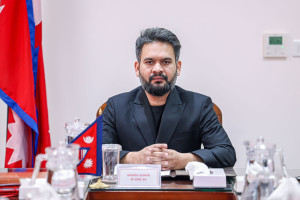
Is Prime Minister Balendra Shah using social media to evade accountability?
At a time when the government is courting one controversy after another, the prime minister’s digital footprint has channelled public energy into superficial online disputes, observers say.Post file photo
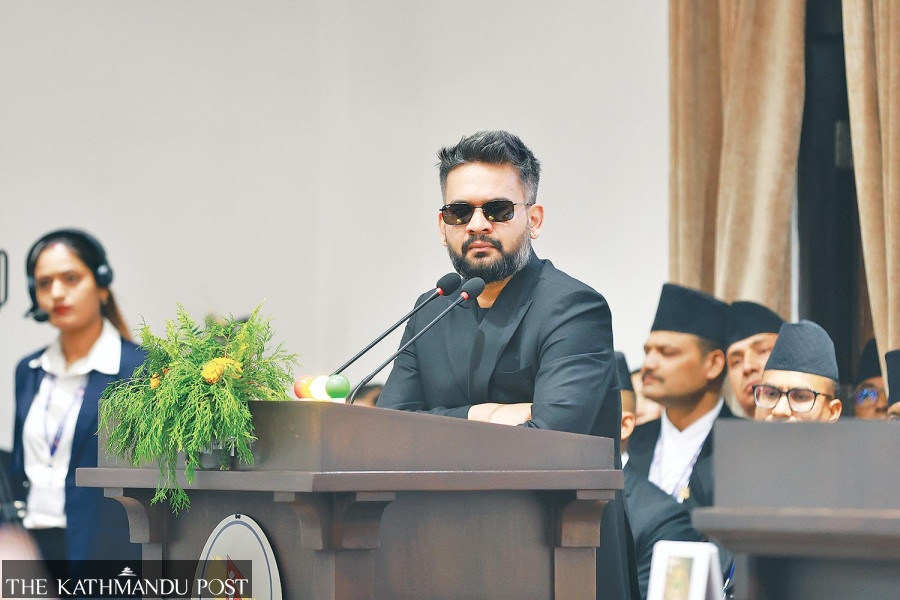
Prime Minister Balendra Shah has triggered a national debate following a series of controversial late-night social media posts and aggressive administrative actions. This political manoeuvring is increasingly viewed by analysts, politicians, and civil society leaders as a deliberate strategy to deflect public scrutiny away from urgent national issues.
At a time when the government faces intense backlash over controversial ordinances, the ongoing plight of displaced landless communities, and the systematic neglect of marginalised communities in the annual budget, the prime minister’s digital footprint has channelled public energy into superficial online disputes, observers say.
The latest controversy erupted on Saturday at 10:15 pm when Prime Minister Shah published a cryptic post on his official Facebook page. “I also want to become an ambassador,” he wrote. “If anyone has the prime minister’s number, could you please share it?”
The post quickly attracted light-hearted and satirical responses from high-ranking government officials, Cabinet ministers, and parliamentarians, drawing sharp criticism from the public regarding the trivialisation of state affairs.
Asim Shah, the prime minister’s political adviser, commented on the post with laughing emojis, writing, “I will tell the PM.” Education Minister and Government Spokesperson Sasmit Pokharel replied, “Shall I message him?” Similarly, lawmaker Tika Sangraula wrote, “I have it, but I won’t give it to you,” while youth leader Ranju Darshana chimed in, “One cannot be both the PM and an ambassador. Choose one first!”
While supporters of the prime minister defended the interactions as light-hearted digital engagement, a large cross-section of society expressed deep concern over the apparent degradation of the executive office. Critics argue that Shah is exploiting ‘clout culture’—a term used to describe individuals who orchestrate public controversies or performative antics solely to capture public attention and manipulate social media algorithms.
“We are witnessing a deeply worrying trend where the line between state affairs and personal amusement is completely erased,” Tanuja Pandey, a Gen Z leader, told Kantipur. “Selecting diplomats to represent Nepal globally is a highly sensitive constitutional matter. This is not his personal affair; it is a matter of state governance, and the failure to distinguish between the two is genuinely tragic.”
On social media, Yadav Devkota argued that the prime minister’s antics mocked the dignity of the executive office, noting that “even a prime minister’s personal life remains inherently political.” Sharing a screenshot of the post, Devkota wrote, “As the Turkish proverb goes—a clown does not become a king merely by entering a palace; instead, he turns the palace into a circus. Are you working hard to prove this Turkish piece of folk wisdom right?”
Similarly, Sarita Tiwari also raised concerns over the prime minister’s maturity, questioning whether he is merely a naive youth ignorant of political diplomacy. “Is our prime minister just a foolish boy who fails to grasp ‘political diplomacy’?” she questioned on Facebook. “Many of his blunders have proved to be self-destructive. It is said that self-sabotaging foolishness is far more dangerous than an enemy's conspiracy. I would strongly advise the prime minister not to add to this string of absurdities.”
This online display follows a highly publicised incident on June 4, when government secretary Krishna Hari Pushkar was arrested under direct orders from the Office of the Prime Minister and Council of Ministers. Pushkar was detained on allegations of breaching the official chain of command by sending a direct personal message to Prime Minister Shah to advance his own interests. The arrest sparked immediate outrage among former bureaucrats, who described the move as an authoritarian overreach that bypasses established administrative procedures and civil service regulations.
Former senior bureaucrats have noted that using law enforcement agencies to detain a high-ranking civil servant over an electronic message sets a dangerous precedent. They argue it undermines institutional stability and instills a culture of fear within the bureaucracy.
Amidst this, Shah’s fresh status has shifted the debate towards what is appropriate and inappropriate for a prime minister to write on social media.
“The police must function according to codified law, not according to the shifting moods of the prime minister,” said Majid Ansari, a civil rights activist. “The current treatment of senior civil servants mocks our democratic framework. The prime minister is misusing power and humiliating public officials simply to divert attention from serious public debates. This is a calculated strategy to keep the public confused and distracted.”
This pattern of behaviour is not unprecedented for the Shah administration. Observers point out that the prime minister has frequently deployed social media spectacles to overshadow policy failures and legislative controversies. The Cabinet abruptly prorogued the federal parliament session—which Shah himself had recommended to the President—to bypass the legislature and introduce controversial ordinances related to the Constitutional Council and cooperative fraud management on April 27.
As public anger mounted over this evasion of parliamentary oversight, Shah posted a stylised photograph of himself on Facebook on May 9. The image went viral, inspiring widespread artificial intelligence-generated replicas across Nepali social media. The legislative crisis was quickly replaced in public discourse by discussions about the prime minister’s portrait.
One week later, on May 16, as the government faced severe criticism over the poor conditions of displaced families in temporary holding centres, Shah published another photograph in the same attire. Holding a piece of cheese, his caption read, “Say cheese, DDC’s cheese,” followed by a comment stating, “DDC belongs to the Government of Nepal, brothers and sisters.” While the post caused a 30 percent spike in local yak cheese sales, it drew sharp criticism from advocates for displaced communities.
“I just watched a heartbreaking video detailing the miserable conditions of a postpartum mother housed in a state holding centre for displaced landless citizens,” social activist Sushma Baraili wrote on Facebook. “This mother, who recently underwent surgery, has no access to proper nutrition, and her newborn lacks basic care. Meanwhile, the head of our government posts playful pictures telling everyone to ‘say cheese’. The entire country is amused by these online antics, completely forgetting that these landless citizens are also equal stakeholders in this nation.”
The trend continued into the recent budget announcement, when the prime minister posted a brief status—”rest assured”—on Facebook at 9:54 pm. This post effectively shifted the digital conversation away from the economic policies and structural gaps within the federal budget for the upcoming fiscal year of 2026-27.
Youth leaders from the Gen Z movement have drawn parallels between Shah’s tactics and the political rhetoric of previous administrations. “There was a time when former prime minister Khadga Prasad Sharma Oli used proverbs, witty epigrams, and sharp sarcasm to disarm critics,” said youth activist Arnab Chaudhary. “Back then, people laughed and praised his wit, and his supporters rushed to justify those jokes as visionary statements on nation-building. While humour has its place, we must question when, where, and who is delivering these jokes. The current leadership claims to represent a new political era, yet they employ the exact same tactics to obscure core issues and avoid accountability.”
The long-term impact of this communication strategy has raised concerns among political strategists. Gaurav Bhandari, a youth leader from the Nepali Congress, warned that the current political discourse is becoming dangerously personality-driven at the expense of substantive policy debate.
“When critical issues like price hike, youth unemployment, the national budget, and macroeconomic stability completely vanish from public consciousness, it points to a calculated exercise in agenda-setting,” said Bhandari. “We must critically evaluate who is dictating what we think about, what we debate, and how we react.”
As the federal government continues to manage complex economic challenges and legislative standoffs, critics warn that social media popularity cannot serve as a substitute for institutional governance and parliamentary accountability.
“The prime minister understands digital algorithms perfectly and knows exactly how to capture public attention,” Gen Z activist Amit Urja said. “He is highly skilled at introducing populist themes to ensure that no single political controversy lingers in the public imagination for too long. However, this approach prioritises spectacles over solutions, undermining the rule of law while offering the public temporary entertainment.”




 16.84°C Kathmandu