Rs100 tax rule aimed at curbing small-scale smuggling hits daily shoppers at Nepal-India border
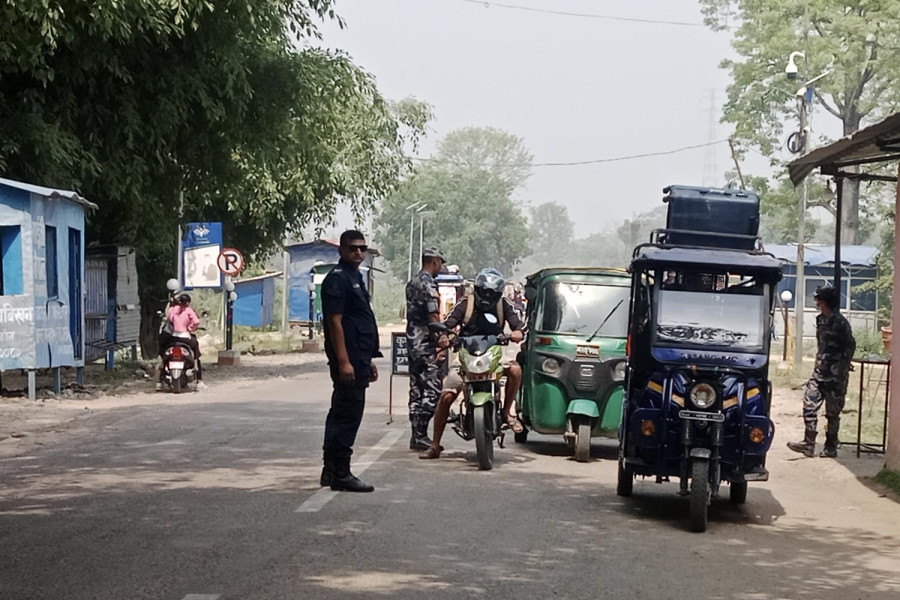
Strict checks on goods valued above Rs100 at Nepal-India crossings draw anger and complaints in border districts. Security personnel check vehicles entering Nepal at the Gaddachauki border point in Kanchanpur on Friday. Bhawani Bhatta/TKP
For residents of the country’s southern plains, crossing the ‘Dashgaja’—the no-man’s land separating Nepal and India—is part of daily life shaped by geography, culture and necessity. From essentials such as salt, cooking oil and medicine to higher-value goods, border communities have long relied on Indian markets for supplies, healthcare and livelihoods.
Although the border divides the two sovereign states, long-standing people-to-people ties have blurred that line in practice. Families on two sides share kinship, cultural traditions and economic interdependence. For many, crossing the border is as routine as travelling to a nearby town, and goods and people move with minimal disruption.
That long-standing pattern of life is now facing a shift after the government announcement to enforce customs duties on goods valued above Rs100 brought into Nepal from India. What was once an informal and largely unregulated flow of small-scale trade has turned into a tightly controlled process, and common folks are now finding themselves under scrutiny.
At major customs checkpoints and smaller transit points alike, the atmosphere has changed a lot. Routine crossings have given way to systematic inspections. Officials from the Department of Customs search bags carried by pedestrians, cyclists and small traders. At the same time, personnel from the Armed Police Force (APF), deployed for border security, are using loudspeakers to announce that any goods exceeding the Rs100 threshold must be declared, assessed and taxed before entry.
The impact of the enforcement has been immediate and visible across Madhesh province’s eight districts that share an open and highly porous border with India. Scenes of confrontation have become increasingly common as residents report frequent disputes with security personnel over everyday items such as sugar, rice, flour and cooking oil—goods that were until recently carried freely for household use.
A recent incident at the Kunauli border point in Saptari district reflects the growing tension. A group of shoppers returning from India with small quantities of daily goods clashed with APF personnel after their goods were seized for not complying with the new rule. The confrontation, which involved pushing and heated exchanges, has come to symbolise the frustration felt by many in the border communities.
For residents of Madhesh and other border regions, access to Indian markets is not simply a matter of convenience but an important aspect of their economic reality. Families frequently cross the border to purchase supplies for weddings, funerals and religious festivals. Such events often require large quantities of goods, and the price difference between Indian and Nepali markets—often ranging from 20 percent to as much as 45 percent—can determine whether a household can afford to carry out these traditions without incurring debt.
On a case by case basis, local ward offices in Nepal have historically issued recommendation letters to facilitate the transport of goods across the border for specific cultural or social purposes. Residents say that these practices helped maintain a balance between regulation and community needs. However, under the current enforcement of customs duties, such letters are reportedly being disregarded. Security personnel at border points say they are acting under strict directives and cannot make exceptions.
The policy has also come at a time when inflation in Nepal has placed additional pressure on household budgets. For many low- and middle-income families, the ability to purchase cheaper goods across the border has served as a crucial coping mechanism. The new restrictions are therefore being viewed not only as an administrative measure but as a disruption to an established survival strategy.
Shyam Prasad Bhandari, director general of the Department of Customs, said the Rs100 threshold is not a new provision but an existing rule now being strictly enforced. “The customs directives issued every year on Jestha 15 (May 29 last year) allow individuals crossing land borders to bring personal goods worth up to Rs100 duty-free. By implication, goods above that value are taxable,” he said.
Bhandari added that officials had earlier exercised discretion for small amounts, but growing pressure to increase revenue, promote domestic markets and discourage cross-border shopping has led to stricter enforcement. He said customs offices and security agencies are now working jointly to implement the rule.
Sources at the Ministry of Finance said the rule had existed for years but was rarely enforced. After the formation of the new government, the Revenue Leakage Control Committee met on April 2, where officials reported that a significant volume of goods was entering through passengers, causing revenue losses. “Following that, the Department of Customs directed all offices to collect duty on items valued above Rs100,” a senior ministry official said.
Officials acknowledge that the move has placed a burden on border residents and that legal adjustments may be required. “An item costing Rs100 in India can cost around Rs150 in Nepal. In such a situation, it is not realistic to expect people to stop seeking cheaper options,” the official said.
He added that the government intends to curb the practice of bringing goods in small quantities for resale in Nepal, not to target ordinary citizens. “But that goal is yet to be achieved. Instead of black-market traders, it is ordinary people who are bearing the immediate impact,” the source admitted.
The public’s response has been swift and vocal. Criticism has spread across social media platforms as well as political circles in Kathmandu and provincial capitals such as Janakpur. On Saturday, a group of youths from Madhesh province staged a sit-in at Maitighar in Kathmandu, accusing the government of targeting economically vulnerable populations under the pretext of revenue collection.
Chandan Singh, spokesperson for the Janamat Party, issued a video statement condemning the move. He described the enforcement as a “systematic assault” on the people of the Tarai, arguing that it undermines long-standing social and economic practices.
“The government is committing excesses at the border under the shield of the Armed Police Force and Nepal Police,” Singh said. “There has always been a practical understanding that goods worth up to Rs5,000 carried for personal use would not be taxed. Reducing that threshold to Rs100 is unrealistic and risks damaging the social harmony that has defined the border regions for generations.”
Rakesh Mishra, a commentator from Madhesh, appealed to Finance Minister Swarnim Wagle and Home Minister Sudan Gurung to reconsider the policy, warning that continued enforcement could further escalate tensions. In Rautahat, local resident Sanjay Yadav shared a video on social media alleging aggressive behaviour by security personnel towards shoppers, particularly women, and called for an end to what he described as an undeclared blockade affecting Madheshi communities.
At the same time, there are voices supporting the government’s move. Some argue that stricter enforcement is necessary to curb informal trade and protect domestic markets. Bindeshwar Mahato, currently living in Kathmandu, wrote on social media that traders in the Tarai-Madhesh region should view the policy as an opportunity to reduce dependence on Indian markets and to strengthen local commerce.
Security agencies maintain that they are implementing a policy decision taken at the federal level. Krishna Dhakal, APF deputy inspector general in Madhesh, said that the force has been instructed to prevent revenue leakage by ensuring that all goods above the prescribed value are taxed.
“We have a clear mandate to enforce the rule,” Dhakal said. “Our personnel are stationed at the border to ensure compliance. We request all citizens to cooperate by declaring their goods at customs points.”
Despite these assurances, the situation on the ground remains challenging. In several instances, travellers have refused to pay the required duty, leading to confiscation or disposal of goods. Videos circulating on social media show essential items such as salt and sugar being thrown onto roads after disputes between returnees and security personnel.
The border economy is complex and highly integrated. Major trading points across the border such as Raxaul, Bairgania, Sonabarsa, Bhitthamode, Madhwapur, Jayanagar and Kunauli have long depended on Nepali customers. Transactions in these markets are often conducted in Nepali currency, reflecting the high level of cross-border economic interaction. While goods are generally cheaper, some shoppers have raised concerns about discrepancies in weight and pricing practices in Indian markets.
According to Superintendent Ramhari Adhikari of the APF, the intensity of enforcement reflects directives from the federal government. “We operate based on instructions,” he said. “When strict enforcement is required, that is what we implement.”
Across the 1,751-kilometre open border, enforcement varies by location, but tensions remain consistent. At the Birgunj-Raxaul crossing, one of the busiest trade routes, authorities began with public announcements before moving to full inspections. While most goods are being processed, items such as rice require quarantine clearance. Limited staffing at local quarantine facilities has led to delays, leaving goods stranded and adding to frustration among travellers.
In the far-western district of Kanchanpur, officials have framed the policy as part of a broader effort to encourage compliance with formal trade rules. Acting customs chief Chakradev Bhatta said the measure is intended to gradually change behaviour by requiring people to pay duty even on small amounts. He noted that a similar rule had been implemented during the fiscal year 2009-10 but was later withdrawn.
In Bhairahawa, customs chief Harihar Paudel acknowledged that enforcement is being applied with some flexibility for very small quantities, but he emphasised that the overall aim is to curb the misuse of the open border to smuggle goods. Paudel pointed out that some individuals make repeated trips across the border, bringing in goods in small quantities that collectively have commercial values for them.
Since the enforcement began, Indian border towns such as Sunauli and Nautanwa, which depend heavily on Nepali customers, have seen a noticeable decline in activity. Shops that once catered to daily cross-border shoppers are reporting fewer customers, reflecting the immediate economic impact of the policy.
On the Nepali side, local traders express mixed reactions. In Nepalgunj, some business owners have welcomed the move, arguing that it could help them compete with cheaper goods from across the border. Chiranjivi Oli, vice-president of the Nepalgunj Chamber of Commerce, said local traders have long struggled to match Indian prices.
“We have been asking for measures like this for a long time,” Oli said. “However, the government must ensure that local traders do not take advantage of the situation by raising prices unfairly.”
Economists and trade experts remain divided on the effectiveness of the Rs100 threshold.
Purushottam Ojha, a former commerce secretary, said the government has a legal basis for the policy in the gazette notification issued on May 29, 2025, in line with provisions of the Customs Act.
“Legally, the government can impose duty on goods above Rs100,” Ojha said. “But the question is whether such a low threshold is practical. If people can save significant amounts by shopping across the border, they will continue to find ways to do so. Enforcement alone may not achieve the intended results.”
Ojha suggested that the government should focus on making domestic markets more competitive by improving infrastructure, reducing costs and providing targeted subsidies, rather than relying primarily on strict border controls.
Krishna Prasad Shrestha, a central member of the Federation of Nepalese Chambers of Commerce and Industry, also expressed reservations. He said that simply imposing duty on low-value goods is unlikely to bring about meaningful changes in consumer behaviour.
“To strengthen the domestic market, the government needs to look at the broader picture,” Shrestha said. “Reducing customs tariffs, improving supply chains and supporting local production would be more effective than imposing restrictions that are difficult to enforce.”
The business community has also called for comprehensive reforms in border management. Traders have suggested installing physical barriers at informal crossing points and deploying additional APF units to monitor smuggling routes. They have also raised concerns about the movement of pedal-cycle rickshaws, which often cross the border without checks.
There have been calls to reopen several sub-customs offices in areas such as Saigaun, Bhanghotana, Khadayacha, Udharapur, Bhagwanpur, Narainapur and Suiya-Baghauda, many of which have been closed since the conflict period. Traders argue that strengthening formal infrastructure would help regulate trade more effectively than relying on ad hoc enforcement measures.
To modernise inspection processes, business groups have proposed installing scanning machines at major checkpoints, including Jamunaha. They have also urged authorities to examine why certain customs offices, such as the one in Nepalgunj, have struggled to meet revenue targets, and to take action against officials found to be involved in irregularities.
Responding to these concerns, Janardan Paudel, chief of the Nepalgunj Customs Office, said that joint operations involving customs officials, Nepal Police and the APF have already improved monitoring and enforcement at border points.
For now, the scenes at border crossings—bags of groceries being inspected, disputes over small amounts of tax and the presence of security personnel—serve as a visible reminder of the tension between policy and practice. Whether the measure will achieve its intended economic goals without further straining social relations remains uncertain.
(Prepared with inputs from Ajit Tiwari in Janakpur, Shiva Puri in Rautahat, Shankar Acharya in Parsa, Madhav Dhungana in Bhairahawa, Bhawani Bhatta in Kanchanpur & Rupa Gahatraj in Nepalgunj)




 21.14°C Kathmandu