



 14.81°C Kathmandu
Sat, Oct 24, 2026
Money
Everest crowding debate resurfaces after 270 climbers summit in a day
Record rush on May 20 revives concerns over safety, carrying capacity and delayed implementation of court-ordered limits on expeditions.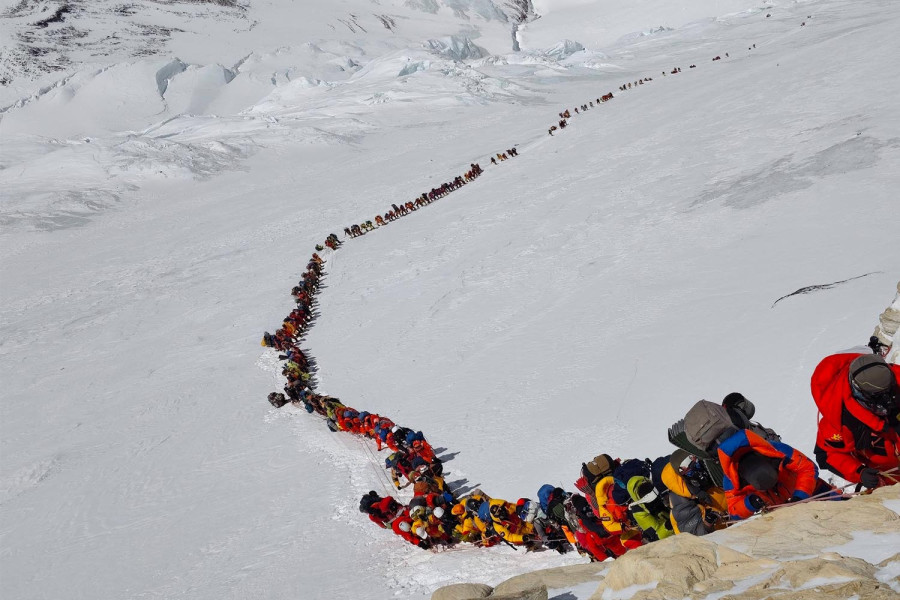
bookmark
Sangam Prasain
Published at : May 22, 2026
Updated at : May 22, 2026 21:26
Kathmandu
What is the carrying capacity of Mount Everest? The question remains unresolved as Nepal once again witnessed massive overcrowding on the world’s highest peak during the spring climbing season.
A drone video and photos that spread rapidly across social media this week showed a long, snakelike line of climbers moving between Camp III and Camp IV, highlighting congestion on Everest’s narrow slopes. Expedition operators estimated that more than 300 people were on the route at one time.
On May 20 alone, more than 270 climbers reached the summit from Nepal’s side, according to expedition agencies, reviving concerns over safety and regulation on the 8,848.86-metre mountain.
“We are yet to verify the numbers, but it’s most likely the same,” said Nisha Thapa Raut, director at Nepal’s Department of Tourism, the government agency responsible for monitoring mountaineering activities.
The scenes immediately drew comparisons with the infamous 2019 Everest traffic jam, when climber Nirmal Purja photographed a long queue of mountaineers near the Hillary Step during a brief weather window on May 22-23. At least three climbers died during that summit rush.
This year, celebrations broke out in Kathmandu after the record number of ascents.
But the images from the mountain again raised questions over whether Nepal should continue allowing hundreds of climbers to attempt the summit in a single day.
Veteran climber Kami Rita Sherpa, who landed in Kathmandu on Friday after completing his record 32nd Everest ascent, said the mountain had become noticeably “more crowded”.
“This time it was more crowded. There were more people than last year,” he said shortly after arriving at the airport.
“It seemed that this needed to be controlled a little.”
Nepal’s Supreme Court had already directed the government in April 2024 to regulate expedition numbers on Everest and other peaks, citing concerns over overcrowding, pollution and safety risks.
Everest has increasingly faced criticism in recent years for traffic jams, mounting waste and rising fatalities during summit pushes squeezed into short weather windows.
According to Raut, two Indian climbers died this week during descent after summiting Everest. One died at Camp II and another near the Hillary Step.
Both had reached the summit on Thursday before dying on the way down. Officials said the exact cause of death remains unknown, although mountaineering authorities suspect fatigue and exhaustion.
The deaths have pushed the Everest death toll to five since the current climbing season began in April.
According to Guinness World Records, the highest number of Everest ascents in a single day was 354 on May 23, 2019, from both the Nepal and Tibet sides.
From Nepal alone, 223 climbers summited on May 22 that year, followed by 212 on May 23, according to the Department of Tourism.
A division bench of Supreme Court justices Sapana Pradhan Malla and Sushma Lata Mathema had ordered authorities to determine climber limits based on Everest’s carrying capacity and safety considerations.
The ruling followed growing concern that Everest was turning into what critics call the “world’s highest garbage dump”.
“We are well aware of the Supreme Court order,” Raut said. “But until now, we don’t have any law controlling permits. There are no limitations.”
Officials say Everest climbing remains heavily dependent on a narrow weather window during spring.
“In 365 days, Everest is climbed for around 15 days or less, depending on the weather,” Raut said. “It’s all about the weather.”
Nepal’s National Assembly on February 9 passed the Integrated Tourism Bill, which introduces stricter mountaineering rules, enhanced safety and insurance provisions, and a permanent environmental fund aimed at cleaning up high-altitude mountains including Everest.
The bill is expected to move to the House of Representatives.
Officials at the tourism ministry say mountaineering provisions were incorporated into the tourism legislation for the first time to strengthen enforcement, as earlier rules were temporary and weakly implemented.
“We are hopeful the law will be enacted to limit climbing and control the environment,” said Raut. “After all, it’s safety that matters.”
One of the key provisions in the proposed law requires Everest climbers to first summit at least one mountain above 7,000 metres in Nepal before obtaining an Everest permit.
Officials say the measure is intended to discourage inexperienced climbers from attempting Everest, a trend often blamed for congestion, accidents and pressure on rescue operations.
The proposed legislation also includes provisions covering climbing seasons, permit conditions, expedition standards, application fees and mandatory recent health certificates for all climbers.
This year’s Everest season had already begun under difficult circumstances.
A massive unstable serac in the Khumbu Icefall blocked the climbing route below Camp I and delayed route opening operations for nearly three weeks.
According to the Sagarmatha Pollution Control Committee, the serac measured around 55 metres long, 37 metres wide and 28 metres high, with multiple cracks making it highly unstable.
After a 19-day delay, the route through the icefall was finally opened on April 28, allowing climbers and guides stranded at base camp to begin moving upward.
Gyanendra Shrestha, the government representative stationed at Everest Base Camp, said authorities may not be able to limit permits immediately, but there is room to reconsider the timing of the climbing season itself.
“Due to climate change, Everest is behaving differently,” Shrestha said. “By the third week of May, rivers start flowing at Camp II and even at base camp, which was unusual in the past.”
He said climbing activities could potentially shift into late April, as rope fixing and ladder installation can now be completed by mid-April.
“Why wait until mid-May to begin climbing?” he said. “It can be done in April.”
Sangam Prasain
Sangam Prasain is Business Editor at The Kathmandu Post, covering tourism, agriculture, mountaineering, aviation, infrastructure and other economic affairs. He joined The Kathmandu Post in October 2009.


Most Read from Money

Why does an hour long flight to Dhangadhi cost more than a flight to New Delhi?
Nepal travel agents threaten to stop selling Thailand trips over visa rules
Malaysia rejects Nepal’s demand to open recruitment to all manpower agencies

No school, but a graduation cap for women dairy farmers
Nepal arrests four medical service providers as Malaysia recruitment row deepens
Editor's Picks




E-PAPER | October 24, 2026

×