From banks to brokers and insurers: The multi-billion-rupee empire of the Bhatta-Agrawal syndicate
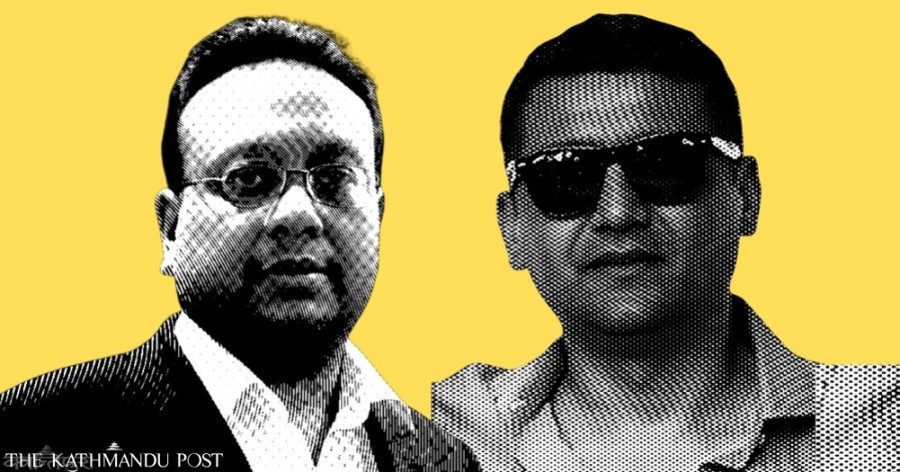
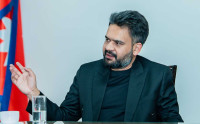
A forensic examination of charge sheets reveals how corporate loans, paper land deals, share trading financed through credit, and alleged market manipulation converged in a 27-billion-rupee financial crime case. Sulav Agrawal (left) and Dipak Bhatta Post Illustration
When officials from the Department of Money Laundering Investigation (DoMLI) asked Deepak Bhatta, chairman of Infinity Holdings, about the scale of his annual business turnover, his answer was imprecise.
“I cannot state the exact figure,” Bhatta told investigators. “However, my personal annual income is approximately Rs300 million.”
Moments earlier, investigators had questioned him about the source of Rs752.6 million that he had transferred to Jagdamba Steels. His response was similarly evasive.
“I cannot disclose the source at this moment. I will have to review my transaction records before providing an explanation,” he said.
Accused of engaging in highly unusual financial transactions that allegedly far exceeded their legitimate sources of income, Bhatta and his principal business associates now face four separate criminal cases involving money laundering, banking offences, securities fraud and insurance-related violations.
The cases were filed simultaneously on Thursday at the Special Court, the Patan High Court and the Kathmandu District Court. The prosecutions stem from a coordinated investigation led by the Nepal Police’s Central Investigation Bureau (CIB) and DoMLI, supported by inspection and supervisory reports prepared by the Securities Board of Nepal (SEBON) and the supervision department of Nepal Rastra Bank.
Among the prominent business figures indicted are Deepak Bhatta; Shanker Group chairman Shanker Lal Agarwal; vice-chairmen Sulav Agrawal and Sahil Agrawal; Shekhar Golchha, chairman and managing director of the Golchha Group; Raj Bahadur Shah, managing director of the Jawalakhel Group of Industries; and Amit More, managing director of the Lucky Group.
Among all defendants, the largest financial claim has been made against Bhatta. Prosecutors have demanded bail and asset forfeiture amounting to nearly Rs27 billion. Sulav Agrawal faces the second-largest claim, exceeding Rs25.5 billion.
A review of the four charge sheets shows a recurring pattern. The key figures at the centre of the case, including Bhatta, Agrawal, Golchha, More and Shah, have consistently denied wrongdoing while attributing responsibility either to one another or to subordinate executives.
According to prosecutors, the network established a complex system to circumvent financial regulations. The charge sheets describe the use of paper-based land purchase agreements, orchestrated family property divisions, and a series of interconnected transactions designed to conceal the origins and movement of funds from regulatory scrutiny.
Central to the prosecution’s case are Bhatta’s own statements to money laundering investigators, particularly his inability to explain the lawful origin of substantial amounts of capital.
The genesis: A Rs545 million ‘advance’
According to the charge sheets, the scheme began between September and October, 2022.
During that period, Rs545 million was transferred directly from the account of Jagdamba Steels, a subsidiary of the Shanker Group, at the Mega Investment Bank to Bhatta’s personal account at Siddhartha Bank.
When asked about the transaction, Bhatta said the money represented an advance payment for the purchase of his 54-anna land parcel in Sanepa, Lalitpur.
However, a senior DoMLI investigator told Kantipur that the money trail revealed a different picture.
According to investigators, Rs545 million transfer was subsequently moved to Infinity Holdings, a company wholly owned by Bhatta, before being invested in Himalayan Reinsurance as share capital. Prosecutors argue that the transaction was disguised as an advance payment for land in Sanepa, while the stated purpose of developing the proposed “Mega City” housing project in Lubhu never materialised.
The timing of the transaction coincided with a major political controversy.
While introducing the supplementary budget for the fiscal year 2021-22 and the annual budget for 2022-23, then finance minister Janardan Sharma faced widespread criticism over allegations that customs duties and tax structures had been altered to benefit Jagdamba Steels’ manufacturing operations.
Public allegations subsequently emerged claiming that Bhatta had acted as an intermediary in securing the policy changes and that the Rs545 million transferred by Jagdamba Steels represented a commission payment.
Following growing public scrutiny, Nepal Rastra Bank flagged the transaction as “suspicious” and formally requested DoMLI to investigate. That referral became the starting point of the broader probe.
Funds obtained through a working capital loan were transferred from Jagdamba Steels to Bhatta’s personal account. Bhatta then moved the money into Infinity Holdings, a company solely owned by him. The funds were subsequently invested in Himalayan Reinsurance as share capital. The prosecutors said the purpose was to conceal their origin.
According to the charge sheet, Jagdamba Steels violated banking regulations by diverting a working capital loan obtained from the then Nepal Investment Bank. Such loans are intended exclusively for operational expenses but were allegedly channelled to a private individual under the guise of a land acquisition deal.
The laundering loop: Round-tripping through the Agrawal family
Several months after the original transfer, as regulatory scrutiny intensified, Bhatta transferred Rs752.6 million back to Jagdamba Steels.
In his statement to investigators, Bhatta said Jagdamba Steels had later informed him that it could not proceed with the land purchase because of financial difficulties. He therefore returned the advance along with accumulated interest.
“Since Jagdamba Steels cited financial difficulties and expressed its inability to purchase the said property, I returned the principal amount along with the accrued interest,” Bhatta said in his deposition.
However, in the same statement, he also claimed that he had no personal or professional relationship with the company.
That contradiction has become a central issue.
Investigators question why a corporate entity would transfer more than half a billion rupees to a private individual without a legally registered agreement, without obtaining a corresponding property loan through formal banking channels, and without completing a property ownership transfer over a period of three to four years.
The charge sheet further notes that Jagdamba Steels recorded the transaction as a “land advance” in its financial statements for three consecutive years. Yet references to the transaction disappeared from company disclosures beginning in the fiscal year 2023-24.
Investigators also found that Bhatta used his personal Siddhartha Bank account to refund the money despite having an authorised overdraft facility of only Rs5 million.
The repayment was made through 24 separate cheques issued to Jagdamba Steels.
Significantly, the repayment took place at the same time Nepal Rastra Bank had begun an on-site investigation into the alleged misuse of the original commercial loan.
Investigators then sought to determine the source of the Rs752.6 million that Bhatta returned to Jagdamba Steels.
According to a special on-site inspection report of Siddhartha Bank obtained during the investigation, Rs679 million of the amount originated from entities linked to the Shanker Group and members of the Agrawal family.
Bank records show that, shortly before Bhatta issued the refund cheques to Jagdamba Steels, funds were transferred into his account from multiple sources. These included Rs143.2 million from Krishiv Agrawal, son of Sulav Agrawal; Rs131.8 million from Shubhi Agrawal, Sulav Agrawal’s wife; Rs103 million from Sulav Agrawal himself; Rs90 million from Sahil Agrawal; Rs83 million each from Jaana Agrawal and Lalita Agrawal; and Rs45 million from Shanker Lal Agrawal. Bhatta’s wife, Ayushma Nepal Bhatta, transferred Rs101.7 million, while Infinity Holdings contributed a further Rs2.94 million.
Investigators have characterised the sequence of transactions as a classic case of “round-tripping”. According to the charge sheet, funds obtained through commercial loans by Jagdamba Steels were distributed through accounts linked to the Agrawal family, channelled into Bhatta’s account, and ultimately returned to Jagdamba Steels in a manner that made the transaction appear to be a legitimate settlement of a failed land deal.
Bhatta described the transfers as personal loans. However, when investigators asked why he had obtained the loans, he said he could not say with certainty what purpose they had served. Asked about funds transferred from Infinity Holdings into his personal account, Bhatta said he could not confirm whether they represented an advance payment or dividend distribution.
He also sought to distance himself from the underlying banking transactions.
“The transactions between Jagdamba Steels and Mega Investment Bank are beyond my personal knowledge,” he told investigators. “I am not the person who secured the loan. Any issues relating to that credit facility are the responsibility of Jagdamba Steels.”
Subordinates deny knowledge
The charge sheets show a recurring pattern of defendants claiming little or no knowledge of transactions in which they were directly involved.
One such example is Sreedhar Khanal, who has worked as a banking assistant at Jagdamba Steels’ corporate office for more than seven years. Khanal was responsible for carrying and depositing the four cheques worth a combined Rs545 million that were issued by the company to Bhatta.
Under questioning, Khanal said he did not know Bhatta.
Investigators, however, found Khanal’s signature and mobile phone number on the reverse side of the cheques. When confronted with this evidence, he said he could not recall who had handed him the cheques or how they had come into his possession, citing the passage of time.
From bank loans to stock trading
According to prosecutors, the alleged scheme later expanded beyond the original banking transactions and moved into the securities market.
Four years after the initial loan transaction, Himalayan Reinsurance, the company that had received the investment routed through Infinity Holdings, became central to a separate securities fraud investigation involving Bhrikuti Stock Broking Company, or Broker No 55.
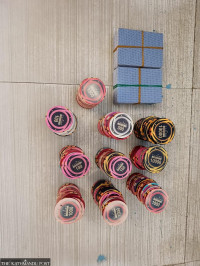
The securities fraud case filed at the Kathmandu District Court alleges that between July 21, 2025, and March 15, 2026, Bhatta purchased securities worth Rs3.80 billion through Broker No 55 without depositing the mandatory advance margin.
Under securities regulations, brokerage firms are prohibited from executing purchase orders unless they have received an advance margin equivalent to at least 25 percent of the transaction value.
During the same period, Bhatta sold shares worth Rs930.5 million through the brokerage. Even after adjusting the sales against purchases, prosecutors say he still owed Bhrikuti Stock Broking approximately Rs2.89 billion for shares acquired on credit.
Investigators allege that the credit-based transactions created artificial demand in the market and helped drive up the share price of Nepal Reinsurance Company.
According to the charge sheet, Nepal Reinsurance shares traded at Rs1,461 on July 21, 2025. By August 26 of the same year, the price had risen to Rs1,686, an increase of 15.5 percent in just over five weeks.
The prosecution alleges that the rise was not the result of normal market activity but part of a coordinated effort to manipulate the stock price.
According to the charge sheet, the operation involved collusion among Deepak Bhatta, Bhrikuti Stock Broking Company, Himalayan Reinsurance, Himalayan Capital, and Nepal Micro Insurance Company, in which Bhatta holds a 15 percent stake.
Prosecutors further allege that Shubhi Agrawal, Himalayan Life Insurance, Rishi Raj More and Raj Bahadur Shah participated in coordinated trading that contributed to the rise in the stock’s value.
Funding the broker
The charge sheets also examine how Bhrikuti Stock Broking financed billions of rupees in credit transactions.
According to investigators, funds were channelled into the brokerage through a network of business figures that included Rohit Gupta and Shekhar Golchha.
Golchha, former president of the Federation of Nepalese Chambers of Commerce and Industry and then chairman of Himalayan Reinsurance, acknowledged transferring Rs525 million to the brokerage on multiple occasions.
However, he told investigators that he had no personal relationship with Sandeep Chachan Agrawal, chairman of Bhrikuti Stock Broking, and did not maintain either a Demat account or a Trading Management System account with the firm.
Asked why he had transferred more than half a billion rupees to a brokerage where he held no trading account, Golchha said the money had been contributed as part of a pooled investment arrangement involving business associates, including Rohit Gupta, Raj Bahadur Shah, Sulav Agrawal and Amit More.
He said he did not know whether the brokerage had used the money to settle the liabilities of other clients and denied providing funds for the purchase of shares in Bhatta’s name or for any unlawful purpose. He also said he had no personal or financial dealings with Bhatta.
In an earlier conversation with Kantipur, Golchha similarly denied his involvement in any market manipulation scheme and said his money had become trapped after regulatory action froze the brokerage’s operations.
Investigators also found that Raj Bahadur Shah purchased Nepal Reinsurance shares worth Rs1.41 billion through the brokerage network. Bank records show that he paid only Rs525 million, leaving nearly Rs900 million outstanding, according to the charge sheet.
Board resignations
Members of the More family, who are associated with the Lucky Group, also feature prominently in the case.
Amit More and Rajiv More, both directors of Himalayan Reinsurance, told investigators that they had merely endorsed board decisions in their capacity as directors and were not involved in detailed discussions concerning specific investments or capital allocations.
Both said responsibility for day-to-day financial and investment decisions rested with the company’s chief executive officer and executive management team.
Notably, both resigned from the board of Himalayan Reinsurance three days before appearing for questioning. Their departures followed the resignation of Shekhar Golchha as chairman on March 9.
According to company insiders cited in the charge sheets, several board members were aware of serious irregularities involving the use of company funds in stock market transactions. Investigators noted that Golchha later acknowledged stepping down after becoming aware of the extent of the alleged financial misconduct.
As scrutiny intensified, the board of Himalayan Reinsurance began to unravel.
Rishi Raj More admitted that he had purchased shares using loans obtained directly from the brokerage and currently owes approximately Rs230 million to the firm.
When asked whether a stock broker is legally authorised to provide credit facilities similar to those offered by commercial banks, he said he was unaware of the relevant legal provisions.
More also told investigators that he did not know Sulav Agrawal, Sahil Agrawal, Deepak Bhatta or Shubhi Agrawal.
Investigators, however, found records showing that he had transferred millions of rupees directly into Shubhi Agrawal’s bank account. Asked to explain the transfers, he declined to provide details, saying the matter was private.
Allegations of a special-purpose vehicle
Shubhi Agrawal, wife of Shanker Group vice-chairman Sulav Agrawal, is among those accused of receiving substantial credit facilities from Broker No 55.
In her statement, she denied using any funds diverted from Himalayan Reinsurance and said her share purchases were conducted under a private credit arrangement with the brokerage.
She acknowledged that she currently owes the brokerage approximately Rs620 million but said she had no knowledge of the original source of the funds used to finance her transactions.
Sulav Agrawal adopted a similar position, arguing that the source of capital provided by a licensed brokerage was not the concern of individual clients.
Investigators take a different view. The charge sheets allege that the group established shell companies, used third-party proxies and operated Bhrikuti Stock Broking as a special-purpose vehicle to launder illicit assets. All defendants have denied the allegations.
Conflicting claims
As the cases moved towards trial, several defendants began shifting responsibility onto one another.
Bhatta denied using Himalayan Reinsurance funds to finance his stock purchases. While acknowledging that some shares were acquired on credit through arrangements with the brokerage, he claimed that Sulav Agrawal had gained access to his trading account credentials and executed large transactions without his knowledge.
Bhatta urged investigators to examine digital records and IP addresses associated with the trades.
Sulav Agrawal rejected the allegation, insisting that Bhatta managed his own trading activities and denying any knowledge of his Demat account or Trading Management System login credentials.
Cases move to court
Amid the conflicting accounts, the state has proceeded with prosecution.
The four charge sheets name 86 defendants and are being heard before the Kathmandu District Court, the Patan High Court and the Special Court. A number of those indicted have absconded and are currently being treated as fugitives.
The Special Court began preliminary hearings on Friday in the money laundering case involving 39 principal defendants, including Bhatta and members of the Agrawal family.
The case is being heard by a full bench of judges Sudarshan Dev Bhatta, Umesh Koirala and Bidur Koirala.
The court began recording Bhatta’s statement on Friday, and officials said the process would continue on Monday. After completing Bhatta’s testimony, the court is expected to question Sulav Agarwal.
The bench will then issue its detention order, determining whether the principal defendants will remain in custody during trial or be released on bail.




 13.58°C Kathmandu