



 14.81°C Kathmandu
Sat, Oct 24, 2026
Money
Farmers turn to rubber cultivation to keep elephants and monkeys at bay
Repeated crop losses from wildlife are pushing farmers in Jhapa to abandon paddy and maize in favour of rubber.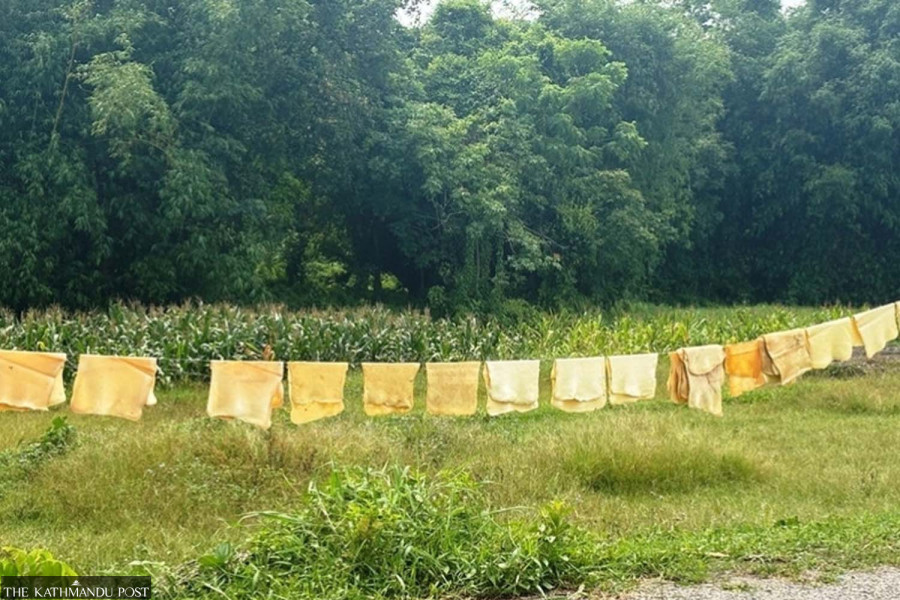
bookmark
Parbat Portel
Published at : June 14, 2026
Updated at : June 14, 2026 06:54
Jhapa
Farmers in Jhapa are gradually turning to rubber cultivation as repeated crop losses caused by wild animals, particularly elephants and monkeys, make traditional farming less viable.
In Buddhashanti Municipality-3, near the Adarsha Namuna Community Forest, many farmers have shifted from cultivating paddy and maize to growing rubber, which they say is far less vulnerable to wildlife damage.
Sitaram Bastola, a local farmer, abandoned paddy and maize cultivation around 12 years ago and began planting rubber on approximately 10 katthas of land.
“When I used to grow paddy and maize, elephants and monkeys would never let me harvest the crops. That is when I started rubber cultivation,” Bastola said. “Now, I earn between Rs35,000 and Rs40,000 a month.”
According to Bastola, damage caused by wild animals in rubber plantations is negligible. Even when animals enter the plantations, they do not harm the rubber trees, providing farmers with considerable relief.
Punya Prasad Khatiwada of the same village has also replaced traditional grain crops with rubber. He started rubber cultivation in 2011 after becoming increasingly frustrated by wildlife-related crop losses.
“Production began seven years after planting the trees,” Khatiwada said. “Now, I am earning a good income while staying at home.”
Khatiwada has planted 150 rubber trees on around nine katthas of land. Rubber trees produce latex for approximately eight months each year. According to him, a single tree yields around 15 litres of latex during the production season.
“One kg of rubber can be produced from two-and-a-half litres of latex,” he said.
However, latex production declines during winter.
“Once winter sets in, the sap becomes thinner,” Khatiwada said. “At that time, it takes around four litres of latex to produce one kilogramme of rubber.”
Farmers currently sell processed rubber for around Rs300 per kg.
According to Chandra Adhikari, president of the Small Farmers Natural Rubber Producers Association, traditional grain cultivation has become increasingly difficult in several parts of Jhapa due to the growing menace of wild animals.
“In elephant-affected areas, rubber farming has not only reduced the risk of crop damage but also provided farmers with a reliable source of income,” Adhikari said.
He said rubber is currently cultivated on more than 500 hectares across Jhapa, Morang, Sunsari, Udayapur and Ilam districts. In Jhapa alone, including plantations established within community forests, rubber cultivation covers around 130 hectares.
The crop is expanding in many municipalities, including Mechinagar, Buddhashanti, Arjundhara, Kankai, Kachankawal, Bahradashi and Damak.
Rubber has been planted collectively on more than 15 hectares in the Adarsha Namuna Community Forest in Buddhashanti, Kalika Community Forest in Dhaijan and Jamunkhadi Community Forest in Kankai.
Adhikari said rubber cultivation has expanded particularly rapidly in areas affected by wildlife.
“Since wild animals do not damage rubber trees, cultivation is growing quickly in the affected areas,” he said.
Dilip Goswami, a trader based in Birtamod, purchases rubber produced by local farmers. Since traders collect the produce directly from fields, farmers say they have no problem with the market.
“At the very least, farmers do not have to worry about selling their produce,” Goswami said. “We collect it directly from their homes.”
According to Goswami, Jhapa produces more than 1,500 litres of latex in a season, from which over 500 kg of rubber is processed.
He supplies the rubber to various industrial plants.
The rubber produced in Arjundhara is purchased by the Goldstar shoes company, he said. “The rubber we collect is also supplied to tyre makers in Chitwan and Rangeli in Morang.”
Goswami said farmers in Jhapa earn more than Rs50 million from rubber cultivation during a single production season. He believes that earnings could increase substantially if the cultivation area expands further.
“There is immense potential in rubber farming,” he said. “With dedication and hard work, farmers can have a handsome income right in their villages.”
Farmers say sandy soil is well-suited to rubber cultivation, although the crop requires adequate irrigation and regular maintenance. Based on their experience, productivity remains highest when soil moisture levels are maintained throughout the growing season.
“Rubber provides a good income, but it demands equal commitment,” Adhikari said. “Farmers cannot afford to neglect the plantations. Continuous care is essential to increase production.”
An organisation known as Rubber Zone, which brings together farmers involved in rubber cultivation, is also active in Jhapa promoting the crop across the district.
According to Ishwari Pokharel, president of the organisation, interest in rubber cultivation is steadily growing, but government support remains minimal.
“Our goal is to produce enough rubber to help revive closed industries such as Gorakhkali Tyres,” Pokharel said. “However, state support is essential. Even a small amount of encouragement from the government would make a significant difference.”
Parbat Portel
Parbat Portel is the Jhapa correspondent for Kantipur Publications.


Most Read from Money

Why does an hour long flight to Dhangadhi cost more than a flight to New Delhi?
Nepal travel agents threaten to stop selling Thailand trips over visa rules
Malaysia rejects Nepal’s demand to open recruitment to all manpower agencies
No school, but a graduation cap for women dairy farmers
Nepal arrests four medical service providers as Malaysia recruitment row deepens
Editor's Picks




E-PAPER | October 24, 2026

×