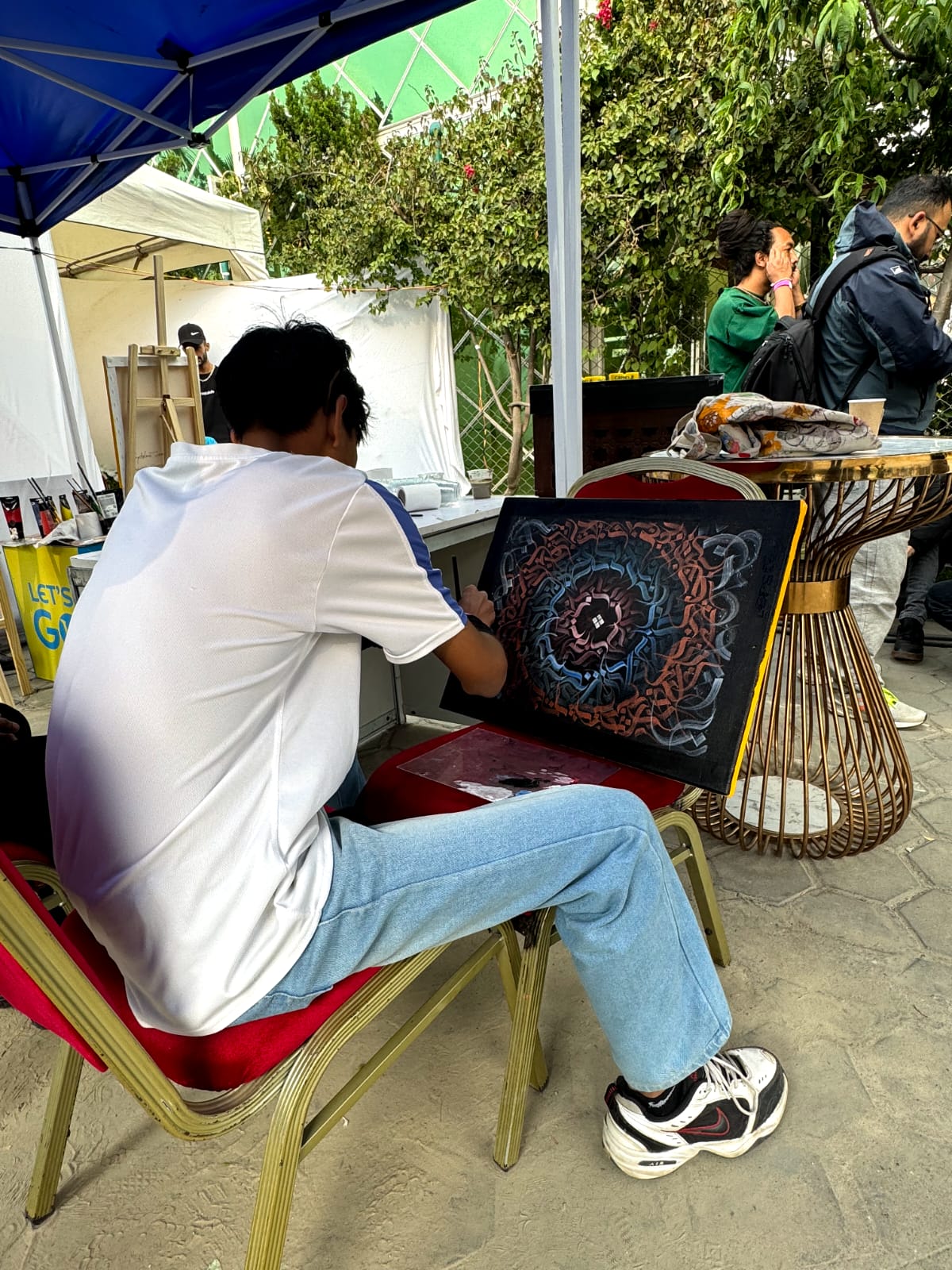
Drawing from Ranjana Lipi and Bhaktapur’s artistic heritage, Kristan Napit turns umbrellas into unconventional spaces for calligraphic experimentation.Courtesy of Kristan Napit
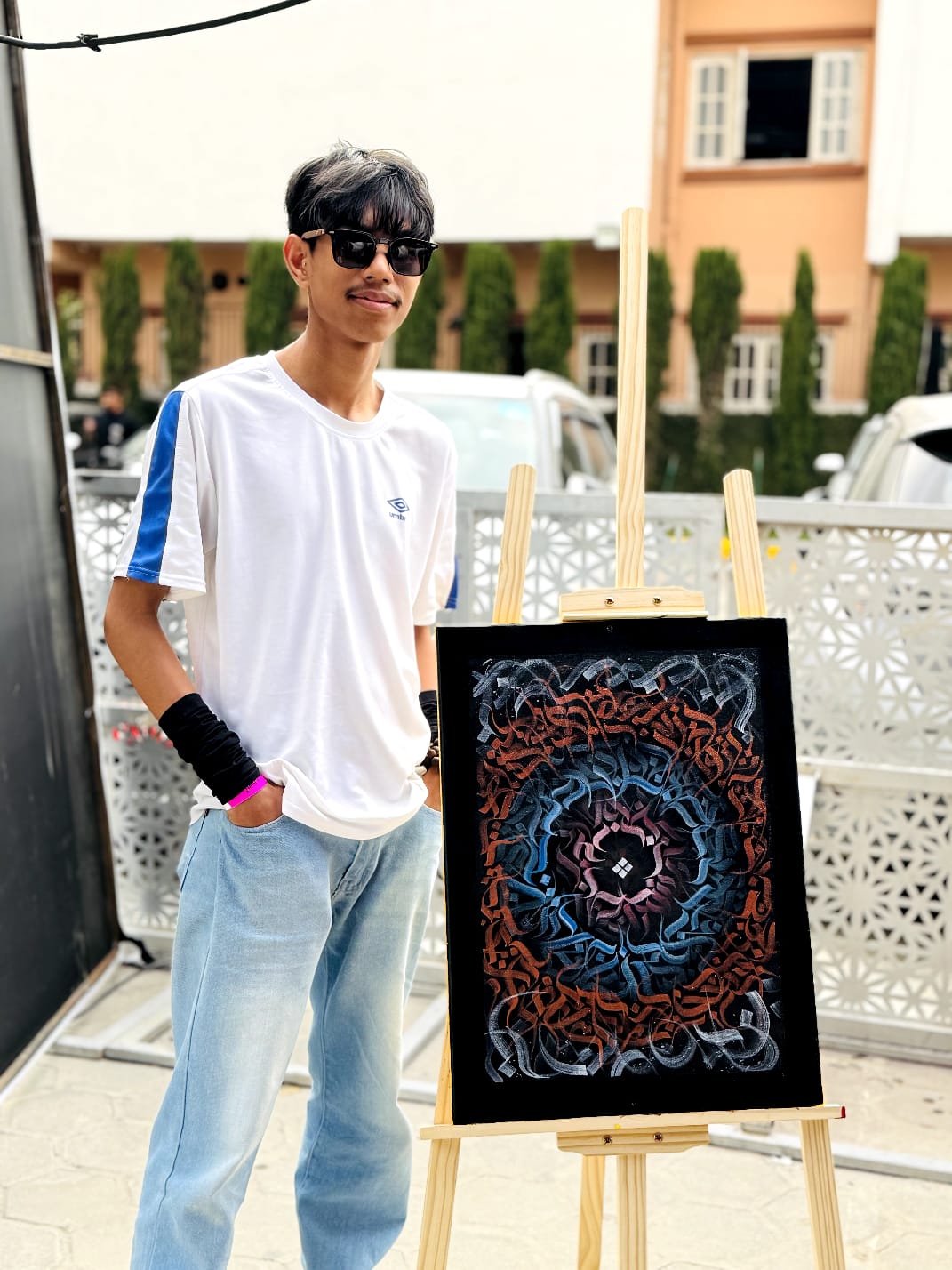
Two years ago, Kristan Napit’s friends introduced him to calligraphy, the art of decorative writing that enhances visual expression. Ever since, he has been experimenting with calligraphy with paintings, canvases, and, more recently, umbrellas.
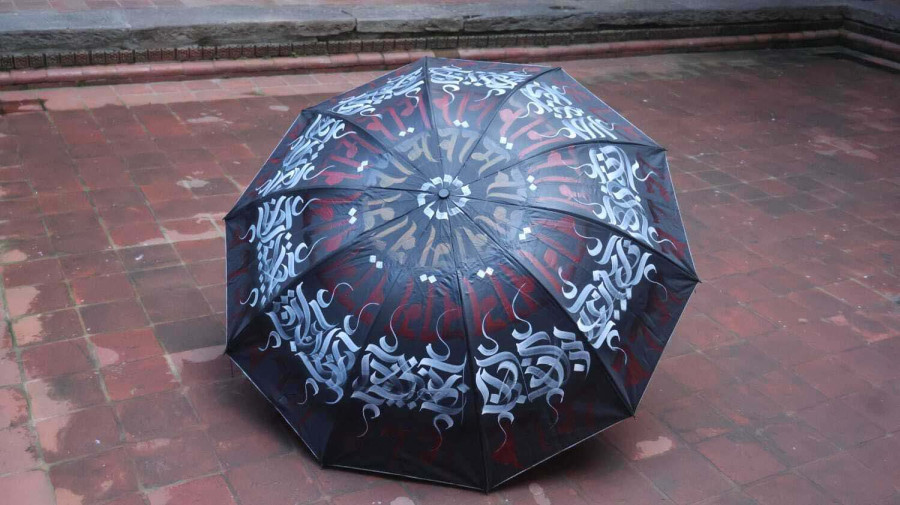
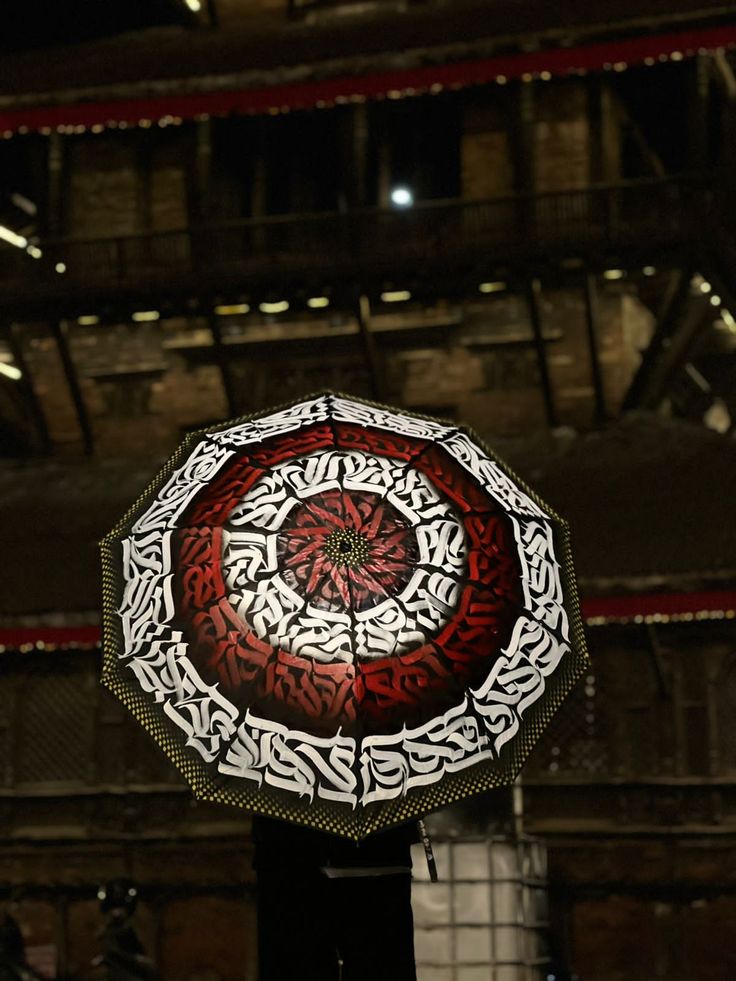
On a rainy evening in Bhaktapur, an umbrella, along with providing a shelter, carried strokes of calligraphy icons that were seemingly inspired by Ranjana Lipi. The design was new, abstract, intriguing and perhaps a visual language in itself.
On the circular surface of a black umbrella, alternating strips of white and red strokes flowed in parallel to the circumference. The outer ring is white and black, highly legible, creating a strong border. The inner rings transition into a deep monochromatic red layered with complexity and depth. Within the inner rings, the white calligraphic layer is superimposed over the red ones in some areas, creating a multi-dimensional effect.
Overall, the design also projects the style and structure of a mandala. Each of these umbrellas incorporates unique designs and a colour palette.
“When I initially started trying calligraphy, I moved from paper to wall and finally to an umbrella,” says Napit, “a perfect canvas to explore new possibilities.”
Kristan Napit
For Napit, a fourth-year BA LLB, umbrellas have become unconventional spaces for artistic exploration.
Growing up among Bhaktapur’s heritage spaces, Napit encountered art and Ranjana Lipi early in his life. “When I was a child, I used to see many temples around the area I lived in,” Napit recalls. “It is within those premises that I first encountered Ranjana Lipi.”
While grounded in the ancient script, his works move rather towards abstraction. Interpreting the rhythm and visual language through freestyle designs, he does not merely reproduce Ranjana Lipi in its traditional form. To him, this form of abstraction is an evolution of calligraphy.
Nearly a year ago, his father denied him permission to paint on an umbrella. Consequently, he bought one himself. Unlike paper or canvas, umbrellas posed technical challenges.
“On paper or walls, colours feel safe,” he expresses. “But on an umbrella, I always wondered, would the colours survive the rain?”
The answer emerged through trial and persistence. Using fabric paint on black umbrellas and working primarily with paintbrushes, Napit spent months understanding colour behaviour and surface dynamics.
This experiment has now grown into a continuing collection, consciously restarted in recent months after a brief halt.
He begins by taking measurements, then moves directly to the umbrella’s surface. Then, he starts painting. “Calligraphy can be done through bamboo tools, markers or paint brushes,” he explains. “I mostly use a paintbrush.”
It takes a day or two to complete one umbrella, depending on his ability to continue and the need for breaks. But the process that takes the most time before the act of painting is thinking, preparing, and holding the brush with a mind full of ideas. “This takes more time than the process of painting itself,” he adds.
Art comes to Napit as a part of life. As a child, he accompanied his mother to the house of a senior local artist, Krishna Ram Chitakar, who was commissioned to paint her portrait. “I was in grade one that year,” recalls Napit. “Right after school, I used to run to his house to watch him paint my mother.”
Moving between visits to the painter’s house, curiosity slowly sparked within him. He began asking questions about colours, brushstrokes, and form. Looking at his mother’s finished portrait, he decided to understand art and eventually create one himself.
Professionally, however, he explains that his future points toward the legal field. “Being in a legal profession is inevitable for me,” he says. “But by heart, I am always an artist.”
His relationship with art remains emotionally layered and, as he says, complicated. At times, academic demands pull him away from it, but in moments of free time, he returns to it with complete immersion.
This tension also reveals his stance toward commercialisation. With positive responses from his close friends, he has subtly resisted commercial ambitions.“The reason I am sceptical about selling these umbrellas is that I fear people may not fully acknowledge their worth,” he says.
However, if someone is willing to buy them, he hopes they will hold the umbrellas with the same pride and care with which they were created.
With Ranjana Lipi as one of his primary inspirations, he reflects on the present status of the ancient script. “Calligraphy, especially the Ranjana Lipi, is the least popular,” he says. “People fail to understand and acknowledge it.”
Still, he remains cautiously hopeful, noting the efforts toward its revival and the momentum that it is slowly gaining.
For Napit, the idea of preservation also means to allow the form to extend into reinterpretation. With his style, he finds a way for an ancient script to enter new, unexpected surfaces. Therefore, on his everyday objects, bag, guitar covers and evidently, his umbrellas, this abstract calligraphy exists.




 22.92°C Kathmandu