



 20.73°C Kathmandu

Mon, Oct 12, 2026
Culture & Lifestyle
Theatre review: The performance of persecution
A mock courtroom trial turns into a disturbing examination of misogyny, collective judgment and the ease with which ordinary people become complicit in cruelty.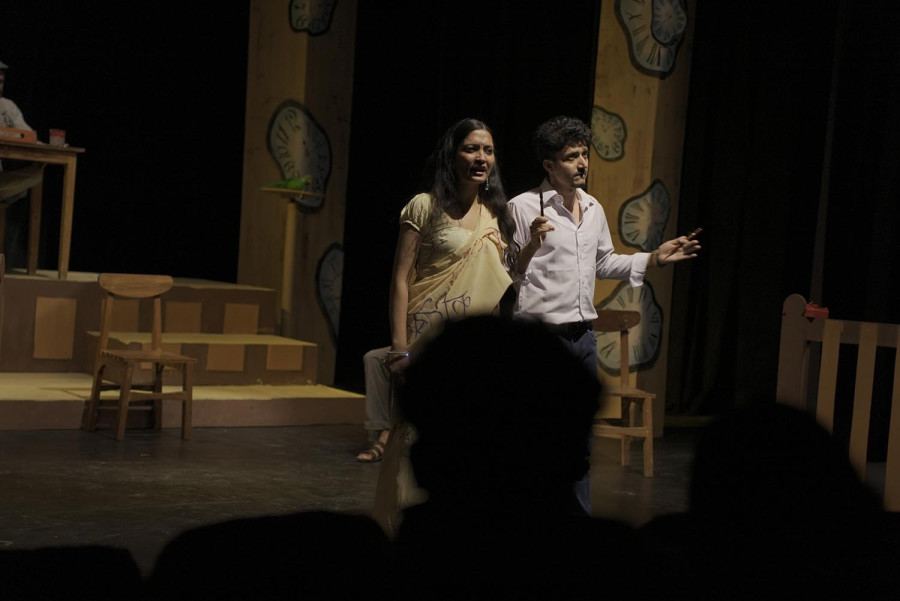
bookmark![]()
![]()
Shrinkhala Chand Thakuri
Published at : July 23, 2026
Updated at : July 23, 2026 15:17
Kathmandu
Courts are built on performance. Judges perform authority. Lawyers perform certainty. Witnesses perform truth. Even the accused must perform innocence convincingly enough to be believed.
‘Shh! Ijlaas Jaari Chha…’ understands that theatre is not very different. Both ask people to step into roles, convince strangers, and blur the line between fiction and reality. Gunjan Dixit's production takes that similarity one step further. It asks how far a game can go before it stops being one. How long till the court ends?
Adapted by Bijay Bisfot (J.B. Deuja) from Vijay Tendulkar's ‘Silence! The Court is in Session’, Gunjan Dixit's production follows a travelling theatre troupe preparing to stage a courtroom drama in a village community hall. When one actor fails to arrive, the inexperienced Ishwar is asked to fill in. Since he has never seen a courtroom, the troupe decides to teach him by staging a mock trial. Devyani becomes the accused. The charge, an unmarried woman accused of abortion, is imaginary.
At least, at first.
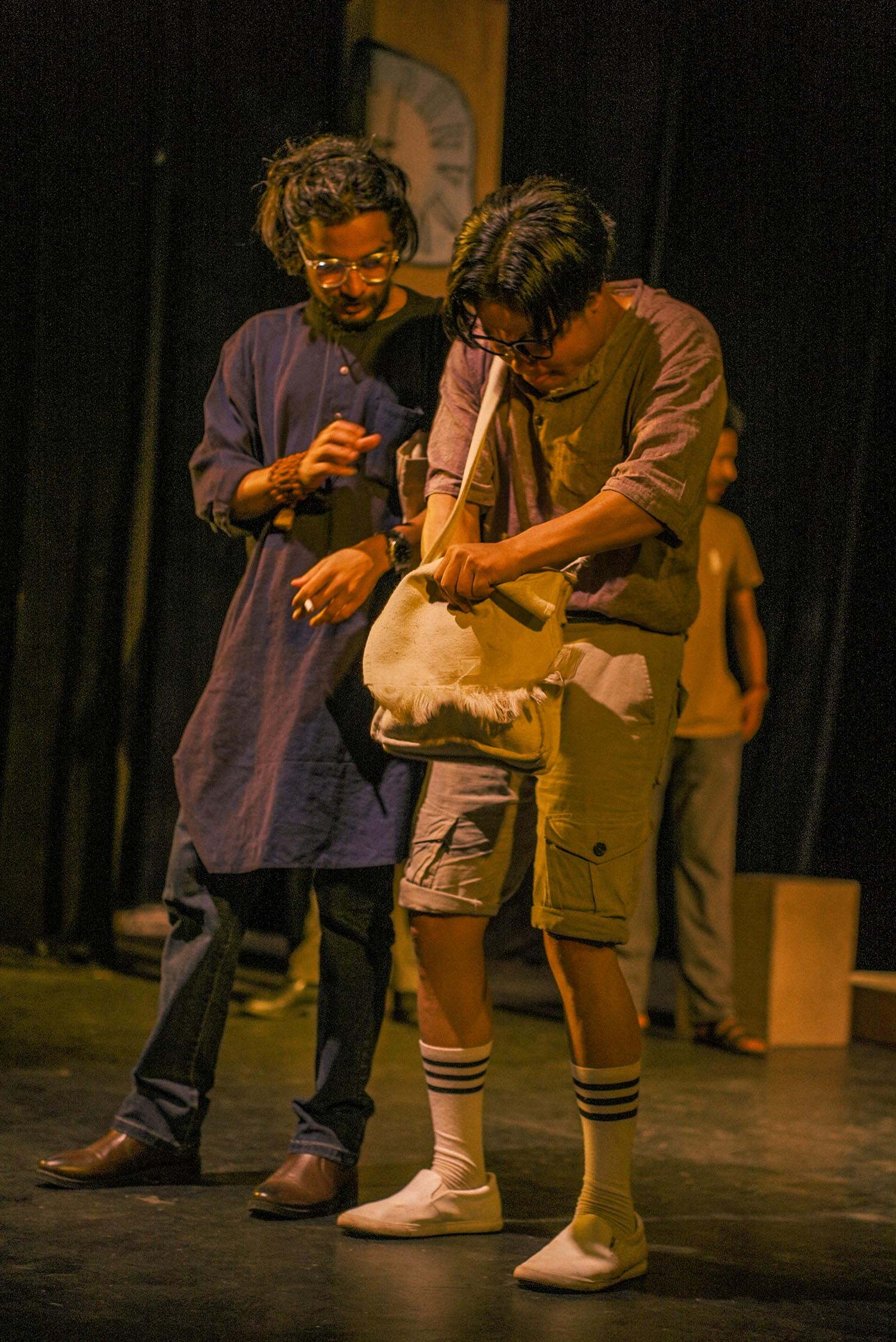
The production's greatest achievement is that it never tells the audience exactly when the rehearsal ends. Nobody announces that the game has gone too far. The actors just become better at their roles. Their questions aim to hurt. They stop searching for answers and start searching for wounds.
By the time Devyani asks them to stop, the mock trial has acquired its own momentum. Nobody is interested in whether the accusations are true anymore. They are too busy performing justice.

The audience laughs during the opening scenes. The actors are genuinely funny. Their conversations have the looseness of people who know each other well, constantly interrupting, teasing and feeding off one another's energy. The humour never feels manufactured. That natural chemistry makes what follows significantly harder to watch because the hostility grows from familiarity. Nobody suddenly becomes a villain. They simply keep saying yes to the game.
The audience laughs in the beginning. I found myself wondering afterwards exactly when we stopped.
The transformation works because the actors never play it as a transformation. Nobody suddenly becomes cruel. They simply become more convincing. The jokes land, the banter feels effortless, and before long those same performers are constructing increasingly personal accusations with the confidence of people who believe they are only doing their jobs. The most unsettling part is that the play never changes tone overnight. It changes intention.
Watching the troupe slowly become a jury is perhaps the production's cleverest piece of direction. Their individuality begins to disappear. The lively actors from the opening half, each with their own quirks and rhythms, flatten into something anonymous. They stop behaving like friends rehearsing together and start sounding like procedure. It is difficult to tell exactly when that happens. By the time you notice, the courtroom has already taken over.
The production rarely explains its symbolism, and it is better for it. The woman in white appears and disappears without announcing who she is supposed to be. She could be Devyani's younger self, the child everyone insists on speaking for, or simply a life untouched by public judgment. The production never insists on an answer because ambiguity is doing the work. Not every symbol needs a caption.
That confidence extends beyond symbolism. Dixit understands that tension is often built by subtraction rather than addition. The murmuring jury gradually replaces conversation until individual voices disappear into collective judgment. The typewriter, initially just another courtroom prop, slowly begins to sound like a verdict being written in real time. Even the lighting conspires against Devyani, isolating her while everyone else remains physically close. She is surrounded by people. That is precisely the problem.
Anuska Karki's Devyani is the emotional centre of the production, although the play wisely refuses to reduce her to a victim. She begins as someone capable of teasing, joking and arguing with everyone else. As the trial continues, that confidence is slowly stripped away through seemingly small moments. She forgets the lines of Devkota's Pagal. She hesitates before answering questions. Eventually, silence becomes her only defence.
Still, the production never lets that silence become surrender.
Devyani remembers writing, “The grass is green, the roses are red, this book is mine till I’m dead,” in her childhood notebook. Later, she corrects the rhyme: “No. I am not dead.” It is a small rebellion, but a satisfying one.
Not every character receives the same level of complexity, though. Rame occasionally slips into caricature, while a few supporting characters seem designed more to represent social attitudes than fully realised people. Yet this feels less damaging than it might have in another play because ‘Shh! Ijalas Jaari Cha…’ is ultimately less interested in individuals than in crowds. The production asks how ordinary people become participants in extraordinary cruelty. That question requires types as much as personalities.
It would be easy to leave the theatre calling this a play about misogyny. Of course it is. But that feels like letting the audience escape too easily. The interesting thing is not how quickly Devyani was judged. It was how eager everyone else was to judge her. The courtroom is frightening not because it is full of villains but because it is full of ordinary people who mistake participation for responsibility. Nobody believes they are doing harm. They are simply following the rules of the game.
The final image leaves little room for comfort. Devyani's white sari, now covered with questions, rumours and verdicts, becomes the physical weight of everything the courtroom has projected onto her. The performers carry it into the audience long after the trial is over, refusing to let judgment remain confined to the stage.
Long after the performance ends, Devyani's suffering lingers. So does the uncomfortable recognition that the audience, too, accepted the mock trial as entertainment before realising what it had become.
By the time the lights fade, the rehearsal has long since ended.
The game hasn’t.
The court, indeed, is still in session.
———-
Shh! Ijalas Jaari Cha…
When: 03 July to 25 July
Where: Mandala Theatre
Time: 5:30 PM, Extra Shows on Saturdays at 1:30 PM
Entry: Rs300- Rs500
Shrinkhala Chand Thakuri
Shrinkhala Chand Thakuri is a Culture and Lifestyle intern at The Post. She is an English Literature and Journalism major.





Most Read from Culture & Lifestyle

It’s a bird … it’s a plane … it’s the Indian ambassador’s farewell tweets

‘Tenzing’ puts the Sherpa at the centre of the Everest story

How should Nepal navigate a world in reorder? Rajib Upadhya on geopolitics and foreign policy

How Anup Poudel took Nepali cinema to Cannes

A Nepali photographer rediscovers Calcutta after decades
Editor's Picks

Constitutional Bench caught in seniority, ‘pick and choose’ dispute

A Dom boy’s long road to becoming a doctor

From blankets to handmade dolls, two foreign women bring comfort to flood survivors

News Analysis: When institutional defence exposes institutional fault lines
It’s a bird … it’s a plane … it’s the Indian ambassador’s farewell tweets
E-PAPER | October 12, 2026

×