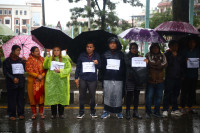
Police sources say the operation to detain journalists and pressure them into revealing their sources followed discussions between senior officials at the prime minister’s secretariat and the home ministry. Journalists stage a protest at Maitighar in Kathmandu on Saturday to protest the authorities’ crackdown. Dipesh Darshandhari/TKP
The Nepal Police, the home ministry and the Office of the Prime Minister and Council of Ministers have been denying responsibility after plainclothes officers were deployed to media houses on Friday to detain journalists and intimidate newsrooms in what appeared to be an attempt to force reporters to reveal their sources.
Nepal Police has said its Cyber Bureau summoned journalists after the Prime Minister’s Office expressed concern over some news reports. The office, however, has denied prior knowledge of the operation, saying instead that Prime Minister Balendra Shah instructed the authorities to release the detained journalists immediately. The home ministry has not commented on the incident.
In a message posted in a WhatsApp group through which police spokespersons communicate with journalists, Nepal Police central spokesperson Abinarayan Kafle explained why the reporters had been summoned.
According to Kafle, the Prime Minister’s Office had raised concerns about what it described as the continued circulation of misleading reports and messages about Nepal Police in the media and on social media. He said the police had acted in response to those concerns.
His message said such reports risked undermining public confidence in police professionalism, damaging relations between the government and the police organisation, and creating negative perceptions of ongoing investigations.
Although Kafle maintained that the journalists had only been summoned for questioning, a team from the Kathmandu Valley Crime Investigation Office took Bishwamani Subedi, a journalist with Nepal Press, into custody from his workplace in New Baneshwar.
Subedi said a team led by a police inspector arrived while he was working in the newsroom. The plainclothes officers entered the building, claiming to know someone there, and told him that a senior superintendent of police (SSP) wanted to meet him over tea. They then escorted him away.
“I would have had no problem meeting them if they had simply called me in. But the way they arrived in a group made it obvious that they were taking me into custody,” Subedi told Kantipur. “At their office, they questioned me about the news reports.”
Under the law, complaints concerning media reports fall within the jurisdiction of the Press Council, Nepal. However, police spokesperson Kafle defended the operation, saying it had been carried out in good faith as part of the police’s duties.
Press Council chair Umesh Shrestha, meanwhile, questioned the police action. He said it was inappropriate for the police to issue a statement warning of action that encroached on the council’s jurisdiction one day before carrying out an operation that appeared to follow through on that threat.
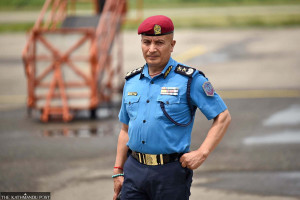
The incident came amid speculation that the government was preparing to remove Inspector General of Police Dan Bahadur Karki. On Thursday, Karki had convened a meeting of the Police Policy Coordination Committee at the headquarters, attended by senior superintendents and deputy inspectors general based in Kathmandu.
Following the meeting, police issued a statement alleging that misleading information was being circulated against the organisation and warning that those responsible would face legal action.
Deepa Dahal, media management coordinator at Prime Minister Balendra Shah’s secretariat, said in a social media post that neither the prime minister nor his secretariat nor the Prime Minister’s Office had been involved in the detention of journalists. She said they had received no prior information about the operation.
According to Dahal, the prime minister instructed the relevant authorities to release the journalists as soon as he learnt about the incident. He also directed them not to enter newsrooms or take action against journalists, she said.
But by then, police officers were already waiting at the Naya Patrika’s office in Putalisadak to detain journalist Nawaraj Mainali.
Police had gone looking for Mainali after he published WhatsApp exchanges between Supreme Court Justice Hari Phuyal and Inam Sapkota, who is under investigation on money-laundering and banking offence charges. The officers told staff that they had come on the orders of SSP Santosh Khadka, chief of the Kathmandu Valley Crime Investigation Office.
At the office of Motivate News in Bijulibazaar, police detained its editor, Shobharaj Baral, after approaching him with the apparently casual remark that he seemed to make good podcasts.
Similarly, police contacted Dhiraj Basnet, editor-in-chief of DNA Khabar, saying there was a problem with an eSewa number and that he needed to come in. He too was taken into custody.
The detention of journalists and police entry into media offices triggered widespread criticism. Reports subsequently emerged that the prime minister had ordered their release. Another official at the Prime Minister’s Secretariat also told Kantipur that the secretariat had not been informed about the operation.
Such matters, however, are generally known to the Prime Minister's Office or the senior political leadership, the official said.
Attempts to reach Prime Minister Balendra Shah’s chief adviser, Kumar Ben (Byanjankar), and Home Ministry spokesperson Ananda Kafle for comment were unsuccessful. Neither answered calls.
A senior police headquarters official, however, claimed that the operation followed discussions with top officials at the Prime Minister’s Secretariat and the home ministry.
“An operation of this scale cannot take place without communication with the political leadership,” the official said. “The decision to summon journalists for questioning came from the leadership at both the Prime Minister’s Secretariat and the home ministry.”
Nepal Press had published a report saying the government was preparing to remove IG Karki. It also reported that Karki had begun seeking legal advice over the matter.
“The report was considered false. There were also questions about how details concerning Supreme Court Justice Hari Phuyal had become public while an investigation was still under way. That was what prompted the action,” the official said. “There was no intention to keep the journalists in custody for long or take further action against them.”
According to the source, the operation followed discussions among senior officials at the Home Ministry and the Prime Minister’s Secretariat, as well as IG Karki. Karki then instructed SSP Khadka to deploy a team to locate and detain the journalists. Following the order to send officers without delay, the crime investigation office dispatched personnel to find the reporters.
An official at the office said the intention was not to make formal arrests, as had happened in previous cases, but to take control of the journalists’ mobile phones and establish the sources behind their reports.
However, amid widespread public opposition, the officers were unable to access information on the journalists’ phones. After questioning them for several hours, police released them, saying they had received instructions from senior officials.
Shiva Gaunle, a former president of the Federation of Nepali Journalists, said detaining reporters to identify their sources amounted to an attack on the spirit of the constitution.
“The immediate concern is not just defending press freedom and freedom of expression. We have reached a point where we must first fight to protect the constitution itself,” he said.
Uttam Subedi, a former additional inspector general of Nepal Police, said that if confidential information about an ongoing investigation had been leaked, authorities should investigate whoever was responsible for the disclosure.
“But taking a journalist or anyone else into custody without an arrest warrant is unconstitutional, illegal and a violation of human rights. Removing someone from a media office in the name of investigating a confidentiality breach makes the action even more objectionable,” he told Kantipur.
He said even law enforcement agencies had no authority to detain people arbitrarily and inspect their mobile phones. If a criminal investigation required access to a phone, he added, the examination had to be restricted to information relevant to the case.
Subedi said the government, as the custodian of the state, should fulfil its responsibility by ensuring that those responsible for any wrongdoing were held accountable.
Matrika Poudel, editor-in-chief of Nepal Press, told Kantipur that he too had been summoned to the Cyber Bureau and questioned about the source of a news report.
“They wanted to know why I had spread what they called rumours,” he said. “I told them I would disclose the source only if a complaint was lodged with the Press Council or a court and the proper legal process required me to do so. I have no obligation to reveal my sources to the police otherwise.”
The sequence of events suggests that the police operation was aimed at intimidating newsrooms and identifying journalists’ sources. But following widespread condemnation, including from the ruling Rastriya Swatantra Party, the police and the government failed to achieve either objective.
Rather than taking responsibility for the operation, the authorities are now attempting to shift the blame among themselves.




 16.66°C Kathmandu