Police action in newsrooms revives memories of Gyanendra-era media crackdown
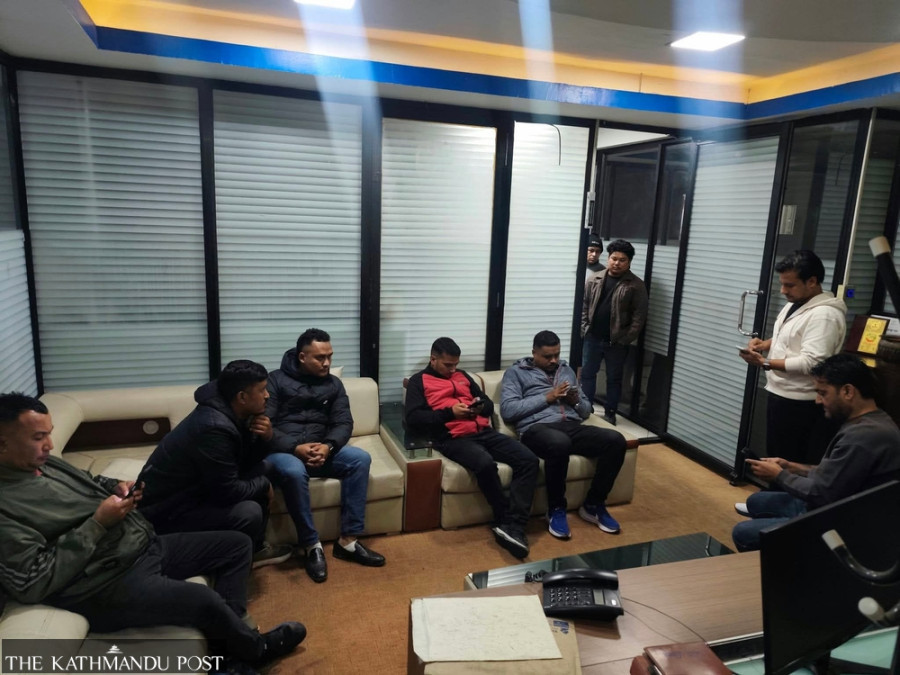
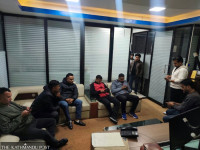
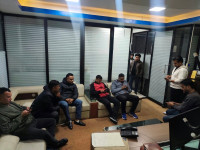
Plainclothes officers barged into the offices of several media outlets and detained three journalists and attempted to take others into custody on Friday, prompting widespread condemnation. Plainclothes policemen and journalists pictured at Naya Patrika daily's newsroom on Friday. Yam Bam's Facebook
Police entered the offices of several media outlets and detained journalists in an apparent attempt to identify the sources of news reports. They have not clearly explained why the journalists were taken in for questioning.
The action has drawn widespread criticism from political parties, including the ruling Rastriya Swatantra Party (RSP), journalists’ organisations and civil society, with many arguing that complaints about news coverage should be addressed through the Press Council, Nepal rather than police intervention.
On Friday afternoon, police detained Bishwamani Subedi of Nepal Press, Shobharaj Baral, editor of Motive News, and Dhiraj Basnet, editor-in-chief of DNA Khabar. They also spent nearly three hours at the office of the Naya Patrika Daily attempting to take journalist Navaraj Mainali into custody. Following widespread protests, the police team left at around 8 pm. A police team also visited the office of Diyo Post in Anamnagar but left after failing to find its editor-in-chief, Sudeep Bishwakarma.
The Federation of Nepali Journalists condemned the detentions, describing them as an attack on press freedom. Its president, Nirmala Sharma, said using the police administration to target media organisations amounted to a direct violation of press freedom and the constitution.
“This has curtailed freedom of expression. The government cannot evade responsibility by saying it did not know about it,” she said. “If the government was not behind this, it must identify who was responsible for the interference in the media and take action. It cannot simply issue a statement and wash its hands of the matter.”
Police entering newsrooms is a practice that brings to mind even the excesses of the royal regime, she said about the situation in the media following King Gyanendra Shah’s government takeover in 2005.
Shiva Gaunle, a former president of the Federation of Nepali Journalists, also said Friday’s police action harks back to the then king’s autocratic rule.
“The way police entered media offices and tried to identify the sources of news reports reminds us of Gyanendra Shah’s rule,” Gaule told Kantipur. He said detaining journalists to establish their sources violated the spirit of the constitution. “This is a situation in which we have to fight to protect the constitution before we can even begin to defend press and freedom of expression,” he said.
A team from the Kathmandu Valley Crime Investigation Office first went to the office of the online news portal Nepal Press in New Baneshwar. According to Matrika Poudel, the outlet’s editor-in-chief, plainclothes officers initially approached Subedi, saying they had come to meet a colleague. When they asked to speak with him, Subedi stepped outside. Journalists realised he had been taken into custody only after the officers said they were taking him to their office.
Poudel and Nepal Press chairperson Binduraj Lamsal were subsequently summoned to the Cyber Bureau. Following widespread protests, all those taken in were questioned and released on Friday evening.
Poudel said police questioned him about the basis, facts, evidence and sources of the news reports.
“We told them that if we were required to produce the basis, facts and evidence for a report, we would do so before the competent court or the Press Council when asked. No one else has the authority to demand them,” he said.
Poudel added that police had also asked why the outlet was spreading negativity. According to him, officers said they had been called in after being told that the Prime Minister’s Secretariat had not asked for the resignation of the person concerned, and that they should be brought in for questioning to establish how the news had been published.
Baral of Motive News was taken in by a team that approached him with the comment that he made good podcasts. Basnet of DNA Khabar, meanwhile, was asked to report to the police office on the pretext of answering questions about an eSewa number.
At Naya Patrika, journalists asked the officials to produce an arrest warrant or a complaint document. The officials stayed at the newsroom, saying they were acting on “orders from above”. They said they had been sent there on the instructions of Senior Superintendent Santosh Khadka, chief of the Kathmandu Valley Crime Investigation Office. Khadka did not answer calls seeking comment.
Deputy Superintendent Deepak Raj Awasthi, spokesperson for the Nepal Police Cyber Bureau, denied that the journalists had been arrested.
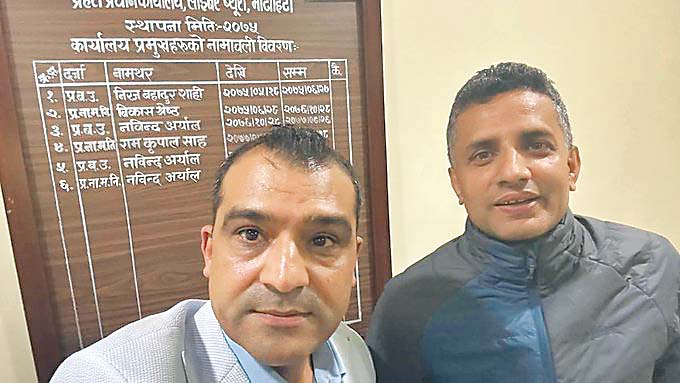
Nepal Press news website editor-in-chief Matrika Poudel (left) and its chair Bindu Lamsal at Nepal Police Cyber Bureau, Friday. Courtesy of Nepal Press
“We called three people in for questioning,” he told Kantipur.
Nepal Press, where Subedi works, had published a report on October 28 claiming that the government had asked Inspector General of Nepal Police Dan Bahadur Karki to resign. The report said Prime Minister Balendra Shah’s secretariat was piling pressure on Karki to step down and that he could be removed if he refused. It linked the alleged pressure to Karki’s contacts with Inam Sapkota, who is under investigation on money-laundering charges.
As reports emerged of the government’s dissatisfaction with Karki’s leadership, a meeting of senior police officials was held at the police headquarters on Thursday. The meeting, attended by senior superintendents and deputy inspectors general and more senior officers available in Kathmandu, lasted five-and-a-half hours.
A statement issued by the police headquarters later said the police would initiate investigations and legal proceedings under existing laws against “the machinations of a few individuals” who, it said, believed they could weaken the police force or drag the security organisation into controversy.
Naya Patrika had published details of WhatsApp exchanges between Sapkota and Supreme Court Justice Hari Phuyal, who is also mentioned in reports concerning the ongoing investigation into Sapkota.
The messages showed Sapkota asking Phuyal to dismiss a petition, claiming that the prime minister had made the request “seriously”. At 10:23 am on September 2, while a hearing was scheduled in a habeas corpus petition filed on behalf of Rohit Gupta, who is accused of banking offences, Sapkota messaged the justice: “Please dismiss it, sir.”
Phuyal replied later that evening, and the messages showed him suggesting a meeting at Hotel Himalaya at around 7 pm the following day.
Diyo Post had published a document bearing the names of Chief Justice Manoj Kumar Sharma and RSP lawmaker Bishwaraj Pokhrel. The document, which allegedly recorded financial transactions, was recovered from Sapkota’s mobile phone. It also carried the stamp of the digital forensic laboratory at the police headquarters.
After the details became public, both Sharma and Pokhrel issued statements denying any connection with Sapkota.
Motive News had also published video reports concerning Karki and Sapkota.
The ruling RSP has itself condemned the police action against journalists. The party said detaining media workers while bypassing established legal and institutional procedures amounted to a blatant violation of the rule of law, particularly when bodies authorised to regulate the media were already in place.
“Attempts to intimidate, place under psychological pressure or restrict the media, whatever the pretext, are unacceptable,” party spokesperson Jagadish Kharel said in a statement. It added that using law enforcement as a pretext to scare the independent press, undermine the standing of media organisations or restrict democratic institutions was incompatible with democratic conduct.
The Prime Minister’s Office, meanwhile, said neither the prime minister nor his secretariat nor office had been involved in the police action, and that they had received no prior information about it.
“The prime minister, his secretariat and the Prime Minister’s Office had no involvement in the detention of journalists and had not been informed about the incident in advance,” said Deepa Dahal, the office’s media management coordinator. She said that as soon as he learnt of the incident, the prime minister had instructed the relevant authorities to release the detained journalists immediately and refrain from entering newsrooms or taking any action against journalists there.
The Press Council, Nepal, at an emergency meeting, also expressed its concern over plainclothes officers entering newsrooms, detaining journalists and attempting to take others into custody.
“The journalists were detained ahead of two consecutive public holidays, even though the reasons for their detention were not made clear, no arrest warrants were shown, no court authorisation was evident, and it was not clear whether any criminal complaint had been filed,” the council said in a statement. “The incident, which followed a statement issued by the police headquarters, has raised serious questions about press freedom and the professional security of journalists.”
Press Council chairperson Umesh Shrestha also told Kantipur that the statement from the police headquarters had used threatening language, warning that investigations and legal action would be pursued over news reports and commentary.
“The council has serious objections to the actions that followed the very next day,” he said. Under the Press Council Act, Shrestha added, the council retains the legal responsibility to investigate, monitor and resolve complaints concerning published material or alleged breaches of journalists’ professional code of conduct.
It was inappropriate, Shrestha said, for police to issue a statement suggesting that they would take action, bypassing the Press Council’s jurisdiction, and then follow through.




 15.54°C Kathmandu