Pushkar Kafle of Jhapa waited a week in Kathmandu for his uncle Jagannath to arrive from Saudi Arabia. In the period, besides meeting his family in the Nepali capital, the Australian returnee shopped for trekking kit for two. After Jagannath landed in Kathmandu one night in early October, he had only a couple of hours’ sleep before flying to Pokhara the next morning. From the airport in the lake city, they dashed to Hari Chowk, where they could catch a jeep to Jhinu Danda, the starting point for a five-day trek to the Annapurna Base Camp at 4,130 metres above sea level. During the ride, the two close relatives had a lot of pleasant talk, as they had met after a long time. They would have a memorable trip together, spend a couple of days in Pokhara, and then go home to Jhapa for Dashain, the biggest festival for Nepalis.
“If we’d gone to Jhapa right away from Kathmandu, we’d miss this opportunity amid the festive rush back home,” Pushkar explained, telling me about their decision to take a week off before heading back home.
Early this month, my nephew arrived from Canada after a decade of migrating there. As he prepared for the trip back to Nepal, he told me about his plan to trek in the Annapurna region while his wife and two children headed to Biratnagar after a few days of familiarising themselves with the weather in Kathmandu. I accepted his offer to join him on the trip, arranged my leave, but made almost no preparations, probably because of my excusable business or my doubts about a long trip at a time of the devastation caused by the Bhotekoshi flash flood and the subsequent spell of nationwide rainfall that snapped highways in places. Instead, we got busy preparing to host them.
After Narayan’s family landed in Kathmandu and they were done with the formalities of visiting the Pashupatinath temple and some relatives here, we split up on our journeys to the eastern Tarai and the western hills. On the morning of October 5, we were relieved to find a tourist bus near Thamel and amazed to be in Pokhara in the afternoon after a largely hassle-free ride. Even then, I wasn’t fully sure we’d be trekking to the Annapurna Base Camp.
After we checked into a Lakeside lodge, we bought some trekking essentials, including sticks, a rain cover and a set of medicines and ORS. I made do with my ordinary bag and shoes.
Seeing so many trekkers, most of them foreigners, made me realise that we were out for some valuable experience. Crossing the footbridge offered a welcome sensation of a stream flowing through a deep gorge, its rumble creating a hill vibe. The steep climb across the suspension bridge under a high sun was an initial stumble, but nothing after that was as daunting. The beelines of trekkers up and down hinted at crowding on a narrow trail with lodges few and far between. After a late lunch at Chhomrung atop, we made frantic calls for some accommodation that night. We could book nothing in the upper ridges, but for the following evening, we found a place for four at Lower Sinuwa.
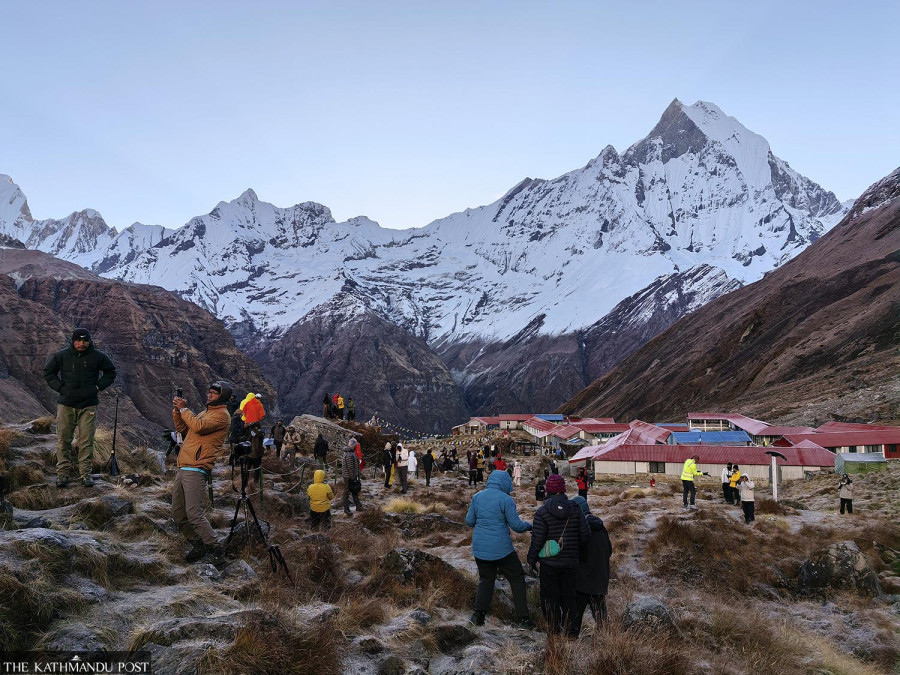
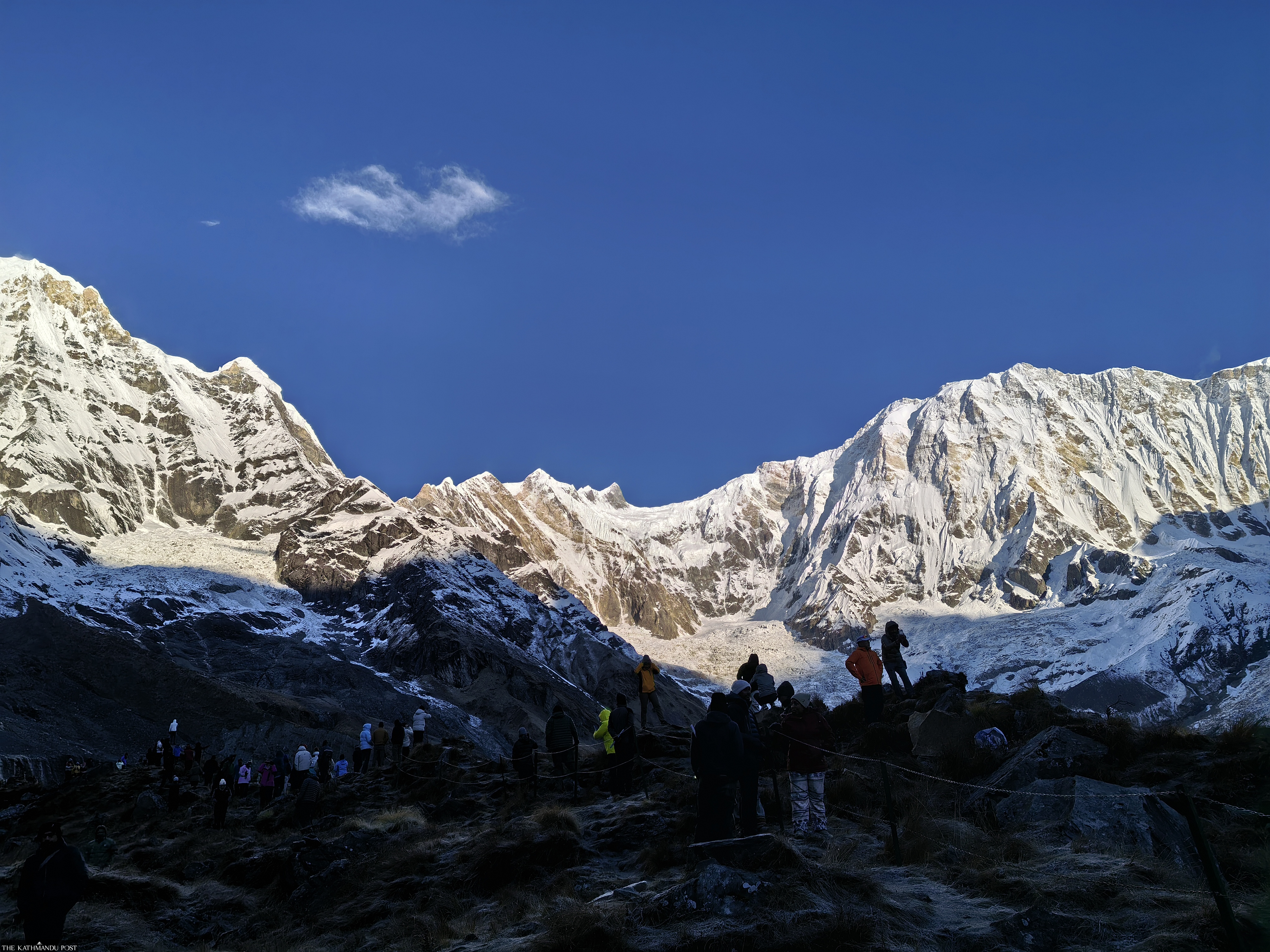
Foreigners pose for pictures at the ABC.
As we descended, the first rain greeted us, bringing chill after an extreme climb under the sunshine. I wasn’t sure my legs would carry me after nearly two decades of city life with little outdoor activity. Wrapped in a rudimentary plastic outfit, I followed the three companions as they stayed ahead.
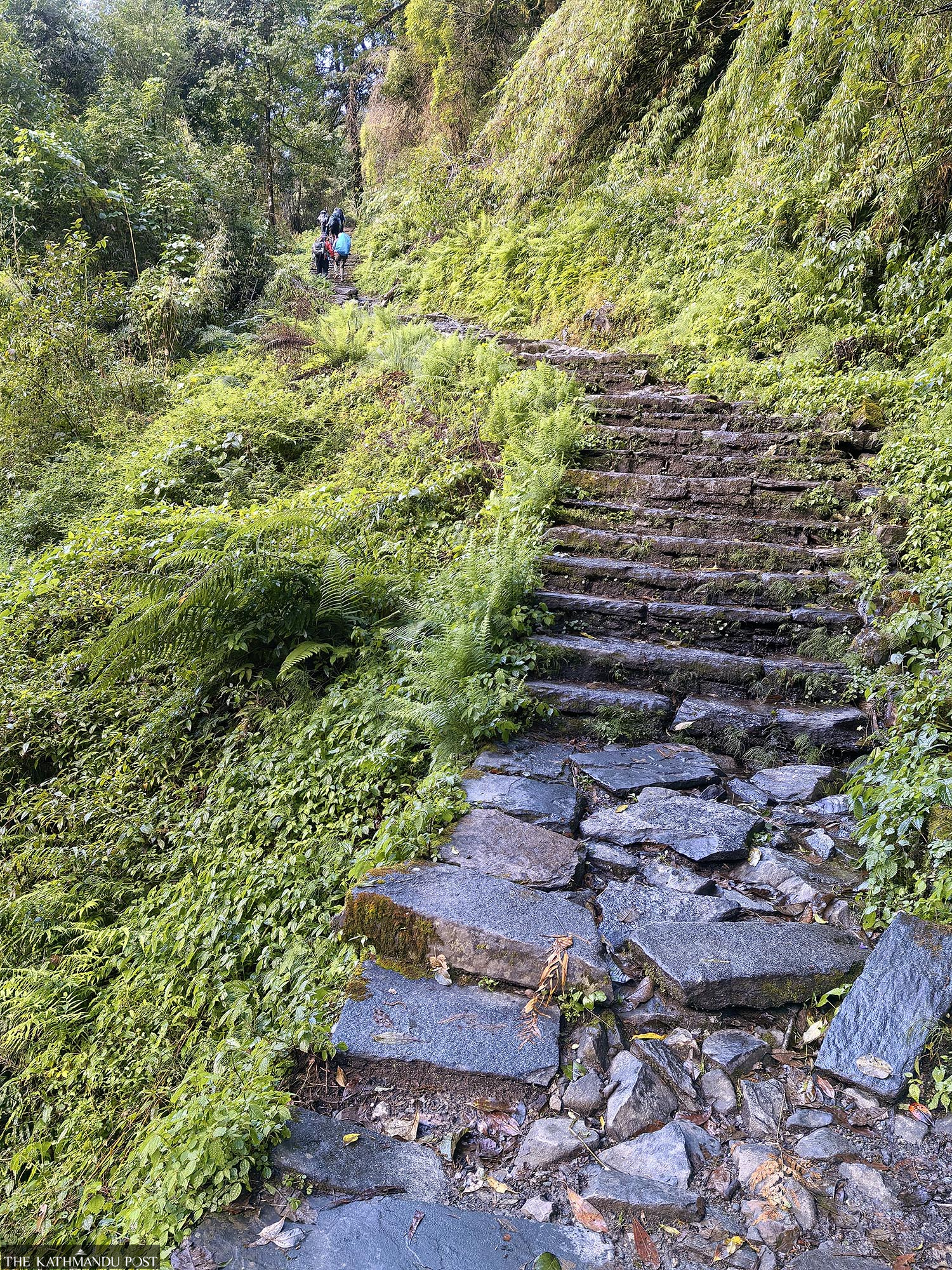
The drizzle and the scenic pastoral setting created a whole new ambience, one I hadn't felt in a long time. My early life was quite like this: no roads, no TV, no television. The rain made it hard to take out the phone and snap pictures, but the darkening clouds over the mountain peaks had already dampened the mood. All that mattered now was to keep going, safely down the stepping stones that had become wet, muddy and slippery.
A mule train crossed us, bringing diesel for an excavator deployed at a hydropower project site. Negotiating with mules and horses carrying tired trekkers is a basic skill; without it, you could be thrown off the trail.
At lower Sinuwa, the inn-keeper warmed us with black tea and an early dinner. The meal tasted extra delicious, rich in vegetables and given our hunger, but as we climbed, supplies grew scarcer, and meals became monotonous, with just rice, dal, and potatoes served. At the first stop, we were lucky to find a dormitory, which lacked the amenities of a room.
After the next morning’s climb and descents, we made it to Dovan by noon. We had been promised a place for two, but what they showed us there repelled us. Besides, we still had half the day for the walk. We decided to go further and try our luck with lodging closer to Machhapuchchhre Base Camp, our third-day stopover.
The ABC trail constantly renews its promise to visitors. Right where the climb begins, a stretch away from the Dovan lodges, a sprawling, cascading waterfall captivates the beholder. At the Chhahara, two rivulets meet, hence the name Dovan. Rain mingled with the falling streams and dropped into the gorge, creating a confusing roar of colliding currents.
The trail runs close to rivulets fed by snowmelt.
Our second night on the trail was forgettable. We enquired with the owners of all four lodges at Himalaya but moved on without finding any space. After taking multiple flights up a paved trail, the Hinku cave offered respite from the rain and a dim view of guesthouses at Deurali. From here, the trail becomes more difficult, as landslides triggered by days of continuous rainfall in late September damaged it in places. In such places, a walking stick or two comes to a trekker’s rescue. The sticks give both anchorage and leverage on a slippery pass bare of stone slabs and keep the holder in place.
Finding two beds at Deurali proved impossible given the high number of travellers. We insisted on staying in the first place we found, after trying everywhere, in a corner of the dining hall, at the mercy of whatever cushioning the owner could provide. After all, he could not shake us off at that time, in that place and under those circumstances. Here we reunited with the Kafles who had overtaken us earlier in the day.
Tourist guides, including Prakash Bhattarai of Chitwan, complained that too many people were at various trailheads, beyond the guesthouses' capacity. Officials with the Annapurna Conservation Area Project (ACAP), which manages Nepal’s biggest sanctuary and issues permits to foreigners, blamed the overcrowding on the closure of the Annapurna Circuit, which covers Mustang and Tilicho in Manang, due to road damage from floods and landslides.
But after the Circuit reopened, tourists have dispersed again, and the burden on the ABC trail has lessened, ACAP’s Narendra Shrestha told me.
Hoteliers complained that they cannot expand capacity because of strict ACAP regulations. Project officials reason that there are constraints on building in the conservation area. However, they have forwarded the concerns to the authorities in Kathmandu, as only a Cabinet meeting can decide on providing government land to build tourist facilities.
On the third day, we didn’t have a long walk. Just until the MBC. A trek at an altitude of 3,700 metres is a hide-and-seek between heat and cold. Heat from the walk, cold from the snowy mountain ridges. I had to double down on my clothing midway, fearing my chest would be overexposed to the chill, especially with my cough. I got up here without swallowing a single medicine tablet or making an ORS solution.
We were done walking for the day after reaching the MBC, but it felt eerily quiet. The cheering mountains were shielded from sight by hovering clouds. Some porters and guides talked about reaching Annapurna Base Camp in the evening to see the mountains if the weather cleared and the sun shone. As there were no such signs and time passed, the four of us tried to keep warm in beds placed closely in a room we shared. My head felt heavy in the gloomy atmosphere. A group of foreign tourists did all sorts of tricks to amuse themselves: playing music on a portable speaker, singing songs, or even taking beer cans.
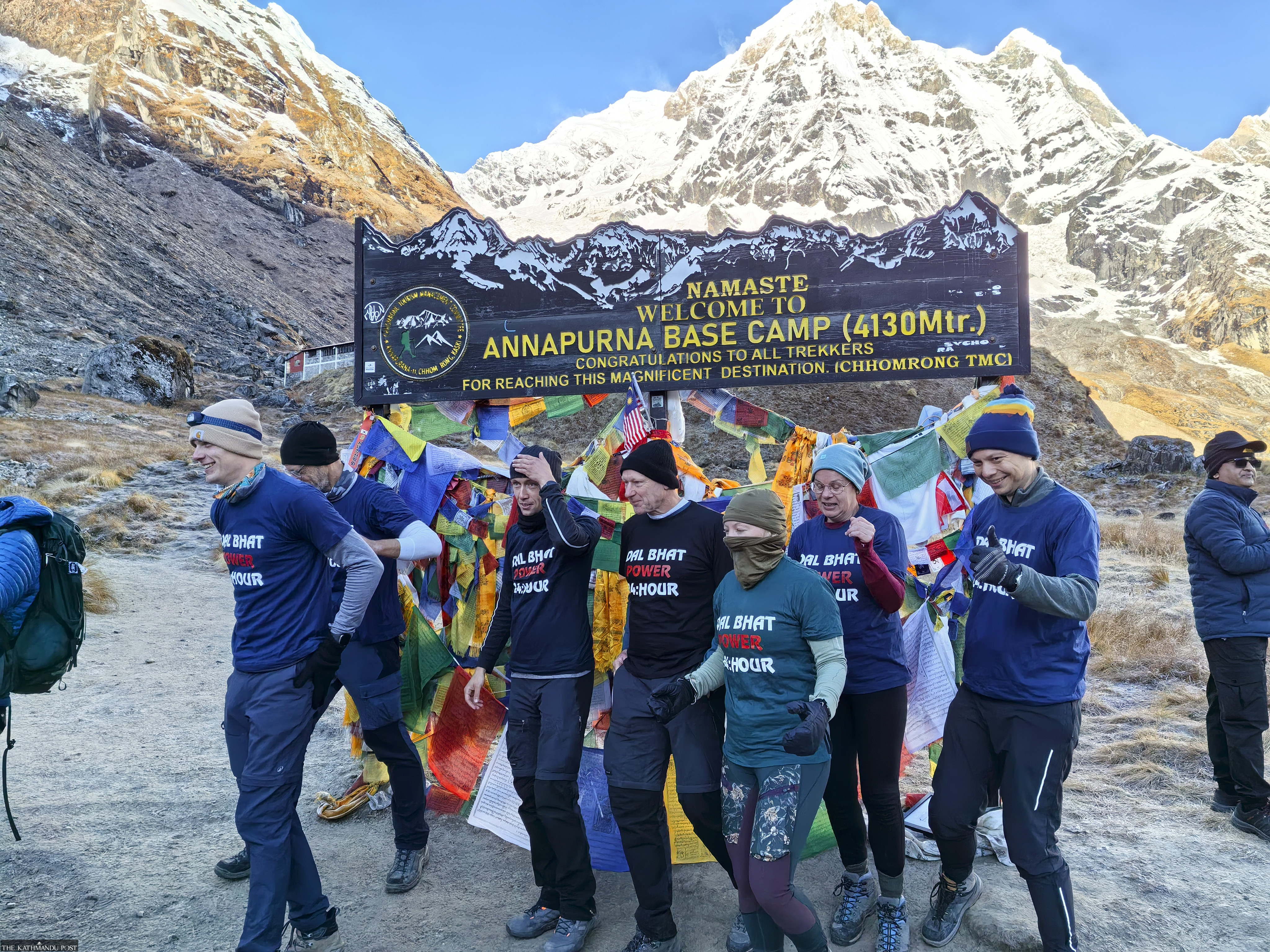
I learnt about the trek all on the way. We heard people say that there could be a clear weather window right after dawn. So we got up in the wee hours and left the camp by 3:30 am. We were at the ABC before sunrise. At the foot of the mountains, a 360-degree view of Annapurna I, Annapurna South, Gangapurna, and Machhapuchchhre kept us hooked. This was our goal. The takeaway was to click as many photos and videos as possible.
Seeing so many tourists at the mountain base felt encouraging for a Nepali. Tourism is one of Nepal’s main hopes, but the industry constantly takes blows one after another. One time it’s an aviation disaster; another, a catastrophic flood, right when the sector is trying to stand up after the pandemic slump.
Twin disasters struck Nepal’s Himalayan region starting August 26 this year. Tourism management officials feared visitor numbers would be hit, but permits issued are at the same level as last year. According to Shrestha, IT in-charge at the ACAP Office in Pokhara, numbers picked up after October.
By Nepali standards, spending on the ABC trail by all tourists is moderate. Indian tourists are notorious in Nepal for spending little, as they travel in vehicles brought across the border and often cook on the way. On the ABC trail, Indian tourists account for a third of all trekkers. Most are young people who buy their food and accommodation up and down the trail.
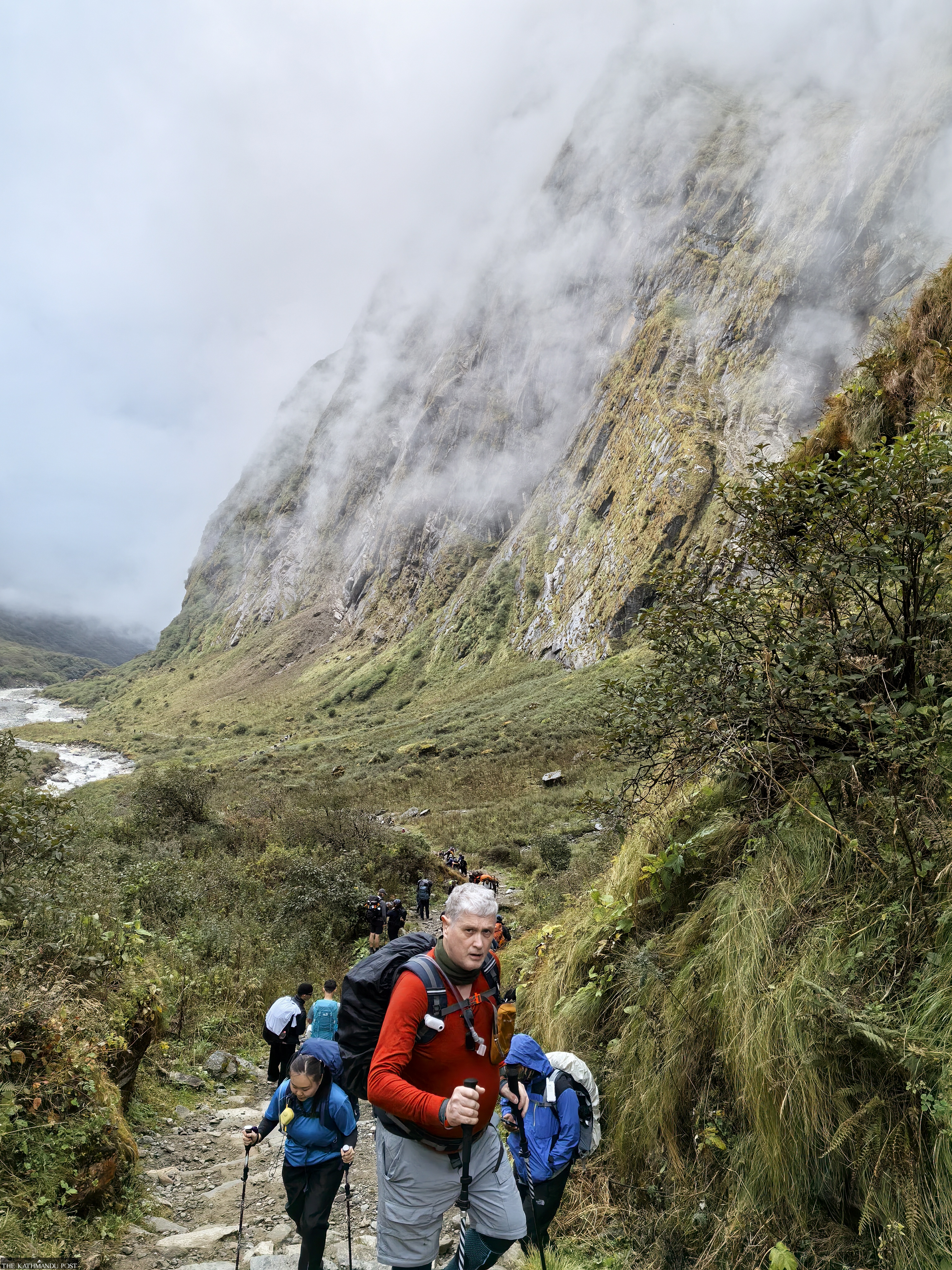
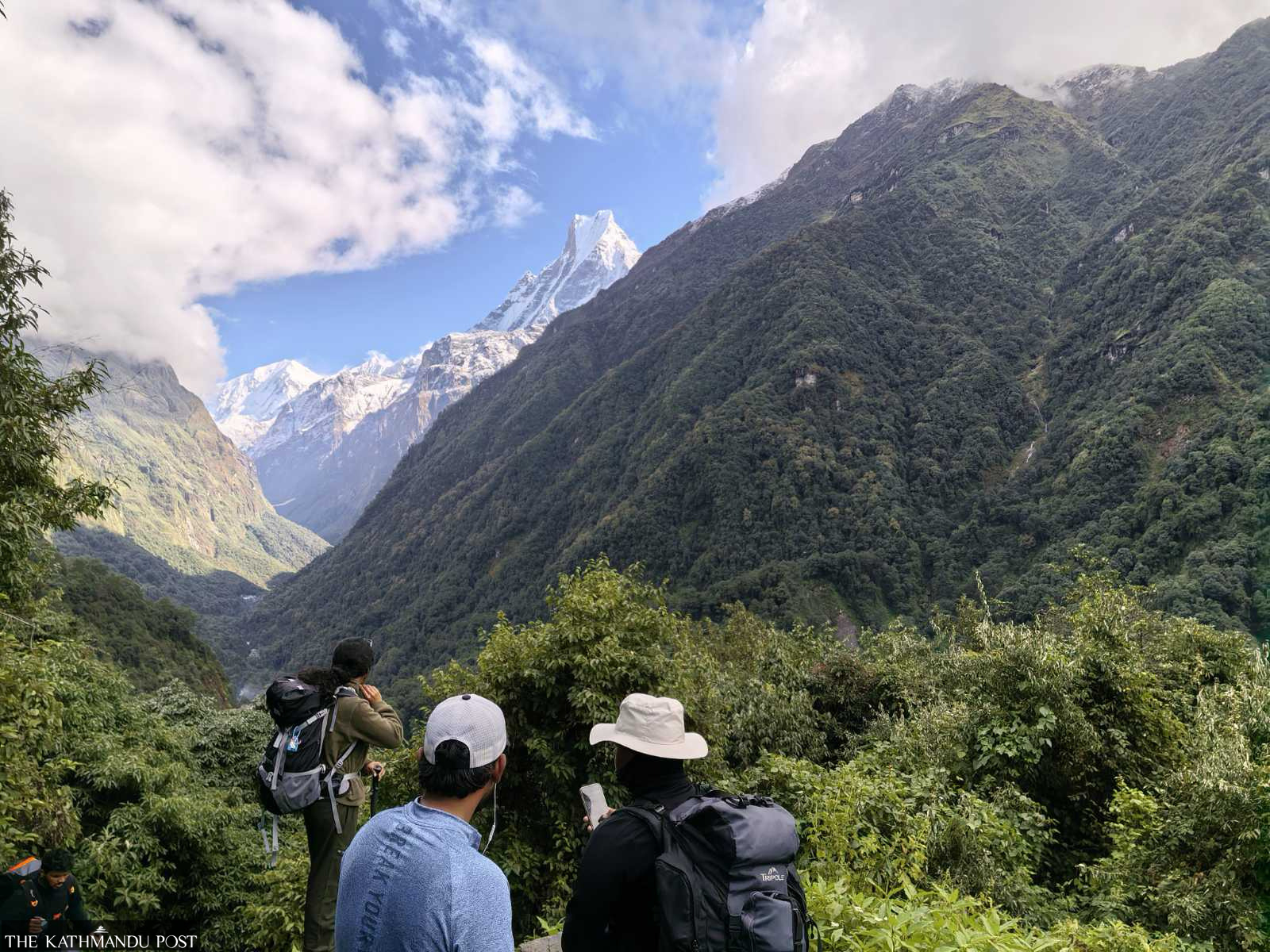
Walking on the trail against the backdrop of Mt Machhapuchchhre.
According to ACAP statistics, total trekkers on the ABC trail numbered 18,236 as of Friday noon. They included 11,973 foreigners, 6,070 nationals from SAARC countries—5,606 of them Indians. Last year, ABC trekkers in the corresponding period of October were recorded as 12,485 foreigners and 6,652 SAARC nationals, including 6,323 Indians.
The count does not include independent Nepali trekkers, but this season the ACAP office in Chhomrung has been issuing permits to Nepali nationals, excluding guides and porters, after charging Rs100 per person for data management. As of Friday noon, such permits numbered 156.
One Indian tourist felt particularly close to me at the ABC. Shan Chakravorty of Assam grew up in a Gorkha-dominant village there and spoke flawless Nepali.
After breakfast and checking out at the MBC, we were back at Dovan in the afternoon. The descent felt easier because we had accomplished our mission and gotten familiar with the trail. The place we had booked this time was decent. There, we had a frank conversation at the dining table, mostly with Bangladeshi college graduates and a fresh French police recruit. They were interested in knowing about Prime Minister Balendra Shah, and we asked about the politics in Dhaka. When India comes between Nepal and Bangladesh, particularly in trade matters, that’s geopolitics. Student protests are raging in France as Emmanuel Macron, an unpopular president, is about to leave office. Marine Le Pen could be his successor as a right-wing wave sweeps Europe, Marthon Hugo, the aspiring police officer, confirmed.
The trek restored my lost confidence in my physical strength. It gave me some mental peace and calmed my emotions. The trek repaired my inner self. We sighed with relief that we came back unscathed.
At the ABC, a foreigner’s expression at my response still lingers in my mind. She was surprised to learn I had been at the base of a mountain for the first time. Mountains are ubiquitous in Nepal. “We Nepalis don’t care too much for the mountains.”
Mohan Guragain is a desk editor at The Kathmandu Post. He edited a provincial youth-oriented monthly paper for nearly two years before joining The Himalayan Times in 2008. Guragain also writes occasionally on politics and socio-economic issues. He joined the Post in 2010.




 17.57°C Kathmandu