In ‘Ka Kaa Ki Kii’, the basics are there, the fluency not quite
Vicky Agrawal and Shraddha Prasai’s bank-heist comedy is easy to sit through, but a weak screenplay keeps it from being more. Actors Mahesh Tripathi, Rekha Thapa and Tripti Nadkar in a scene from the film. Screengrab from YouTube
‘Ka Kaa Ki Kii’ is one of the first exercises Nepali children undertake when learning to recognise and write letters. There is a distinct pleasure in the rhythm the syllables produce when read aloud. This is perhaps why this exercise has endured, passed down through generations. Does ‘Ka Kaa Ki Kii’, co-directed by Vicky Agrawal and Shraddha Prasai and released last Friday, offer a similar delight?
Both directors come from a comedy background. Given that the film is a social comedy, audiences can reasonably expect a good dose of humour. Nepali films rarely live up to the promise of their titles. In this case, however, the reason behind the unusual title becomes clear at a particular point in the story, and the explanation feels both logical and justified. Still, unlike Agrawal and Prasai’s comedy shows, the film offers few opportunities for unrestrained laughter.
Some sequences are clearly designed to provoke laughter but feel neither fresh nor original. They seem borrowed from situations already explored in Bollywood comedies. Nevertheless, the film regularly maintains an atmosphere of gentle amusement.
The screenplay, however, rests on a weak foundation. The central idea is intriguing, but the film struggles to establish it convincingly. Kulebari village is gripped by extreme poverty. With no hospital in the area, residents continue to die because they cannot access medical treatment. Building a hospital would cost millions of rupees, so the villagers hatch a plan to travel to the city and rob a bank to raise the money.
For people who barely have access to motor vehicles, let alone the means to travel comfortably, this is an extraordinary ambition. But how did the villagers reach a point where robbing a bank seemed their only option? The screenplay fails to make this predicament believable. Consequently, the central conflict lacks force. The audience never fully connects emotionally with the villagers’ struggle to survive without medical care. Deeya Maskey’s character, for instance, has the potential to leave a lasting impression, but the screenplay does not do enough to deepen her emotional journey.
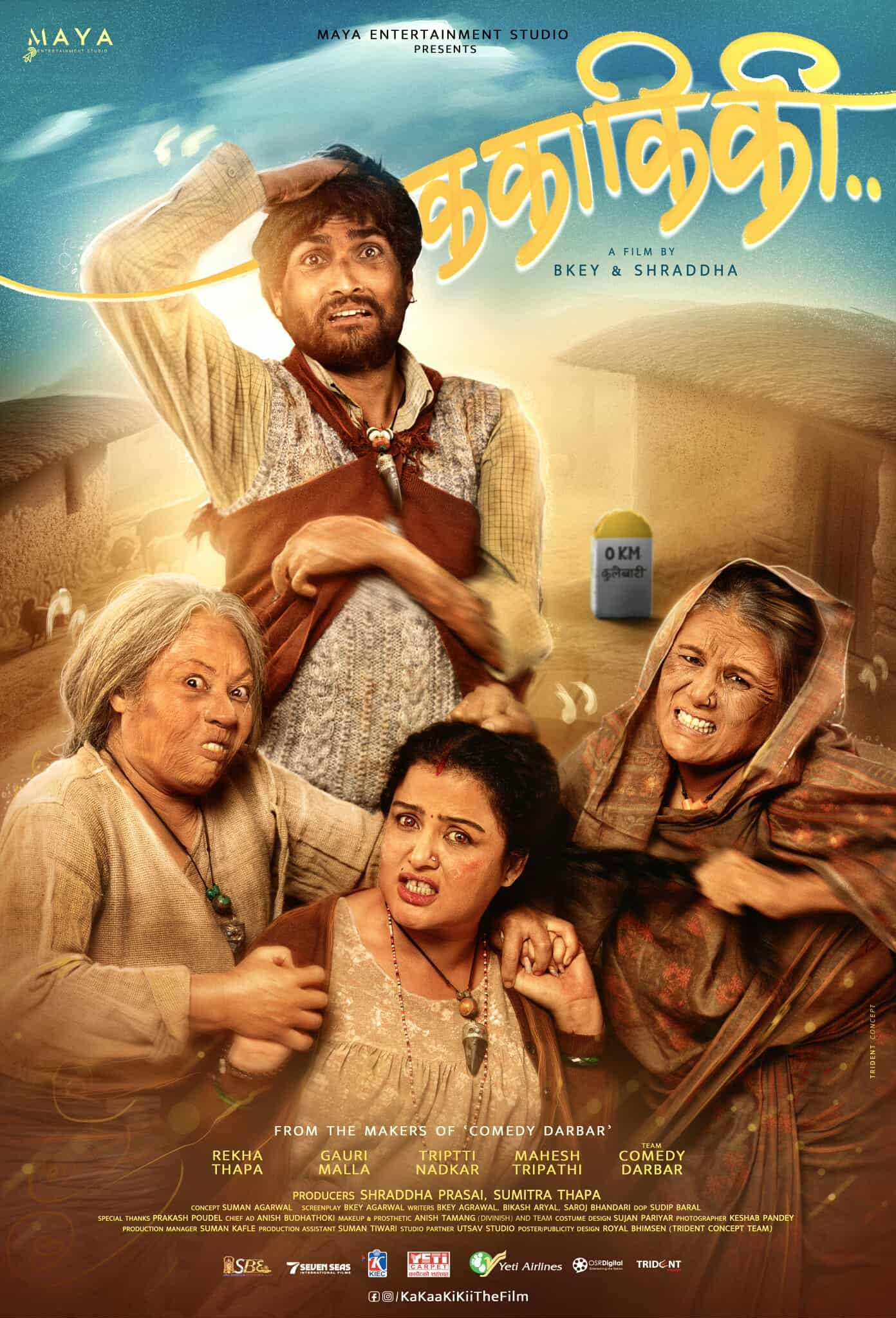
The film also tries to tell too many characters’ stories, slowing its pace. Four characters carry much of the narrative: Bhola (Mahesh Tripathi), Kamala (Rekha Thapa), Jhupri (Tripti Nadkar) and Ranke Budhi (Gauri Malla). Yet the story often loses sight of the purpose that drives their struggles. Instead of progressing through its scenes, it remains caught in the village’s surroundings. The pace picks up once the characters reach the city, where unfolding events sustain the audience’s curiosity. The climax is entertaining, although it does not feel particularly realistic.
While the directors make several scenes amusing, they pay insufficient attention to the logic and reasoning behind them. The flashbacks, in particular, disrupt the narrative flow.
There are also inconsistencies in the film’s visual details. While other characters are dressed in thick, full-sleeved clothes, why is the person holding an umbrella over the village chief wearing a thin vest? The story is set in a cold village, making the choice even more puzzling. The chief himself is neither entirely positive nor negative. Yet the film offers no convincing explanation for why the umbrella bearer remains in the same outfit throughout.
A twist in the story’s resolution, however, gives the film an emotional turn and succeeds in moving the audience.
The film's first-look poster. OSR Digital's Facebook
The dialogues are among the film’s stronger elements. They are entertaining and infused with humour, preventing the narrative from becoming tedious. At times, however, jokes about characters’ physical conditions and the use of double entendres feel uncomfortable. In such moments, the writer’s presence becomes more pronounced than the characters themselves.
The characterisation of the principal figures also needed greater attention. Bhola’s personality and behaviour are rooted in his upbringing, allowing viewers to connect with his decisions and experiences. Ranke Budhi, on the other hand, is not as convincingly developed. Why does she live near the cremation ground? Why does she attack villagers whenever a body is brought there for cremation? The film offers no satisfactory answers. Although it takes viewers through her past in a flashback, the explanation behind her behaviour is hardly convincing.
Similarly, Kamala is presented as rebellious and courageous, but the motivations behind her defiance remain unclear. Her rebellion within the household could have been developed more convincingly.
The relationship between Jhupri and Ranke Budhi, by contrast, is established with greater credibility. Even so, one cannot help wondering whether the flashbacks used to explain their relationship were necessary.
The performances help hold the film together, although the characters’ accents do not always suit their surroundings.
Mahesh Tripathi delivers a particularly noteworthy performance as Bhola. He captures how the character’s upbringing has shaped his personality and state of mind. Whether through his accent or physical mannerisms, Tripathi disappears into the role. Bhola’s dialogue and decisions do more than generate laughter; they also create moments of genuine emotion.
Gauri Malla’s portrayal of Ranke Budhi, however, lacks the naturalness the role demands. Her performance feels exaggerated throughout the film. Although the screenplay attempts to justify the character’s behaviour, her makeup also seems out of place in the circumstances depicted.
Rekha Thapa’s accent is inconsistent. Her mannerisms feel natural in ordinary situations, and she generally fits the character. But when Kamala makes important decisions, Thapa herself seems to take over, leaving the character less convincing.
Tripti Nadkar’s accent and dialogue delivery also feel out of sync with the situations. The film attempts to explain her distinct manner of speaking through the character’s background, but does not adequately account for how she might have changed over time. Meanwhile, Diya Maskey, Maotse Gurung, Prakash Ghimire, Shishir Bangdel and Rear Rai, among others, contribute performances that help lend the film a degree of naturalness.
The background score is another strength. Its sounds and rhythms reflect the village setting and the changing circumstances of the story, keeping viewers engaged. The music is particularly effective in establishing the passage of time and the atmosphere of different situations.
The cinematography also brings certain dark moments to life, particularly the death of a young girl and her mother’s suicide.
Unlike many Nepali films, ‘Ka Kaa Ki Kii’ is not difficult to sit through. But unnecessary detours and inconsistencies in the story prevent it from becoming a more potent work of art. Still, considering that it marks a defining ‘Ka Kaa Ki Kii’ moment in the directing duo’s careers, one can hope they will bring greater maturity and refinement to their next project.




 15.12°C Kathmandu