Nepal and Bhutan propose dedicated COP31 agenda on 1.5°C warming in mountain regions
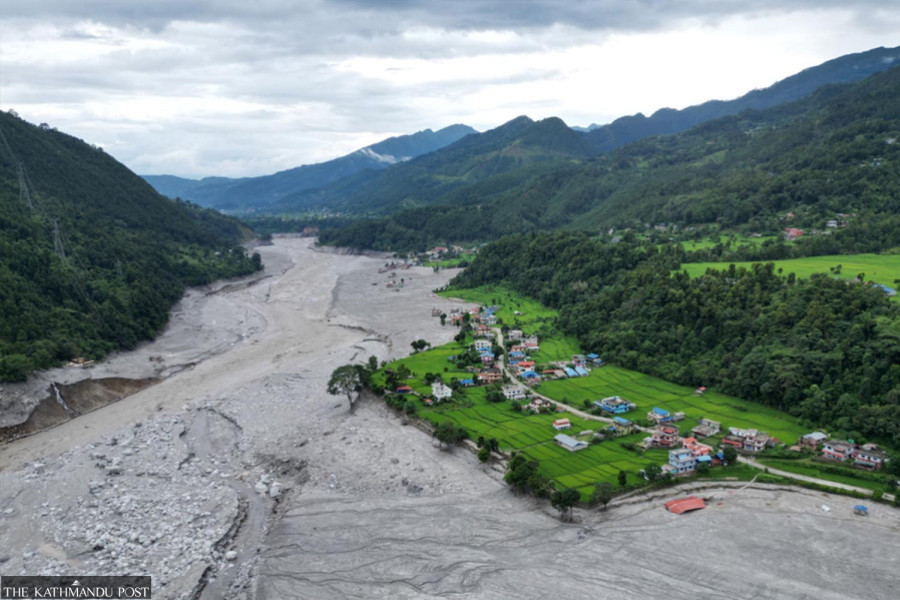
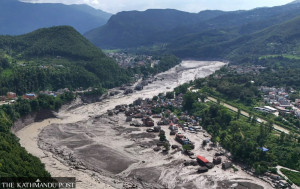
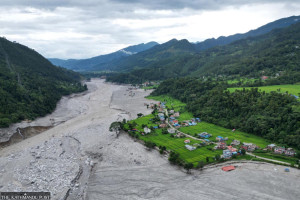
In a formal submission addressed to the UNFCCC, the Himalayan nations urge the inclusion of the proposed agenda item in the supplementary provisional agenda of COP31. A town in Batrawati, Nuwakot, eaten into by the Trishuli river in a flash flood triggered by a glacier collapse in the Langtang-Lirung mountain in August. Post file photo
Nepal and Bhutan have jointly proposed the inclusion of a dedicated agenda item titled “1.5°C Warming in Mountains” at the 31st Conference of the Parties (COP31) to the United Nations Framework Convention on Climate Change, calling for stronger international action to address the escalating impacts of climate change on mountain ecosystems and communities.
In a formal submission addressed to the COP president, incoming COP president and executive secretary of the UNFCCC, the two Himalayan countries have urged the inclusion of the proposed agenda item in the supplementary provisional agenda of COP31. The Post has obtained a copy of a letter sent by Minister for Agriculture, Forest and Environment Gita Chaudhary.
“On behalf of the Government of Nepal and the Royal Government of Bhutan, I have the honour to submit, in accordance with Rule 12 of the draft Rules of Procedure of the Conference of the Parties, a proposal for the inclusion of a supplementary provisional agenda item entitled “1.5°C Warming in Mountains” at the thirty-first session of the Conference of the Parties to the United Nations Framework Convention on Climate Change (COP31), to be held in Antalya, Türkiye, from 9 to 20 November 2026,” reads the letter sent by Chaudhary.
The proposal highlights the growing scientific evidence of accelerated warming in mountain regions, particularly the Hindu Kush Himalaya (HKH), and warns that rising temperatures are threatening glaciers, biodiversity, water security, food systems, energy production and the livelihoods of millions of people.
The submission argues that mountain ecosystems require greater institutional recognition within the global climate negotiation process, given their critical role in sustaining human populations and maintaining ecological balance.
Mountain regions are warming rapidly, exposing glaciers, snow cover, permafrost and fragile ecosystems to increasingly severe and potentially irreversible changes. The proposal warns that such changes could push adaptation capacities beyond their limits, threatening mountain communities, critical infrastructure and regional economies. The submission emphasises that mountain ecosystems are indispensable to global environmental stability and human well-being.
Mountains serve as the sources of major river systems, supplying freshwater to more than two billion people across Asia and beyond. According to the joint submission, these river systems are essential to water, food, energy and health security, connecting mountain ecosystems with downstream populations and coastal regions.
Mountain regions also cover nearly a quarter of the Earth's surface, support approximately 15 percent of the global population and contain around 50 percent of the world's biodiversity hotspots. Beyond their ecological significance, mountains preserve indigenous cultures, traditional knowledge, unique languages and community-based adaptation practices, the two South Asian nations said.
The proposal underscores the interdependence between upstream and downstream communities, highlighting how changes in glaciers, snowpack and permafrost can affect downstream water availability, agricultural production, hydropower generation and disaster risks.
Mountain ecosystems, particularly those of the Hindu-Kush Himalaya and other high-mountain regions, face growing risks of extreme weather events, reads the letter jointly sent by Nepal and Bhutan.
These impacts endanger the lives and livelihoods of mountain communities and carry far-reaching consequences for the water, food, energy and economic security of billions of people living downstream. The growing frequency and severity of climate-induced disasters further underscore the urgent need for enhanced adaptation, strengthened transboundary cooperation, and equitable access to climate finance and support for loss and damage, reads the letter.
The proposal draws its legal foundation from the preamble and Article 4.8 of the UNFCCC, which recognise the specific needs and vulnerabilities of countries with fragile ecosystems, including mountain ecosystems. It also aligns with international commitments on sustainable mountain development, including Chapter 13 of Agenda 21, United Nations General Assembly Resolution A/RES/71/234 and the Sendai Framework for Disaster Risk Reduction 2015–2030.
The proposal is grounded in the obligations and principles of the Convention, in particular its Preamble and Article 4.8, and bases its observations on the relevant assessments of the Intergovernmental Panel on Climate Change (IPCC), the outcomes of recent UNFCCC negotiations, and the political momentum generated by the Sagarmatha Sambad and its Sagarmatha Call for Action of May 2025. It further seeks to advance the outcomes of COP30 and of the Dialogue on Mountains and Climate Change convened in June earlier this year.
Nepal and Bhutan propose that COP31 consider advancing scientific understanding of the impacts and risks of 1.5°C warming and of potential temperature overshoot in mountain regions; institutionalising an annual high-level dialogue on mountains and climate change; initiating a process towards a dedicated UNFCCC Work Programme on Mountain Ecosystems; and integrating mountain-specific priorities into adaptation frameworks, climate finance arrangements and loss and damage mechanisms.
The proposal stresses that a dedicated agenda item could strengthen the collective response of the international community to mountain-related climate risks, and foster solidarity between upstream and downstream countries.
Nepal and Bhutan have expressed their readiness to engage constructively and in a spirit of consultation with all parties, the presidency and the secretariat.
The declaration of 2025 as the International Year of Glaciers' Preservation and the International Decade of Action for Cryospheric Sciences (2025–2034) further demonstrates the growing international recognition of the importance of protecting mountain and glacier systems, the document states.
Citing findings from the Intergovernmental Panel on Climate Change, including the Special Report on the Ocean and Cryosphere in a Changing Climate and the Sixth Assessment Report, the submission stresses the urgent need to limit global warming to 1.5°C and avoid temperature overshoot.
It calls for stronger transboundary cooperation, coordinated disaster risk reduction, improved early warning systems and systematic data sharing among countries sharing mountain river basins.
Recent disasters in Nepal, including the Melamchi floods in 2021, the Kathmandu and Thame events in 2024, the Ilam disaster in 2025 and the Bhote Koshi catastrophe in 2026, demonstrate the growing exposure of mountain communities and infrastructure to extreme rainfall, floods, landslides and cryosphere-related hazards.
The submission highlights the Bhote Koshi disaster as a particularly serious example of the economic consequences of climate vulnerability in mountainous developing countries.
Citing Nepal's National Disaster Risk Reduction and Management Authority, the proposal states that $4.7 billion, equivalent to around 10 percent of the country’s gross domestic product, would be needed for the reconstruction of property and infrastructure damaged in the flash flood triggered by a glacier collapse.
The countries argue that these events demonstrate the urgent need for enhanced adaptation measures, risk-informed development, regional cooperation and equitable access to climate finance, particularly funding for addressing loss and damage.
They also emphasise that the impacts of climate change extend beyond economic losses, affecting cultural heritage, traditional livelihoods, indigenous knowledge and the social fabric of vulnerable mountain communities.
In the proposed agenda item, Nepal and Bhutan have identified four major areas for consideration by the international climate community. Advancing scientific understanding of 1.5°C overshoot in mountains; institutionalising an annual High-Level Dialogue on Mountains and Climate Change and mountain-related priorities within the UNFCCC process; establishing a dedicated UNFCCC Mountain Work Programme and integrating mountain priorities into global climate finance and adaptation frameworks.
These would help ensure that mountain countries and vulnerable communities receive adequate, predictable and equitable support to address climate impacts and strengthen resilience.
Anil Giri is a Chief Sub Editor covering diplomacy, international relations and national politics for The Kathmandu Post. Giri has been working as a journalist for more than two decades, contributing to numerous national and international media outlets.




 16.66°C Kathmandu