Wagle unveils sweeping tax reforms, privatisation plans and major infrastructure targets, but critics question the record borrowing and feasibility of achieving 7 percent growth amid economic fragility.
The new government under the Balendra Shah administration on Friday unveiled an ambitious Rs2.12 trillion annual financial plan for the fiscal year 2026-27, beginning mid-July, prioritising infrastructure expansion, structural reforms and tax overhauls despite mounting resource constraints and growing concerns over debt sustainability.
The budget has cheered the middle class through sweeping income tax relief and reform-oriented policies, but critics say it has failed to adequately address the concerns of low-income groups struggling with high inflation triggered by the West Asia crisis.
The bloated budget is 8.15 percent bigger than the ongoing fiscal year’s original allocation and 25.2 percent larger than the revised estimate presented by the Sushila Karki-led interim government during the mid-term review.
Of the total allocation, Rs1.27 trillion or 59.8 percent has been earmarked for recurrent expenditure, Rs431.1 billion or 20.3 percent for capital expenditure, and Rs422.64 billion or 19.9 percent for financial management.
To finance the estimated expenditure for the upcoming fiscal year, the government plans to raise Rs1.4 trillion from revenue and Rs61.74 billion from foreign grants, leaving a financing gap of Rs657.29 billion.
To bridge the shortfall, the plan is to mobilise Rs247.28 billion through foreign loans, while the remaining Rs410 billion will be financed through domestic borrowing.
As Rs245.89 billion in domestic debt principal repayments become due in the next fiscal year, the net domestic borrowing will amount to only Rs164.11 billion, according to the budget statement.
With the new financial outlay, the government has targeted an annual economic growth rate of 7 percent while aiming to cap inflation at 6 percent.
Lawmaker Niskal Rai of the Nepali Congress, the main opposition party, criticised the size of the budget and the scale of proposed borrowing.
“The National Planning Commission had set the proposed budget ceiling at Rs1.89 trillion. This is way higher than the prescribed limit,” he said.
“Looking at the sources of financing, the government aims to raise huge amounts through foreign loans. This is the highest amount of foreign borrowing ever proposed, and adding national borrowing, it would increase the per capita debt burden of a Nepali to over Rs120,000.”
Critics also pointed out that Finance Minister Swarnim Wagle himself had repeatedly criticised the ballooning internal and external debt accumulated by previous governments before joining the Rastriya Swatantra Party (RSP).
RSP leaders had publicly pledged to cut aid dependency and limit excessive borrowing.
However, critics say the current budget contradicts those commitments by proposing large-scale external and domestic borrowing.
Wagle is widely viewed as a prudent economist with strong academic and institutional credentials. Besides his national and international career at reputed institutions, including the United Nations, he is now serving as finance minister in what many describe as one of the most powerful governments in Nepal’s contemporary political history.
Economists and former finance ministers argue that the budget size is unnecessarily large and that the resource mobilisation targets appear overly ambitious given the country’s fragile economic condition. They also say extensive tax concessions, grants and exemptions have made the budget highly unrealistic.
But some observers say the financial plan marks a major positive departure from conventional budget-making practices after the restoration of democracy in 1990.
“Of all annual budgets since 1991, this one has the largest number of reform-oriented policies and programmes,” former finance minister Rameshore Khanal told the Post. “In that sense, this is the most sensible and reform-oriented budget that raises people’s hopes.”
A key highlight of the budget is a broad package of tax reforms aimed at boosting revenue collection, encouraging investment and widening the tax base.
To reduce the tax burden, Wagle announced that the personal income tax exemption threshold would be raised to Rs1 million for individualsfrom the previous Rs600,000 ceiling for married individuals.The existing separate thresholds for married and unmarried taxpayers has been removed.
Under the new tax rates, individual income up to Rs1 million is taxed at 1 percent. Income between Rs1 million and Rs1.5 million is taxed at 10 percent on the additional Rs 500,000, while income between Rs1.5 million and Rs2.5 million is taxed at 20 percent on the additional Rs1 million. Likewise, income exceeding Rs4 million will be taxed at 29 percent on the excess amount.
This means people earning less than Rs83,333 a month will only have to pay a 1 percent Social Security Tax.
The broad overhaul is expected to provide significant relief to salaried and middle-class populations by increasing disposable income and easing financial pressure.
But questions remain over what the budget offers to the poor and vulnerable sections of society most affected by soaring prices following the US-Israeli war on Iran.
Former finance minister Yuba Raj Khatiwada said, “This is a middle class-oriented budget. The middle class has been addressed, but the poorest sections have been overlooked.”
“The government aims to cap inflation at 6 percent. When current inflation is around 2.5 percent—if the government maintains a 6 percent target, who stands to be affected? What is the basis for these projections, and how will those affected be compensated?”
“Taxpayers have been given concessions and are largely fine. But what about citizens who do not pay taxes and those living below the absolute poverty line? What additional support have they received? What has increased in social security? Nothing has changed.”
“There is nothing substantive for the poorest, who make up around 20 percent of our population,” Govinda Raj Pokharel, former vice-chairman of the National Planning Commission, told the Post.
The budget has deviated from the track that the RSP had envisioned, what low-income Nepalis had expected, and what such a powerful government could have delivered, he argued.
The government has also addressed one of the private sector’s longstanding demands by reducing taxes on industrial raw materials.
“To ensure that customs duties on industrial raw materials remain at least one tier lower than those on finished goods, I have reduced customs tariffs on 273 types of raw materials. The existing 11-tier customs structure has been compressed into seven tiers,” Wagle told the joint session of Parliament.
“I have abolished excise duties imposed on 360 goods. Scattered taxes such as infrastructure development tax and road repair and improvement fees collected at customs points have been consolidated into a Green Tax.”
The private sector welcomed the budget.
Sur Krishna Vaidya, senior vice-president of the Federation of Nepali Chambers of Commerce and Industry, said the government had incorporated most of the recommendations made by the private sector.
“The provisions in the budget for the coming fiscal year are welcome, and with a stable government in place we hope the announced measures will be effectively implemented,” he said.
“The increase in income tax exemption for individuals, reduction of customs duties on 273 goods, and removal of excise duties on many products are encouraging for the private sector,” Vaidya added.
Cost cutting and efficiency enhancement have also been projected as key pillars of institutional reform.
“To this end, we will maintain unprecedented fiscal discipline and allocation efficiency while controlling recurrent expenditure. Office operation expenses have been significantly reduced,” Wagle said.
As part of austerity measures, budget allocations for off-site training and related expenses, including cameras, televisions and similar equipment concerning government offices have been removed.The practice of creating separate funds to distribute perks and benefits has been discontinued. Discounts provided to officials and employees of institutions for purchasing goods and services produced by the same institutions have also been withdrawn.
Funds allocated to merged or dissolved agencies have been frozen until staff adjustment and liability management processes are completed.
According to Wagle, these measures are expected to save around Rs20 billion initially.
“At a time when foreign exchange reserves remain comfortable, we have adopted a policy of mobilising a certain percentage into a sovereign wealth fund,” Wagle said.
“We will establish a ‘Motherland Fund’ to invest in strategically important projects such as maintaining fuel reserves sufficient for at least three months and AI factories.”
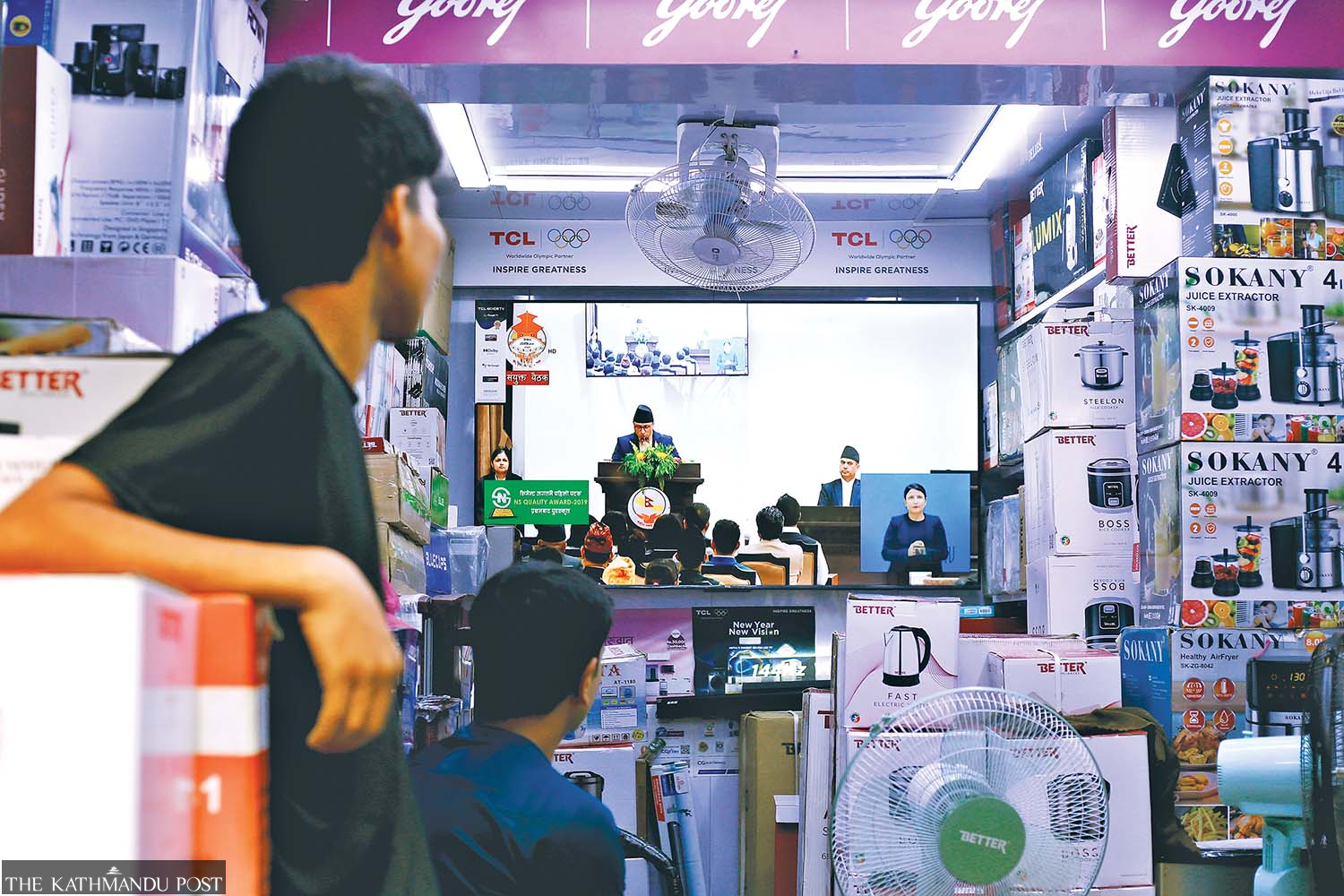
People watch the 2026–27 budget speech on a giant television screen at a home appliances shop in Kathmandu on Friday afternoon. Post photo
From the upcoming fiscal year, the government will also introduce hedging services at appropriate premiums to minimise exchange rate risks in projects financed through foreign loans or investments.
“We will create a favourable economic environment to improve outcomes from the first and second sovereign credit ratings. We will remove Nepal from the anti-money laundering grey list as soon as possible,” Wagle said.
The government has also given high priority to expanding information technology infrastructure.
Among other budget highlights, the government has decided to divest shares of Nepal Telecom. The federal government will retain a 66 percent stake, while the remaining shares will be sold to the public within the next fiscal year. The proceeds will be used to develop Nepal as a “tech hub”.
Provisions have also been introduced to allow overseas investment in the IT service sector.
“Clear legal arrangements will be made to facilitate remote work from Nepal for foreign employers and attract international remote workers,” Wagle said.
Procurement of software used by government agencies will be centralised through a single body. Investment in digital public infrastructure will be increased, while a fintech marketplace will be established under the supervision of Nepal Rastra Bank. Dozens of government services will also be integrated into the Nagarik App.
The long-delayed unbundling of the Nepal Electricity Authority will finally be completed, according to the budget statement.
The authority will be divided into three separate companies responsible for generation; transmission; and distribution and trade.
Licences of projects that signed power purchase agreements but failed to begin construction will be cancelled, and future PPAs will follow a “take or pay” model.
PPAs for projects up to 10 MW capacity will be signed immediately. Electricity purchase rates will also be fixed based on seasonal supply differences during the dry season.
In a major agricultural reform, the government has announced a pilot programme under which farmers investing up to Rs20 million in agriculture and livestock production will receive subsidies of up to 40 percent on initial capital investment.
The subsidy will be reimbursed at 10 percent annually for four consecutive years from the date production begins.
According to the budget statement, genuine farmers will be supported through improved seeds, fertiliser, irrigation, electricity and agricultural insurance while preventing misuse of subsidies.
In agriculture and livestock insurance, subsidies of up to 80 percent will be provided on insurance premiums, while other subsidy programmes will be gradually phased out.
The government has also announced preparations for Visit Nepal Year 2028-29 and Nepal Wellness Year 2027.
Physical and financial incentives will be provided for the construction and operation of high-value tourist resorts and hotels.
To remove Nepal from the European Commission’s air safety list, the Civil Aviation Authority of Nepal will be restructured within the coming year to separate regulatory and service functions by mid-January, according to the budget statement.
Although successive governments have repeatedly promised to remove Nepal from the EC air safety list through annual budgets, this is the first time a clear timeline has been announced. Nepal has remained on the list since December 2013 due to regulatory deficiencies.
Within the next three years, 65 percent of citizens, and within five years all citizens, are expected to gain access to safe and clean drinking water services.
The regulatory system will also be strengthened to ensure quality standards, tariff structures and service accountability in drinking water supply.
In the coming fiscal year, 40 bridges and 5.4 kilometres of tunnels will be completed along the Kathmandu-Tarai/Madhesh Expressway. Construction of link roads to the expressway will also begin.
According to Wagle, the long-delayed Postal Highway will be completed within the next three years.
The budget further stated that 670 MW from hydropower projects and 370 MW from solar projects, totalling 1,040 MW, will be connected to the national transmission system in the upcoming fiscal year, taking the country’s total installed capacity to 5,535 MW.
Financial management and tender processes will begin for the 1,061 MW Upper Arun, 828 MW Uttar Ganga, 210 MW Chainpur Seti, 99 MW Tamakoshi-5 and 77 MW Ghunsa Khola hydropower projects.
Studies will advance for the 417 MW Nalgad, 490 MW Arun-IV and 281 MW Naumure projects.
Tender procedures will also begin for the 439 MW Betan Karnali Hydropower Project with investment from Employees Provident Fund.
Construction of the 1,200 MW Budhigandaki Reservoir Project will move forward under an autonomous authority model, according to the budget announcement. Financial closure and tendering will also begin for the 670 MW Dudhkoshi Reservoir Project.
Linking sports infrastructure with youth development and local economies, the government has announced plans to upgrade at least 10 football stadiums with capacities of at least 8,000 spectators and floodlights within the next three years.
Modern cricket stadiums will also be constructed in eight major cities within five years.
The allocation for chemical fertiliser procurement has been increased to Rs32.46 billion for the next fiscal year. A fertiliser supply calendar will be prepared to ensure timely distribution during major crop planting seasons.
Special conservation projects will be launched for at least two dozen historical Buddhist monasteries over 200 years old in high Himalayan districts such as Mustang and Manang.
The construction modality for the Nijgadh International Airport will be finalised within six months, Wagle said.
As Nepal’s two international airports in Pokhara and Bhairahawa remain underutilised, the government plans to collaborate with the private sector in managing operations at Gautam Buddha International Airport and Pokhara Regional International Airport.
Economist Chandra Mani Adhikari said the budget size is excessively large and resource mobilisation would remain a major challenge.
“The deficit of over Rs600 billion will obviously increase foreign borrowing,” he said.
“Nepal has a poor track record of capital expenditure. Besides, private sector investment remains weak. In this situation, achieving a 7 percent growth target appears highly difficult.”
To encourage reverse migration and channel remittance income into productive sectors, the government will introduce a “Remittance-Investment Matching Fund”.
A returnee migrant programme will also be implemented to utilise the knowledge, skills and expertise of returning migrant workers.
Third-party insurance coverage, which has remained unchanged for years, will be increased to Rs1 million.
Vehicles will be required to install accident detection devices to reduce road accidents. Insurance against accidents, deadly diseases and cargo transport will be made mandatory.
Insurance coverage will also become compulsory when approving building construction maps in urban areas.
“As salaries of civil servants have not increased over the past four years despite a 17.3 percent rise in consumer prices during this period, I have felt the need to review remuneration and benefits to ensure dignified living standards,” Wagle said.
While continuing the existing inflation allowance, the government has increased the starting salary scale of civil servants by 10 percent.
To introduce a performance-based remuneration system, a monthly incentive allowance equivalent to 10 percent of the new salary scale has also been arranged.
As a result, take-home remuneration will increase by around 21 percent, with minimum salaries including grades ranging from approximately Rs40,000 to over Rs100,000.
The new pay scale will come into effect from July 17.
“This budget marks the beginning of implementation of a new vision and commitment for state governance, a clear roadmap for economic transformation, and the political contract made with citizens,” Wagle said.
“With goals centred on good governance, strengthening the middle class, productive employment, a competitive economy and dignified living standards, the budget seeks to redefine the role of the state not merely as a regulator but also as an institution that creates opportunities.”
Wagle said the budget initiates a new phase of structural reform by promoting energy, agriculture, forestry, industry, tourism, information technology and human capital as drivers of economic prosperity in the coming decade.
Former finance minister Barshman Pun, however, argued that the budget reflected the RSP’s political calculations ahead of the upcoming local elections.
“There appears to be a psychology at work that the current level of popularity of the government may not last indefinitely, and that a distribution-oriented budget could help consolidate public support,” he said.
Sangam Prasain is Business Editor at The Kathmandu Post, covering tourism, agriculture, mountaineering, aviation, infrastructure and other economic affairs. He joined The Kathmandu Post in October 2009.
Anil Giri is a Chief Sub Editor covering diplomacy, international relations and national politics for The Kathmandu Post. Giri has been working as a journalist for more than two decades, contributing to numerous national and international media outlets.




 24.23°C Kathmandu