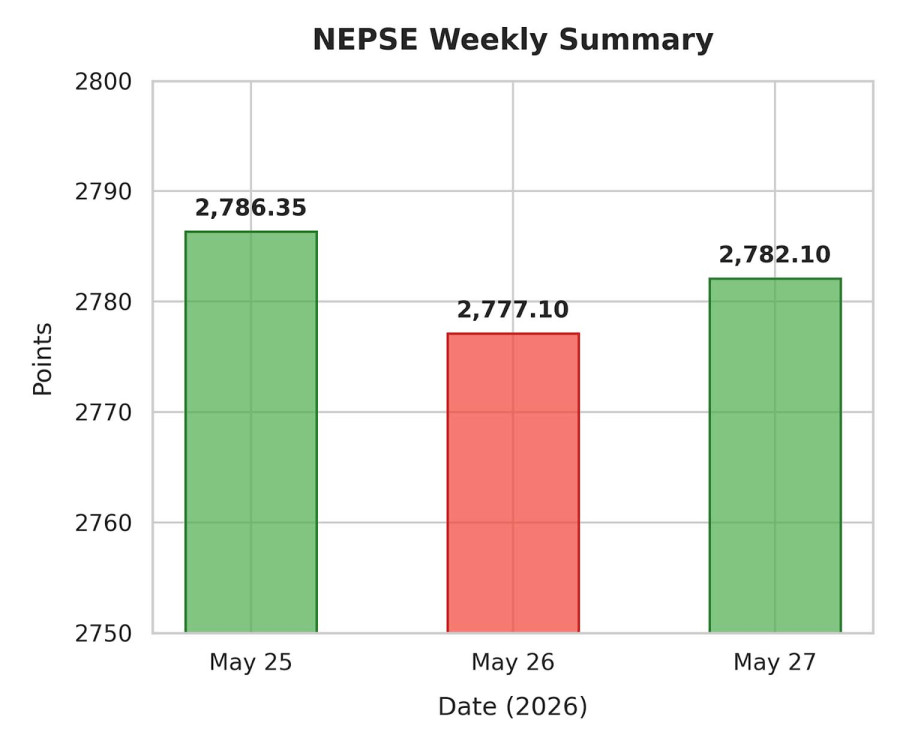
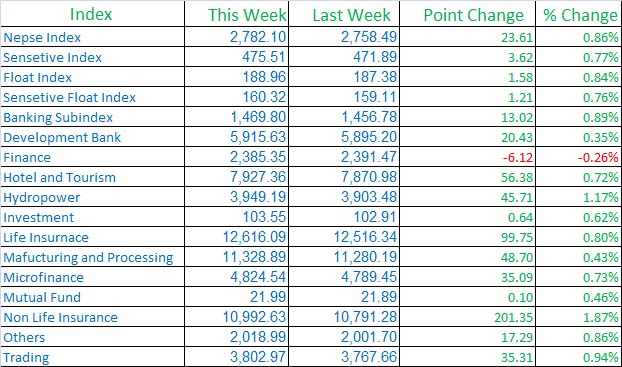
The Nepal Stock Exchange (NEPSE) index extended its gains during a holiday-shortened trading week, rising 23.61 points, or 0.86 percent, to close at 2,782.10.
After the market closed for the week, the government unveiled its budget for fiscal year 2026-27, including several measures directly affecting the capital market. The decision to classify capital gains tax (CGT) on listed securities as a final tax has drawn mixed reactions from market participants. Some welcomed the provision for bringing policy clarity, while others have criticised the accompanying tax hikes.
The Finance Bill, 2083, increased the CGT rate for short-term traders holding shares for up to one year to 10 percent from 7.5 percent. Long-term investors holding listed securities for more than a year will now pay 7.5 percent, up from 5 percent.
Some investors believe the final tax provision will remove longstanding uncertainty over tax liabilities and support market development. Others argue that the higher tax rates could discourage investment activity.
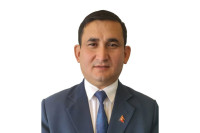
Market analyst and former banker Jagannath Dhungel said the revised tax rates may affect investor sentiment in the short term because many participants will view them as a tax increase. However, he said the decision to treat capital gains tax as a final tax resolves a major source of confusion in the market.
The secondary market remained open for only three trading days between May 25 and 27 due to public holidays, compared to a full five-day trading week previously. Despite fewer trading sessions, most sectoral indices ended the week higher.
The benchmark's rise boosted investors’ paper wealth, with total market capitalisation increasing by Rs42 billion over the week.
Market capitalisation stood at Rs4.746 trillion at the close of trading, up from Rs4.704 trillion a week earlier.
Although overall weekly turnover declined because of the reduced number of trading days, trading activity remained robust on a daily basis.
Total turnover reached Rs16.87 billion during the week, compared with Rs17.756 billion in the previous five-day trading period.
Average daily turnover climbed to Rs5.623 billion from Rs3.551 billion a week earlier, indicating stronger investor participation and buying interest on the days the market was open.
Among sectoral indices, non-life insurance recorded the highest percentage gain, rising 1.87 percent, or 201.35 points. The hydropower index followed with a 1.17 percent gain, or 45.71 points. Finance was the only major sector to post a loss, declining 0.26 percent, or 6.12 points.
Hydropower companies dominated trading activity throughout the week.
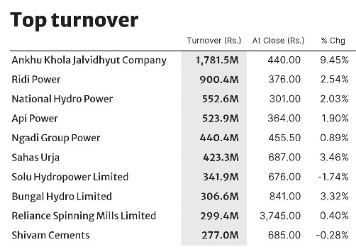
Ankhu Khola Jalvidhyut Company emerged as the most actively traded stock. It topped the turnover chart with transactions worth Rs1.781 billion and recorded the highest trading volume, with 4.205 million shares changing hands. The stock also ranked as the second-biggest gainer, rising 9.45 percent to close at Rs440.
Kalinchowk Hydropower posted the week's highest gain, surging 25.60 percent to Rs376.80, its 52-week high.
Ridi Power and National Hydro Power also attracted strong investor interest, recording turnovers of Rs900.4 million and Rs552.6 million, respectively.
Daramkhola Hydro Energy Limited was the biggest loser of the week, falling 4.21 percent to Rs640.
Beyond tax changes, the budget outlines a series of structural reforms aimed at modernising the capital market and attracting foreign investment.
The government has pledged legal amendments related to investment approval, profit repatriation and capital gains procedures to facilitate the participation of Non-Resident Nepalis in the secondary market. It has also announced plans to gradually introduce advanced trading instruments, including intraday trading, short selling and derivatives trading.
Dhungel said these measures could support long-term market growth if implemented effectively.
He also pointed to indirect support from the budget’s income tax reforms, including raising the personal income tax exemption threshold to Rs1 million and reducing the highest personal income tax rate from 39 percent to 29 percent.
According to him, the measures could increase disposable income and potentially channel more funds into investment, including the stock market.




 26.12°C Kathmandu