Vegetable prices skyrocket in Valley as landslides disrupt transport
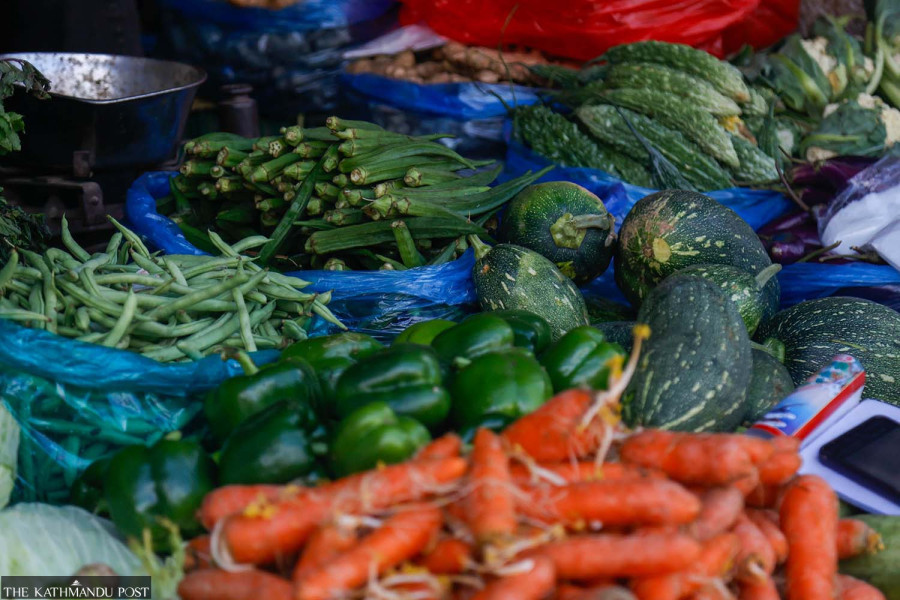
Arrivals have fallen by nearly two-thirds since Thursday as highways to major vegetable-producing districts are damaged in places, leading to a steep price rises. Post file photo
Vegetable supplies to the Kalimati market have fallen by nearly two thirds since Thursday as relentless rain triggered landslides and blocked highways leading to the Kathmandu valley, causing prices to rise sharply.
The market received just 242 tonnes of vegetables on Friday, compared to 657 tonnes on Thursday. Vegetable supplies stood at 817 tonnes a week earlier.
The Kalimati Fruits and Vegetable Market Development Board, the country's largest vegetable and fruit bazaar that keeps Kathmandu’s homes supplied with fresh produce, receives 700–800 tonnes of vegetables daily during normal times.
“The supply of vegetables has declined significantly since Saturday, which has led to a rise in prices,” said Ram Sharan Rijal, a vegetable trader.
The disruption traces back to a low-pressure system over the Bay of Bengal, which the Department of Hydrology and Meteorology says is bringing rain to much of the country. Heavy to very heavy downpour was forecast on Friday in parts of Koshi, Bagmati, Gandaki, Lumbini and Karnali provinces, and the department confirmed that heavy rain had already been recorded at many locations across Koshi, Bagmati, Gandaki and Lumbini over the preceding 24 hours, with some areas seeing very heavy rain.
The persistent rainfall has triggered landslides at multiple locations, disrupting road connections between Kathmandu and the rest of the country. The Prithvi Highway and BP Highway, both critical links between the Valley and vegetable-producing districts, have been obstructed by landslides along various sections, cutting off or restricting the flow of produce into the Valley.
Kathmandu's vegetable demand is largely met by supplies from neighbouring districts such as Dhading, Chitwan, Makawanpur and Kavrepalanchok, along with many pockets in the Tarai, while most of the potatoes, onions and lemons are imported from India. Because commercial vegetable production within Kathmandu, Lalitpur and Bhaktapur falls far short of what the Valley consumes, even minor disruptions on these supply routes are quickly felt in local markets, and the current blockages have had an outsized effect on availability and prices.
Pradyumna Raj Pandey, executive director of the Kalimati Fruits and Vegetable Market Development Board, said the arrival of vegetables at the market has slowed considerably since Thursday, with the regular flow of supplies disrupted by the rain. He noted that with major festivities and the wedding season approaching, demand for vegetables is set to rise further, which will add an upward pressure on prices even after the weather situation normalises.
The impact has already been steep and swift. According to the board’s daily price index, wholesale prices for a wide range of vegetables have surged over the past week, including tomatoes, potatoes, onions, cabbage, cauliflower, eggplant, cow peas, sword beans, bitter gourd, bottle gourd, pointed gourd, sponge gourd, squash, okra and green chilli.
As per market lists, wholesale tomato prices climbed 61.76 percent within a week to Rs110 per kg, pushing retail prices up to Rs150–160 per kg. Cabbage prices more than doubled, rising 171.43 percent to Rs95 per kg, while cauliflower increased 22.73 percent to Rs135 per kg. Potato prices rose 3.45 percent to Rs55.17 per kg wholesale, with retail prices ranging from Rs65 to Rs75 per kg. Eggplant climbed 22.22 percent to Rs55 per kg wholesale, retailing between Rs80 and Rs90 per kg. Bitter gourd and bottle gourd prices rose 54.55 percent and 18.18 percent, respectively, reaching Rs85 per kg and Rs65 per kg wholesale, with bitter gourd retailing between Rs100 and Rs110 per kg and bottle gourd between Rs80 and Rs90 per kg.
The supply crisis also comes amid broader inflationary pressure in the economy. According to Nepal Rastra Bank, year-on-year consumer price inflation stood at 5.96 percent in mid-August, up sharply from 1.68 percent a year earlier, with vegetable inflation alone rising 6.90 percent during the review period.
Krishana Prasain is a business reporter for The Kathmandu Post covering markets. Before joining The Kathmandu Post in 2018, she spent 3 years in New Business Age magazine covering business.




 16.72°C Kathmandu