



 14.69°C Kathmandu
Sat, Oct 24, 2026
Money
Nepalis cut back on food as ‘hyperinflation’ and shortages bite
Consumers in Kathmandu Valley are cutting back on food and festive preparations as supply disruptions and rising transport costs push up the prices of daily essentials.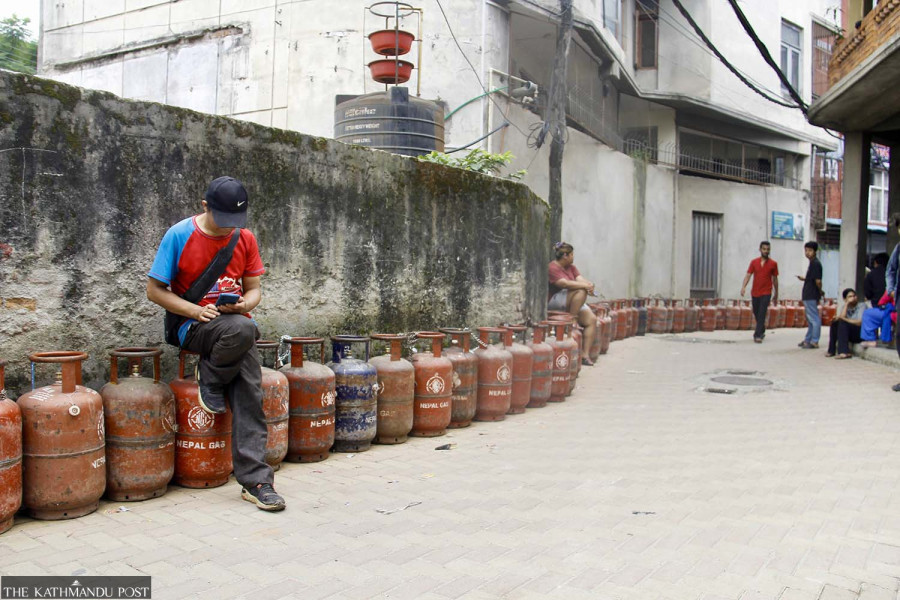
bookmark![]()
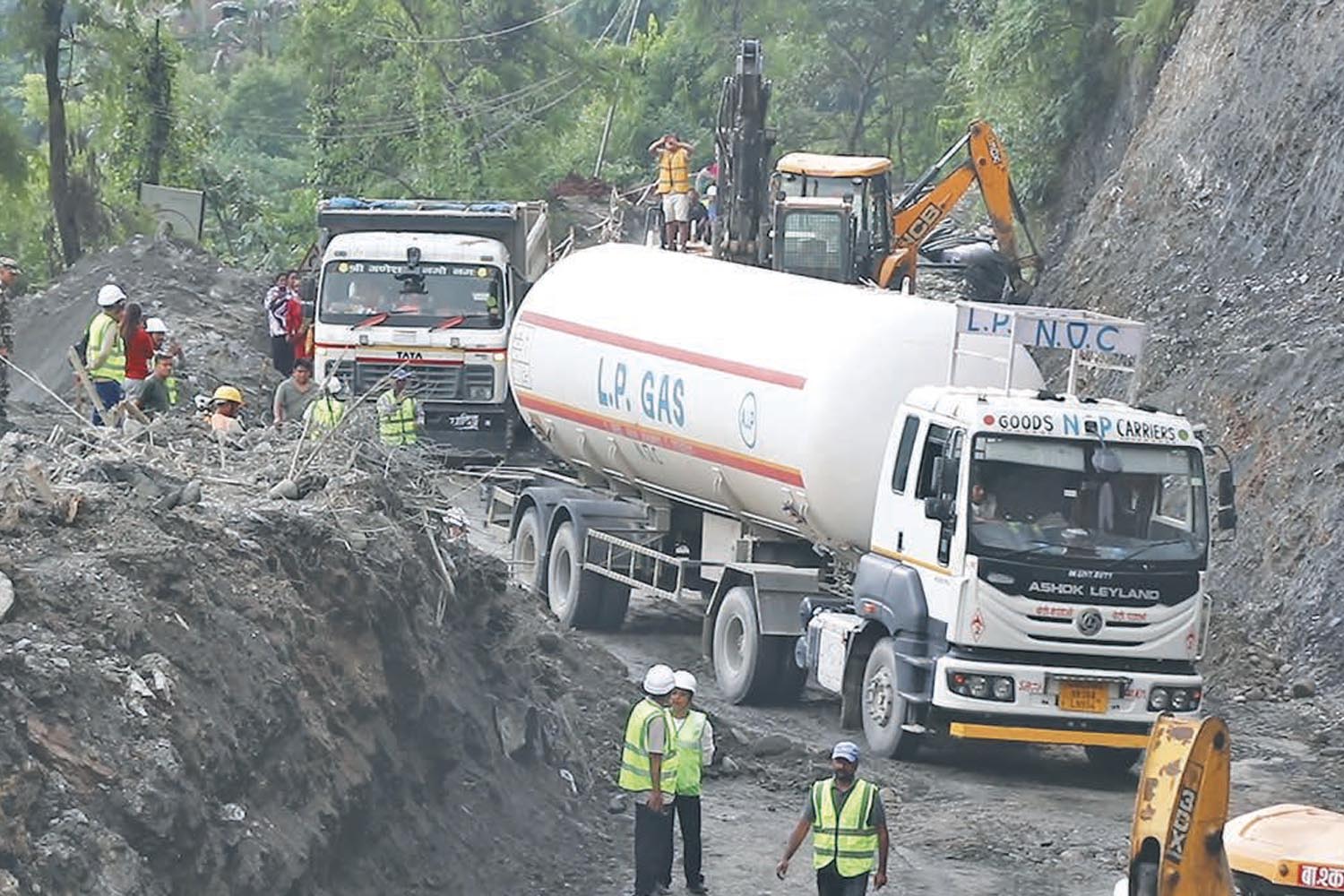
A test passage of LP Gas bullets through a track cut above Krishnabhir after the Prithvi Highway stretch was swept in Trishuli river floods on August 30. RSS
Krishana Prasain
Published at : September 13, 2026
Updated at : September 14, 2026 07:08
Kathmandu
Shanti Belbase, 53, was planning to make sel-roti for dar, a heavy meal eaten by women in preparation for fasting during the Haritalika Teej festival, for her three younger sisters, which began on Sunday.
But when she visited the market last week, she was perplexed.
“The prices of all commodities needed to make selroti, such as rice flour, sugar, edible oil and spices, have increased,” she said. “Everything is super expensive.”
She dropped the idea of preparing selroti, a traditional Nepali rice-based fried bread round in shape.
The price of a 20-kg sack of jeera masino rice has reached Rs2,700, an increase of Rs500 per sack. A litre of sunflower oil now costs Rs300, up Rs60 within two weeks.
The price of sugar has crossed Rs140 per kg, up from Rs100. These are only a few examples, but consumers in Kathmandu Valley say they are bearing the brunt of price hikes reminiscent of a decade ago, when an unofficial Indian blockade disrupted daily life across Nepal.
“Above all, there is an acute shortage of cooking gas,” said Belbase, a housewife who lives in Chapagaun, Lalitpur. Belbase has cut her kitchen menu and stopped preparing festive dishes.
“I didn’t invite guests either this year for Teej.”
In Nepal, price hikes or inflation mean hardship for a large section of society. Rising prices can lead to social and economic instability by worsening the living conditions of people with limited incomes, particularly the poor and middle class, who are forced to compromise on their diets.
Amrit Thapa is a private car driver who lives in a rented house in Balkumari. He did not buy rice in a sack last week and instead bought a few kilos at a time. He earns Rs20,000 per month.
“My income almost vanished within two weeks,” he said. “Daily household essentials, children’s school fees and rent—it’s really very expensive to live in Kathmandu.”
Thapa said he borrowed money from friends to buy food for the festivities.
He has returned to using a kerosene stove after the cooking gas shortage persisted for the last three weeks. He said he has not bought fruits or meat since then.
Like Belbase and Thapa, consumers across Kathmandu Valley have been hit hard. Prices of many commodities were already rising following the war in West Asia, which pushed up fuel prices and eventually increased the prices of almost every commodity.
The price hikes and shortage of cooking gas have worsened since the August 26 devastating flash flood in Rasuwa damaged a section of the Prithvi Highway, severely affecting cargo transport to Kathmandu Valley, the country’s business hub.
According to the Nepal Retail Traders Association, the price of mustard oil has reached Rs460 per litre from Rs410 a month ago. Sunflower oil has crossed Rs295 per litre from Rs245. Black lentils have increased to Rs200 per kg from Rs180. Turmeric has risen to Rs525 per kg from Rs450.
The wholesale prices of most vegetables—including tomato, potato, onion, cabbage, cauliflower, French beans, bitter gourd, pointed gourd and pumpkin—have also gone up within a month, according to the Kalimati Fruits and Vegetable Market Development Board.
The wholesale price of Nepali tomatoes has increased by 15.38 percent to Rs75 per kg. In retail, they cost Rs120 per kg. Potato prices have surged 7 percent to Rs53.50 per kg, while sword beans have increased by 13.33 percent to Rs85. The retail price of sword beans is around Rs130 per kg.
The wholesale price of bitter gourd has climbed 44.44 percent to Rs65 per kg, while in retail it trades at around Rs100 per kg. The wholesale price of Fuji apples has climbed 29.31 percent to Rs375 per kg. In retail, they cost Rs450 per kg.
The retail price of mutton, which was hovering around Rs1,300 per kg, has reached Rs1,700. The price has increased by nearly Rs400 amid severe bird flu cases reported in the Valley and other districts in July.
The price of a large egg now stands at Rs25 per piece in retail markets, up from Rs22.
Economic activity in Nepal typically sees a significant uptick during the September-October period, with major festivals such as Teej, Dashain and Tihar celebrated across communities. An estimated 40 percent of annual market activity takes place during Dashain, Tihar and Chhath, according to economists.
But economists say ultra-high inflation could affect the market.
“When people don’t buy, demand drops,” said Nara Bahadur Thapa, former executive director of Nepal Rastra Bank.
The drop in demand could create a recession-like situation.
“As a section of Krishnabhir caved in following the Rasuwa flood, it has created chaos in Kathmandu Valley, where more than three million people live,” said Thapa. “Everywhere, consumers are seen queuing for hours to get a cooking gas cylinder.”
“This shows our supply management is fragile,” said Thapa.
In most parts of the Valley, members of the public are grouping themselves to bring LPG cylinders from the Tarai after the state mechanism failed to ensure adequate supplies.
On September 10, Supplies Minister Gauri Kumari Yadav resigned after failing to ensure a smooth supply of LPG. Days earlier, she had made controversial remarks threatening LPG bottling industries, drawing public criticism.
Bagmati Province, which hosts Kathmandu, accounts for an estimated 36 percent of Nepal’s gross domestic product. Wholesale and retail trade has the highest contribution, at 23 percent, to Bagmati’s GDP.
Kathmandu is only around 150 to 200 kilometres from the Indian border near Raxaul-Birgunj, depending on the specific border point. The nearest major Indian border point is about 160 km away via the Tribhuvan Highway.
However, Kathmandu remains vulnerable to any disruption in the supply chain. Whenever obstacles emerge along the border with India, the first impact is often felt in the Valley.
Nepal has been constructing the 76-km Kathmandu-Tarai Expressway to connect the Capital with the Tarai and the Indian border, with the aim of improving trade, transit and the movement of supplies. But the project itself has been held hostage to delays, a perennial problem facing Nepal.
“Unless two or three alternative routes are developed where eight-wheelers can pass and storage capacity is built, the country’s economy will not be resilient and market prices will remain unstable,” said Thapa, the economist.
Nepal is highly vulnerable to climate-related disasters. In the past three years, the country has suffered damage from floods and landslides in different parts of the country.
“So it is high time the government invested in and worked on a logistics management policy for essential commodities and food security jointly with the private sector,” said Thapa.
With the Prithvi Highway shut down, supplies have been rerouted. Vehicles, particularly cargo trucks, now have to take routes that can take up to 72 hours to reach the Capital, increasing transportation costs by an estimated 20 percent, said Thapa.
“The burden is passed on to consumers,” he said.
Consumer rights activists, however, claim that the current increase in market prices, particularly for daily essentials, is unnatural and artificial.
Traders tend to increase the prices of food items ahead of the festive season despite sufficient stocks and normal supplies, citing increased demand.
This year, opportunistic traders got an excuse to hike the prices of goods on the pretext of the highway disruption connecting the Valley, said Pabitra Bajracharya, president of the Nepal Retail Traders Association. Big traders, wholesalers and producers have stocks of food items for three to four months, he added, suggesting that there is no reason to hike the prices of food items when stocks are sufficient.
“However, big traders, wholesalers and producers hike the prices of food items to take advantage of disasters such as the current one,” Bajracharya said.
The festive season has arrived. Now people tend to spend more and opportunistic traders raise prices when demand is high, he said.
The rise in global fuel prices and a strong US dollar had already been building pressure for inflation. The disruption in road connectivity after the Bhotekoshi floods has further increased transportation costs, with transporters using alternative routes to supply goods to the Valley.
Consumer rights activists see the situation differently.
“Retailers and importers are manipulating invoices and hiking the prices of daily essentials. The supply and production of rice, sugar, edible oil, legumes, fruits, vegetables, eggs and meat products are sufficient, but the prices of these goods have been increased unnaturally on various pretexts,” said Madhav Timalsina, president of the Consumer Rights Investigation Forum.
The government does not have a mechanism to study how much market prices rise during abnormal situations like the current one, he said.
“The government does not have a clear supply policy, and implementation of existing laws is poor. There is a dearth of government data on the quantity of supplies, and a lack of coordination among government entities.”
Krishana Prasain
Krishana Prasain is a business reporter for The Kathmandu Post covering markets. Before joining The Kathmandu Post in 2018, she spent 3 years in New Business Age magazine covering business.



Most Read from Money

Why does an hour long flight to Dhangadhi cost more than a flight to New Delhi?
Nepal travel agents threaten to stop selling Thailand trips over visa rules
Malaysia rejects Nepal’s demand to open recruitment to all manpower agencies

No school, but a graduation cap for women dairy farmers
Nepal arrests four medical service providers as Malaysia recruitment row deepens
Editor's Picks




E-PAPER | October 24, 2026

×