A month after the flood, survivors have nowhere to go, no way to earn
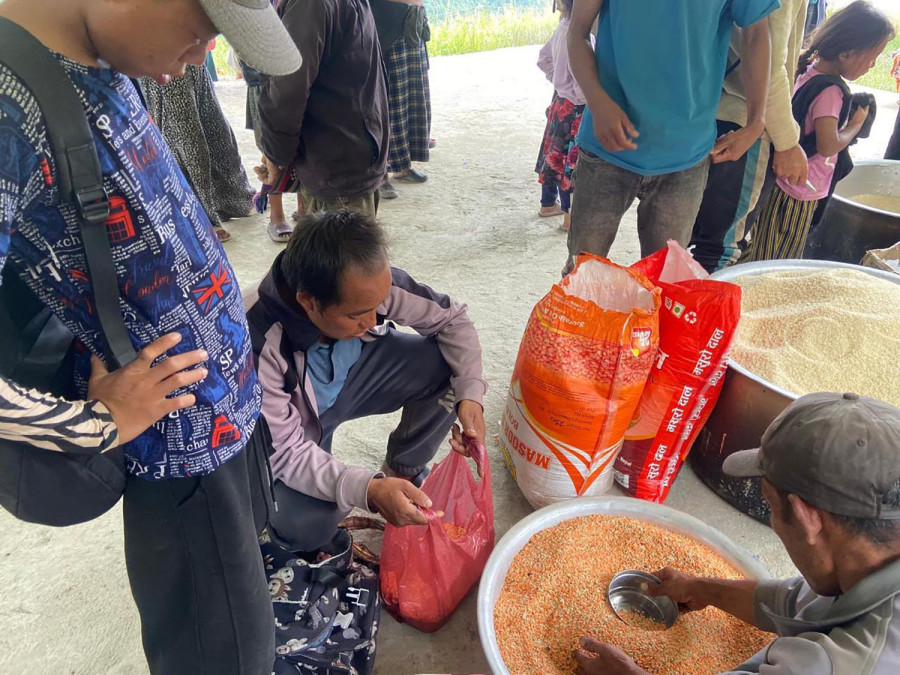
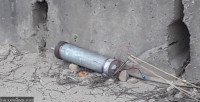
Relief has helped families through the immediate aftermath, but damaged roads, lost homes, closed schools and shattered livelihoods are making recovery harder. Relief pulses being rationed in Tarsa of Gosaikunda Ward 1, Rasuwa in this recent photo. Photo: Courtesy of Ward Chair Urken Chhiring Tamang
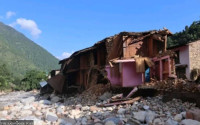
A month after the Bhotekoshi floods tore through settlements in Rasuwa, the immediate danger appears to have passed, but the disruption remains. Roads and bridges are still broken, homes and public buildings have been swept away, schools remain closed, and farmers are watching crops rot in fields they cannot reach by road.
For families living in temporary shelters and holding centres, relief has helped them get through the first few weeks. But they are now confronting a harder question: how to rebuild their lives when the routes back to their villages remain cut off and their livelihoods have been destroyed.
For Dolma Yangjen Tamang of Syaphrubesi in ward 5 of Gosainkunda Rural Municipality, rebuilding the road and bridge to her village and restoring transport should be the priority so she and other survivors can return to work. She has been staying at a holding centre in Koming since the August 26 floods.
“Those who were going to die have already died. Those of us who survived now need roads and transport to earn a living,” she said.
The flood swept away much of the Syaphrubesi settlement, and survivors are now living in holding centres and temporary shelters in Rasuwa, Nuwakot and Kathmandu. A month on, Dolma said, people need more than relief. They need the roads, bridges and transport links that will allow them to return home and support themselves.
“We don’t know how long the relief will continue. Displaced families have survived on aid for a month. But how long can we live like this?” she said.
Dolma, who represents 45 households staying at the Koming holding centre, said shops in the village were also running out of supplies.
“People cannot buy food because the shops have nothing left. And there is no road to bring supplies in,” she said.
Her concern is shared across the flood-hit areas. Damaged infrastructure has cut communities off from markets and essential supplies, while schools and local government offices remain disrupted. In some areas, farmers have been unable to take vegetables worth millions of rupees to market, and their produce is now rotting in the fields.
The government has approved monthly cash assistance for six months for displaced families in Rasuwa, Nuwakot and Dhading who make their own accommodation arrangements. Families of up to four members receive Rs15,000 a month, with an additional Rs2,000 for each extra member. Those receiving the cash will not be prioritised for other relief, including food, according to the National Disaster Risk Reduction and Management Authority.
The decision has been sent to local units for implementation. Shanti Mahat, spokesperson for the authority, said families receiving the monthly assistance would not be prioritised for other food and relief support, while those without homes or arrangements for food and accommodation would continue to receive relief based on need.
“The government will continue to provide relief as needed to families who have no home or arrangements for food and accommodation.”
Mahat said the government was also working to arrange temporary housing as “quickly as possible” so affected families could resume their daily lives.
There are currently 183 people in eight holding centres in Nuwakot, 805 in nine centres in Rasuwa and 121 in four centres in Dhading. Their families have been approved to receive between Rs15,000 and Rs17,000 a month for six months.
For families still living in temporary camps, however, the uncertainty extends beyond the six-month relief period.
Mar Singh Tamang, ward 1 chair of Uttargaya Rural Municipality, has been staying with displaced families at Pipaltar in Nuwakot. Around 300 households from Mailung and Salletar have been living there since their settlements were swept away.
“We have been living on relief for a month, but we can’t depend on it forever. We don’t know what comes next,” Mar Sing said. “The government needs to act quickly.”
He said almost every family had lost someone in the flood. “We are staying here in Pipaltar, but our thoughts are still with our own settlement that was swept away,” he said.
The disruption is also hampering the restoration of basic services in Rasuwa. The Gosainkunda Rural Municipality office in Syaphrubesi was swept away and is now operating temporarily from Dhunche, the district headquarters. Six schools remain closed, including those in Timure, Syaphrubesi, Langtang, Thuman, and Buddhim.
Kaisang Nurpu Tamang, chairman of the rural municipality, said that about half of the people from the affected area had moved to Kathmandu, while others were staying in temporary camps. Authorities are trying to place children in schools that remain accessible, but displaced families are still uncertain about where they will live once the temporary arrangements end.
“People have already spent a month in temporary camps. They are now worried about where they will go and how long the assistance will continue,” Kaisang said. “They need permanent housing so they can start supporting themselves again.”
In Amachhodingmo Rural Municipality, the damage is threatening farmers’ incomes. Wards 2, 3, 4 and 5 sold vegetables worth around Rs30 million last year, and farmers had expected this year’s production to be worth about Rs60 million. But the floods cut off access before they could take their produce to market.
Around Rs80 million worth of cauliflower and beans are now at risk of rotting in the fields, municipal officials say.
“No vehicle has reached the rural municipality since the floods,” said Buchung Tamang, chairman of the rural municipality. “It has become difficult even to bring food and other essentials. Farmers have vegetables worth millions of rupees ready for market, but they can’t sell them.”
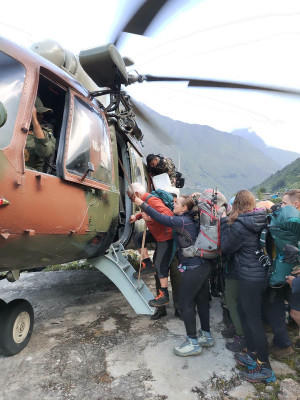
The rural municipality is relying on helicopters to bring in food and other supplies. “How long can we keep relying on helicopters to bring in supplies?” Buchung said.
Farmers in Chilime, Mesing, Katlang and Guljung are particularly worried. Buchung said rebuilding the Syaphru and Hakubesi bridges was essential to restoring transport and allowing people to resume their livelihoods.
Surendra Tamang, chairman of ward 3, said farmers had vegetables ready to harvest but no way to get them to market.
In ward 4 of Uttargaya Rural Municipality, 28 households have been staying at a temporary camp in Bhimsensthan. Their homes and livelihoods were swept away, and some families lost relatives. Their main concern now is where they will go next.
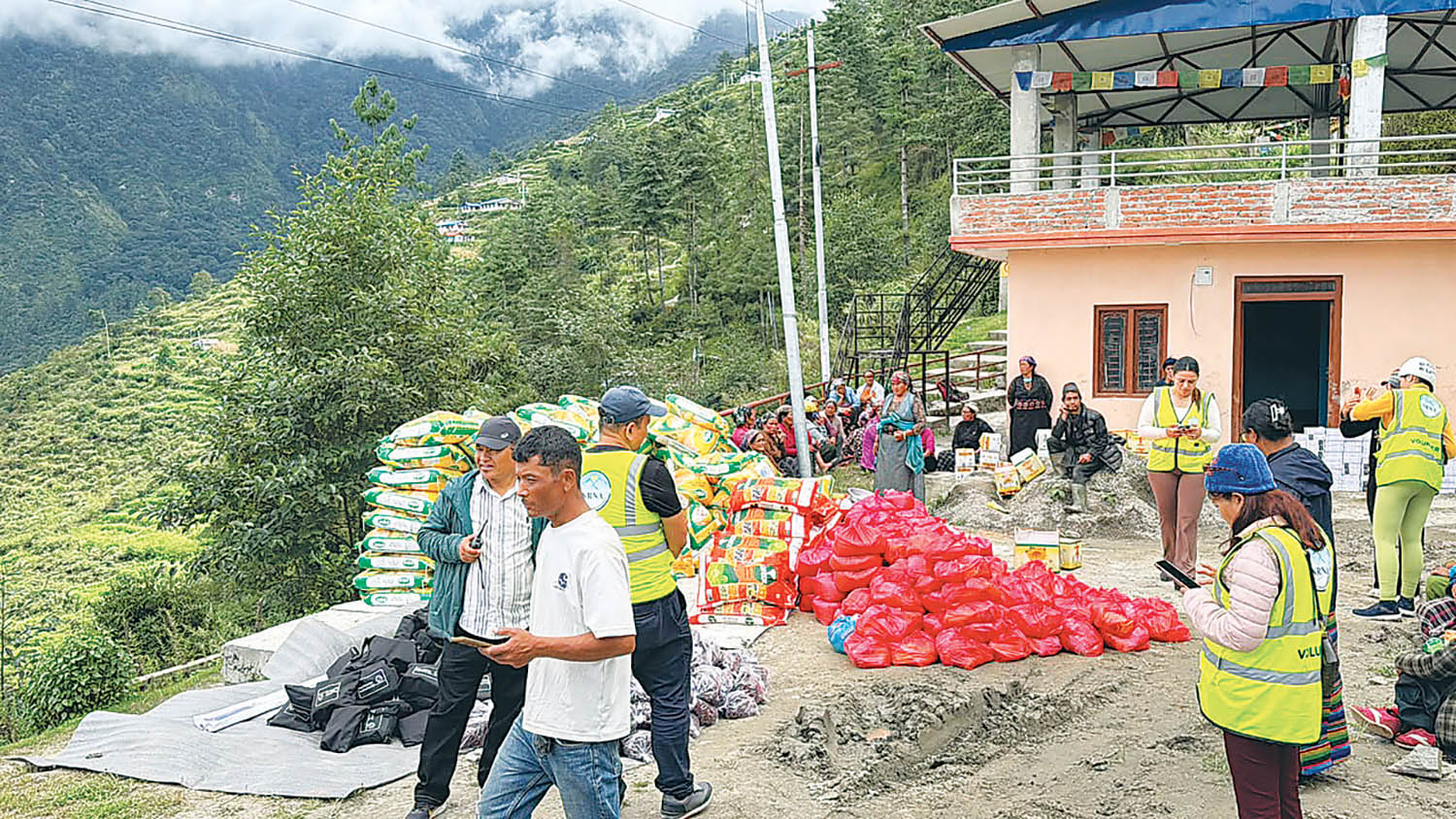
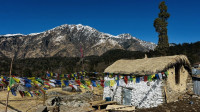
A food depot for flood victims at Thulo Syaphru in Gosainkunda Rural Municipality, Rasuwa, pictured earlier this month. Photo: Courtesy of Urken Chhiring
“They need a permanent place to live and a way to support themselves,” said ward chair Amar Bahadur Bulan.
Madhav Aryal of the rural municipality said relief could not be a long-term solution. He said life would return to normal only after roads and bridges were rebuilt, and transport restored.
The floods also destroyed three schools—Chipleti Basic School in Salletar, Malikadevi Basic School in Pairibesi and Trinity Boarding School in ward 5. Malikadevi students are attending Navajyoti Mahendra Secondary School, while Salletar students have been moved to Dandagaun Secondary School.
The rural municipality says 134 students are still missing and 150 have lost their parents.
Its office at Laharepauwa was also swept away. Officials are now working from a community health centre and trying to reconstruct records.
“The building was swept away. There are no vehicles or ambulances available, and we are making do with just two motorcycles,” a municipal official said. “All the documents were swept away. We have recovered some of them online, but the rest have to be recreated.”
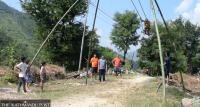
With bridges gone, communities on opposite sides of the river have also been cut off, making it difficult even for officials to meet. The rural municipality has requested suspension bridges and tuins—improvised cable crossings—and is preparing to install a tuin linking Pairibesi with Kispang Shantibazar.
The disruption extends into neighbouring Nuwakot, where displaced families from Rasuwa remain in holding centres in Bidur, Belkotgadhi, Tarakeshwar, and Kispang.
Shambhu Prasad Regmi, chief district officer of Nuwakot, said relief distribution was continuing. Families staying in temporary camps for longer periods would need sustained support, while those receiving the monthly cash assistance would be expected to make their own arrangements, he said.
In Kalika Rural Municipality, poor road access is disrupting trade and essential services. Traders are struggling to bring in supplies, ambulances cannot easily transport patients, and prices of basic commodities have risen sharply.
The rural municipality has subsidised cooking gas and arranged some supplies, but officials say such measures are not sustainable.
“The main need now is roads,” said Sandip Poudel, spokesperson for the rural municipality.
In Nuwakot, displaced families face similar concerns over housing, work, and schooling. Deputy mayor of Bidur Municipality Prabha Bogati said many survivors, including those displaced from Rasuwa, were worried about where they would settle and how they would earn a living.
Some displaced traders and business owners are also struggling to repay bank loans after losing their businesses and have asked the government to help them negotiate repayment arrangements.
Six schools in the area were destroyed and three others partially damaged by the flood, according to local officials. Arrangements are being made for teachers, students and other staff to resume classes.
For families who have spent the past month in tents and holding centres, the challenge is no longer simply getting through another day. They need to return to their communities, rebuild their homes, get children back to school and restore their livelihoods.
For Dolma, that starts with reconnecting her village.
“The road and bridge to our village need to be rebuilt. Transport needs to resume. Then we can work and earn a living,” she said.




 19.53°C Kathmandu