Government to relocate Valley squatters to home districts
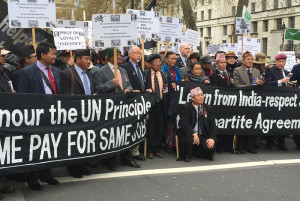
Landless families evicted from Kathmandu’s riverbanks are being sent to their permanent home districts as Valley municipalities cite a lack of land for resettlement. The National Land Commission published its first list of verified beneficiaries on July 16, identifying 14 people with no registered land anywhere in Nepal. Jyoti Shrestha/TKP
The government has begun relocating landless squatters displaced from the riverbanks of the Kathmandu Valley to their permanent home districts, saying there is little land available within the Capital for their resettlement.
The move comes as authorities continue clearing settlements along the Bagmati river corridor, displacing hundreds of families who have lived in Kathmandu for decades and leaving many uncertain about where they will rebuild their lives.
The relocation process follows directives from the Ministry of Land Management, Cooperatives and Poverty Alleviation and relies on digital land ownership records compiled by the High-Powered Committee for Integrated Development of the Bagmati Civilisation.
To identify genuine landless households, the Department of Land Management and Archive cross-checked applicants through the Land Records Information Management System (LRIMS), verifying whether they own land anywhere in the country. Those found to have no registered land are being referred to their home districts for land allocation under existing laws, while those with property elsewhere are disqualified.
Balbhandra Banstola, chairperson of the National Land Commission, said official correspondence has already been sent to local authorities to facilitate land allocation for 28 families in their home districts.
“We search the land registry across all 77 districts to determine whether an applicant owns property,” Banstola told Kantipur. “If someone is found to own land elsewhere, they no longer meet the legal definition of a landless squatter and are therefore ineligible for state land.”
According to the commission, six families have so far been disqualified after land registered in their names was discovered in other districts.
Banstola said the verification process is still under way and has yet to cover all displaced households.
“For those who are confirmed to have no land anywhere in the country, we are moving ahead with the process,” he said. “Once verification is complete, people whose citizenship was issued outside the Valley will be referred to their home districts for resettlement. We hope to complete most of the verification within this month.”
He acknowledged that providing land within Kathmandu Valley is virtually impossible because local governments have no land to spare.
“The metropolitan cities and municipalities of Kathmandu, Lalitpur and Bhaktapur have informed us that they do not have land available for distribution,” Banstola said. “Given this constraint, we have proposed an integrated housing model as an alternative for landless families who cannot be accommodated within the Valley.”
The National Land Commission published its first list of verified beneficiaries on July 16, identifying 14 people with no registered land anywhere in Nepal. Their files have already been forwarded to the relevant district authorities to begin the land allocation process.
The first list includes Kumal Ghalan and Arjun Syangtan of Makawanpur, Madan Kami of Taplejung, Rajesh Majhi of Morang, Achhelal Paswan of Rautahat, Pabita Thapa Magar of Dhankuta, Jiban Kumar Pahari of Sindhuli, Niraj Thapa of Sindhupalchok, Rabbani Ansari of Mahottari, Som Bahadur Nepali of Kathmandu, Apsara Damai of Bhojpur, Harkil Giri of Sunsari, Tek Bahadur Layo of Dhanusha, and Jitman Tamang of Sarlahi.
For many of those on the list, however, the prospect of returning to districts they left years or even decades ago has brought anxiety rather than relief.
Kumar Ghalan, 46, learnt through Facebook that his name had appeared on the list. Days later, he received a phone call from Bagmati Rural Municipality in Makawanpur informing him that land would be allocated there.
Ghalan moved to Kathmandu with his parents as a child and grew up in the Thapathali squatter settlement. His two children were born and raised in the capital. His daughter is in the first year of university and his son studies in Grade Four.
“They told me I would receive land in Ward 8, but local officials are still looking for a suitable plot,” Ghalan said after travelling to Makawanpur.
He said he had hoped to be settled somewhere near Kathmandu because his family's life is rooted in the capital.
“My children study in Kathmandu, and we have lived here all our lives. Starting over in a rural area and finding work will be extremely difficult,” he said. “I have explained our situation to the local authorities, but I don't know what decision they will make.”
Pabita Thapa Magar, 45, who is staying at the Kharipati holding centre in Bhaktapur after being evicted from the riverbanks, said she discovered through social media that she had also been selected for relocation.
Although her citizenship certificate lists Dhankuta as her permanent address, she said she has never visited the district.
“I have not received an official call yet,” she said. “I have never been to Dhankuta and have no idea how I will survive if I am sent there. There are no jobs for us. If we have to leave Kathmandu, starting life again will be very difficult.”
The amount of land allocated to beneficiaries is governed by the Land Rules 2021 (19th Amendment).
Under the rules, verified landless Dalits and landless squatters are entitled to up to 130 square metres of residential land free of cost within Kathmandu Valley, metropolitan cities, sub-metropolitan cities and municipalities. Outside these urban areas, they can receive up to 300 square metres for housing.
For agricultural purposes, beneficiaries are entitled to up to 2,000 square metres in the Tarai and Inner Tarai and up to 3,000 square metres in the hills and mountains.
Unregulated settlers are eligible for up to 130 square metres of residential land in Kathmandu Valley and other urban areas, and up to 1,000 square metres elsewhere, subject to payment of the prescribed government revenue.
Banstola said land would be distributed strictly in accordance with these provisions. He added that the commission had streamlined administrative procedures to speed up the issuance of land ownership certificates.
“On the day we forward the files to district committees, we also hold virtual meetings instructing them to treat these cases as a priority,” he said. “The Ministry of Home Affairs has also directed Chief District Officers to handle the process with urgency. If beneficiaries cooperate with the local committees, they should be able to receive their land ownership certificates within two to three months.”




 13.46°C Kathmandu