Major parties walk out of constitution review taskforce
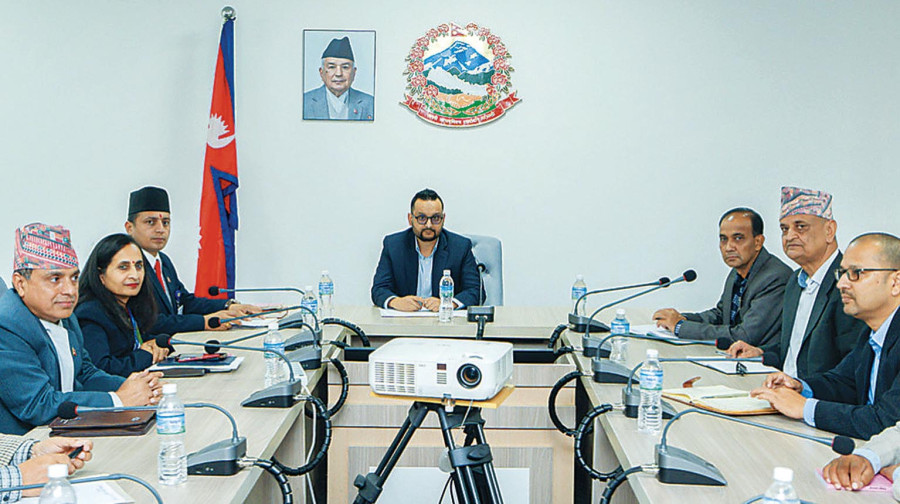
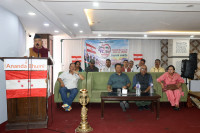
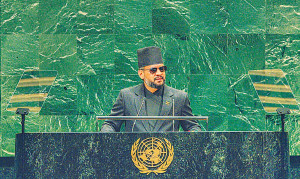
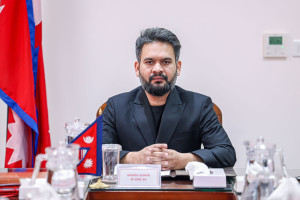
Dispute centres on whether the panel is preparing a discussion paper on amendments or laying groundwork for rewriting the constitution. Asim Shah (centre) heads a meeting of the taskforce mandated to prepare a discussion paper on constitution amendment, last month. Post file photo
A government taskforce mandated to draft a discussion paper on constitutional amendments has plunged into political turmoil after several political parties walked out of the process.
Representatives from four influential political parties announced their formal dissociation from the panel on Monday, handing over a six-point dissenting memorandum to the taskforce coordinator Asim Shah, who also serves as the political advisor to Prime Minister Balendra Shah.
The Nepali Communist Party (NCP), the Loktantrik Samajbadi Party (LSP), the Janata Samajbadi Party (JSP) and the Rastriya Janamorcha announced their disassociation with the taskforce. In their joint memorandum, the parties raised serious concerns over the intent and the operational jurisdiction of the panel.
The political problem comes at a time when the taskforce was close to concluding its assignment within a strict 100-day deadline. The joint departure has triggered wider anxieties within the federal capital regarding the future of the nation's fragile constitutional consensus.
The escalating dispute spilled into public over the weekend. On Sunday, Nepali Congress President Gagan Kumar Thapa launched a scathing attack on the taskforce during a political address at the party’s central office in Sanepa. The main opposition party’s chief described the government's current methodology as highly immature and reckless.
"You cannot approach a solemn exercise like amending the national constitution in a flippant or casual manner," Thapa told party workers. "The taskforce appears to have picked up the constitution like a small booklet, whimsically deciding to throw out this section or strike down that clause.”
Recalling the intense socio-political friction during the first and second Constituent Assemblies, Thapa emphasised that the 2015 constitution was a hard-won document born out of historic struggles by indigenous groups, Dalits, Tharu, and Madhesi communities. "While the constitution is undeniably a dynamic, living document that can be reviewed and amended, it must never be reduced to a playground for populist whims," he asserted.
Following Thapa's warning, representatives from the four dissenting parties formalised their protest on Monday. They demanded an immediate scrapping of the current discussion-paper formulation process. They called for a binding commitment to safeguard the preamble and the foundational tenets of the current constitution. Furthermore, they demanded that any proposed amendment must emerge from an all-party meeting with national consensus.
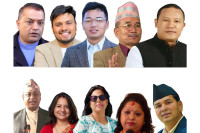
The dissenting memorandum was signed by Dev Gurung of the NCP, Laxman Lal Karna of the LSP, Surendra Jha of the JSP, and Manoj Bhatt of the Rastriya Janamorcha. The inclusion of the Rastriya Janamorcha raised eyebrows in political circles, given the party's opposition to federalism.
"If the government is genuinely serious about constitutional reforms, it must first scrap this flawed taskforce process," reads the joint statement. "Secondly, there must be an explicit, unshakeable state commitment that the constitutional preamble, inclusion frameworks, and fundamental principles will remain untouched. Any justifiable amendment must be routed through an official all-party mechanism to build national consensus before any draft reaches the floor of parliament."
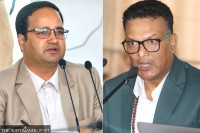
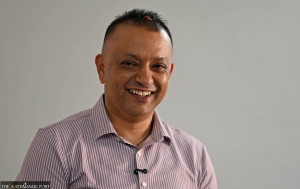
Elaborating on the exit, NCP leader Dev Gurung alleged that the panel had overstepped its original administrative boundary. "We initially joined to assist in formulating a broad, balanced discussion paper. However, the taskforce began functioning like a supreme drafting committee tasked with rewriting the entire constitution," said Gurung. "An exercise born out of a sovereign Constituent Assembly cannot be dismantled or altered under the unilateral leadership of a prime ministerial advisor. We refuse to endorse this non-parliamentary approach."
Laxman Lal Karna, a former lawmaker representing the LSP, shared a similar perspective. He revealed that while the initial stages involved constructive interactions with constitutional experts and retired bureaucrats, the taskforce’s subsequent working method became highly problematic.
"The turning point arrived when the coordinator and select members began visiting private residences to collect arbitrary opinions," said Karna. "We strongly objected to this unscientific, door-to-door approach for a national charter. More importantly, we discovered that the leadership intended to push through a final report based on internal majority and minority voting, rather than forging a consensus. We refused to sit as silent witnesses to a majoritarian rewriting of our country's supreme law."
Karna warned that opening up the preamble for revision would invite absolute institutional chaos. "The moment you fiddle with the preamble, the entire constitutional architecture collapses. Tomorrow, someone will demand the reinstatement of the monarchy, another group will demand a Hindu state, and someone else will want something entirely different. This taskforce simply does not possess the mandate for this," he said.
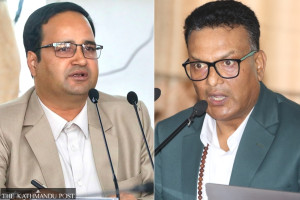
Bhishma Adhikari, who was nominated to represent the CPN-UML on the taskforce, clarified that his party had boycotted the process from its very start. "The UML has maintained a consistent stance. The constitution itself lays out the procedure for amendments, and the sovereign parliament is the only legitimate forum for such an exercise. We did not participate in any of the taskforce meetings," said Adhikari.
Defending the taskforce’s credibility, coordinator Shah described the multi-party walkout an act of political opportunism. He expressed disappointment that the opposition representatives chose to quit the panel after participating in its work for 83 days.
"These representatives were present from our very first meeting, formally presenting their party positions and actively participating in our extensive stakeholder consultations," said Shah. "To suddenly walk out on the 83rd day and claim jurisdictional overreach smells of a calculated strategy to sabotage the entire reform agenda. They fear that if a comprehensive, globally informed discussion paper is successfully submitted, the government's popularity will rise."
Shah dismissed fears regarding the dilution of basic constitutional features, claiming he had repeatedly assured all participating members that the core identity of the constitution would remain fully protected. Despite the walkout, Shah announced that the taskforce would meet its deadline and present the final report directly to the Council of Ministers.
Supporting the coordinator, Mohan Lal Acharya, a taskforce member and Rastriya Swatantra Party (RSP) lawmaker, accused the dissenting parties of manufacturing a crisis for media attention. "Abandoning such a crucial state exercise at the eleventh hour reflects deep political irresponsibility," said Acharya.
Pushkar Sapkota, the law secretary at the Office of the Prime Minister and Council of Ministers, also urged the political parties to set aside their suspicions. "This discussion paper does not undermine constitutional supremacy; it strengthens it. The process has been entirely transparent and democratic," said Sapkota. "Abruptly withdrawing from a vital constitutional dialogue would send a deeply negative signal to the public and deepen disillusionment with political parties."
According to prime ministerial records, the taskforce has so far reviewed historic reports from the original Constituent Assembly and compiled digital feedback from 44,700 Nepali citizens residing at home and abroad. Yet, with major parliamentary forces now out of the loop, the fate of the proposed constitutional review hangs in a delicate political balance.
Four political parties who walked out of the taskforce have raised a five-point objection against the government's constitutional amendment taskforce, accusing it of attempting a complete rewrite under the guise of preparing a discussion paper.
First, they questioned the legal validity of the panel, arguing that the government has failed to clarify its amendment agenda or the taskforce's jurisdiction. Second, they claimed that open-ended consultations across all clauses violate the public mandate. "Opening up the preamble and core structures of the constitution goes against its spirit; therefore, we cannot participate," reads the statement.
Third, they recalled that the 2015 constitution was forged through national consensus among all major political parties, legal experts, and the public. Fourth, they argued that the current government's five-year governance mandate differs fundamentally from a mandate to overhaul the constitution. They stressed that parliament can only amend limited sections, excluding the preamble and basic structures.
Finally, they demanded an immediate scrapping of the discussion-paper process and a firm commitment to protect core constitutional principles. They urged the government to hold an all-party meeting of the parties representing in parliament to build a genuine national consensus, clearly outlining which specific provisions require amendments and the exact reasons behind them.




 17.94°C Kathmandu