Lawmakers absent as Parliament’s work loses momentum
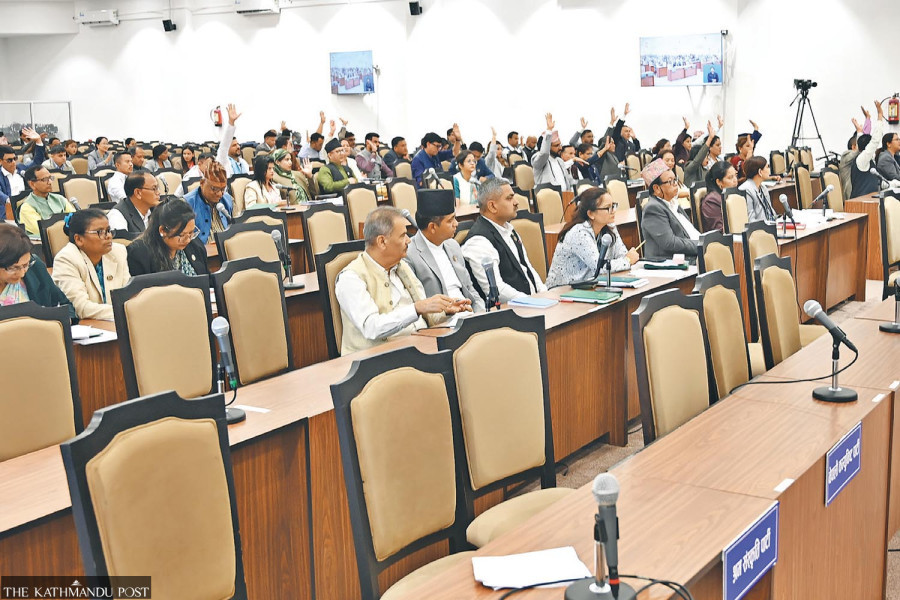
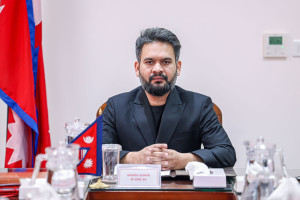
Tuesday’s failed vote exposes a wider attendance problem, with senior leaders and ministers frequently missing sittings and raising questions over parliamentary accountability.Article 94 of the constitution of Nepal requires at least one-fourth of the total membership of either house of the Federal Parliament to be present before any motion or proposal can be put to a decision. With 275 members in the House, at least 69 lawmakers were required. Post File Photo
The House of Representatives on Tuesday failed to advance a key government bill after most lawmakers left the chamber, leaving Parliament without the minimum number required to conduct a vote.
The episode has renewed questions over parliamentary discipline and accountability in a House where the ruling Rastriya Swatantra Party (RSP) commands a near two-thirds majority, but lawmakers failed to remain present for a core legislative duty.
The session began at 1pm with 223 lawmakers recorded as present. By 8:05pm, however, when Speaker DP Aryal called for a vote on whether to proceed with the Mines and Minerals Bill, 2026, only 61 MPs remained in the chamber.
Lawmakers supporting the proposal initially raised their hands and voiced “Aye”. But when the Speaker sought opposing views, Nishcal Rai, whip of the main opposition Nepali Congress, objected and demanded a physical count to establish whether the House had the required quorum.
After the Speaker rang the quorum bell for three minutes, a headcount found that just 61 lawmakers were present.
Article 94 of the constitution of Nepal requires at least one-fourth of the total membership of either house of the Federal Parliament to be present before any motion or proposal can be put to a decision. With 275 members in the House, at least 69 lawmakers were required.
The failure was particularly striking on the ruling benches. Of the 182 lawmakers supporting the government, only 52 remained, including one minister. The opposition, which has 92 seats, had just eight lawmakers in the chamber.
As the quorum requirement was not met, the proposal presented by Minister for Industry, Commerce and Supplies Gauri Kumari Yadav to consider the Mines and Minerals Bill was deferred. It will now be put to a vote at the next sitting on August 17.
The ruling alliance, excluding the Speaker, has 182 seats, comprising 181 RSP lawmakers and independent MP Mahabir Pun, who serves as minister for science, technology and innovation. The government is led by Prime Minister Balendra Shah and has 17 other ministers.
Parliamentary rules also require at least one minister to be present for a sitting to proceed. Yadav, the minister sponsoring the bill, remained in the chamber. Ministers and Deputy Speaker Rubi Kumari Thakur, who stayed until the session ended, are also counted towards the quorum.
The opposition benches were even more sparsely occupied by the end of the sitting. Only Nepali Congress lawmakers Nishcal Rai, Bishnu Bahadur Khadka, Narendra Kumar Kerung and Ninu Kumari Karna remained, along with NCP lawmakers Ramesh Malla, Gopal Sharma and Nirasha Chaudhary, and Shram Sanskriti Party lawmaker Purna Prasad Limbu.
Not a single lawmaker from the CPN-UML or Rastriya Prajatantra Party (RPP) remained until the end of the sitting.
The incident has raised questions about the ruling party’s responsibility to ensure that its own legislation can be taken up in Parliament. With the RSP holding a formidable majority, the failure to maintain a quorum was largely a failure of attendance among government lawmakers.
After the session, RSP whip Krantishikha Dhital urged party lawmakers in a WhatsApp group to reflect on what had happened.
“The blame for today’s lack of quorum will fall on all MPs. While opposition presence was also very low, the primary responsibility lies with us,” Dhital wrote.
She said the failure was not an isolated incident but reflected a broader failure among both party leaders and rank-and-file lawmakers to recognise Parliament’s dignity and the value of its time. She urged lawmakers to set aside other priorities and attend parliamentary proceedings regularly.
Lack of focus and accountability
The failure to maintain a quorum on Tuesday was not an isolated lapse. Parliamentary officials and lawmakers say it reflects a broader problem of absenteeism and a loss of focus on Parliament’s core functions.
Rajendra Phuyal, former secretary of the National Assembly, said lawmakers appeared to be losing sight of their primary responsibility.
“An MP’s primary job while Parliament is in session is Parliament itself,” Phuyal said. He urged parliamentary leadership to examine where lawmakers go after signing the attendance register and to structure parliamentary business in a way that encourages sustained participation.
The House should balance government business with non-official motions and question hours to make its agenda more engaging, he said.
Opposition whip Nishcal Rai said opposition parties also had a responsibility to uphold the dignity of Parliament, but the greater burden rested with the ruling side.
“Why should ruling party members be absent during government business?” Rai said. “In parliamentary practice, proposals pass by majority. Our MPs feel demoralised when our voices aren’t heard, but we take this matter seriously and will motivate our lawmakers as well.”
NCP lawmaker Ramesh Malla said the ruling party must understand that passing government legislation requires it to maintain a working majority in the chamber.
“The ruling party must possess the basic understanding that passing its own government’s bill requires numbers,” Malla said. The ruling benches must remain prepared for a vote even if the opposition decides to boycott proceedings or challenge a proposal, he added.
Phuyal said the current House, formed after the Gen-Z political movement, should adopt a structured annual calendar and work plan setting out legislative priorities, bill schedules and response times.
RSP whip Prakash Chandra Pariyar said the parliamentary party would take measures to prevent a repeat of Tuesday’s failure.
“We will conduct a thorough review and prepare a report,” Pariyar said. “We will issue clear directives to enforce responsibility and tighten the lawmaker evaluation system.”
Pariyar and fellow RSP whip Krantishikha Dhital had already been tasked with reviewing parliamentary attendance. Tuesday’s quorum failure will now form part of that assessment, Pariyar said.
Parliament Secretariat records point to a wider pattern. The House held 41 sittings between April 2 and July 15, but only six lawmakers attended every sitting: RSP lawmakers Sunil KC, Ratna Kumari Thapa and Govinda Panthi; Nepali Congress lawmakers Narendra Kumar Kerung and Bharat Bahadur Khadka; and NCP lawmaker Nirasha Chaudhary Dagaura.
Secretariat spokesperson Ekram Giri said attendance figures for the current month of Shrawan, which runs from July 17 to August 16, were still being compiled.
Some of the country’s most senior political leaders recorded particularly low attendance during the 41 sittings.
Prime Minister Shah, who leads the RSP parliamentary party, attended just six sittings, despite repeated requests from Speaker Aryal for lawmakers to attend parliamentary proceedings.
Former prime minister and NCP parliamentary party leader Pushpa Kamal Dahal attended five sittings, citing illness and an official visit to Sri Lanka. RSP president Rabi Lamichhane attended 21 sittings.
UML parliamentary party leader Ram Bahadur Thapa attended 24 sittings, while Shram Sanskriti Party chairman Harka Raj Rai and RPP parliamentary party leader Gyan Bahadur Shahi attended 25 each. Main opposition leader Bhishma Raj Angdembe had a significantly higher attendance, appearing in 35 of the 41 sittings.
Attendance among ministers was also low, with several failing to attend even half of the House sittings.
Minister for Energy and Water Resources Biraj Bhakta Shrestha had the lowest attendance after the prime minister, appearing in seven sittings. Minister for Education and Sports Sasmit Pokharel, who is also government spokesperson, attended eight.
Minister for Infrastructure Development Sunil Lamsal and Minister for Foreign Affairs Shishir Khanal attended nine sittings each. Minister for Culture, Tourism and Civil Aviation Khadga Raj Paudel attended 12.
Finance Minister Swarnim Wagle and Minister for Communication and Information Technology Bikram Timilsina attended 15 sittings each, while Minister for Health and Food Safety Nisha Mehta attended 16.
Minister for Land Management, Cooperatives, Federal Affairs and General Administration Pratibha Rawal attended 17 sittings, followed by Minister for Agriculture, Forests and Environment Gita Chaudhary with 18.
Minister for Law, Justice and Parliamentary Affairs Sobita Gautam attended 23 sittings, while Minister for Industry, Commerce and Supplies Gauri Kumari Yadav and Home Minister Sudan Gurung attended 24 each.




 18.53°C Kathmandu