Paddy season is slipping away, but two Nepali farmer brothers are stuck in India jail
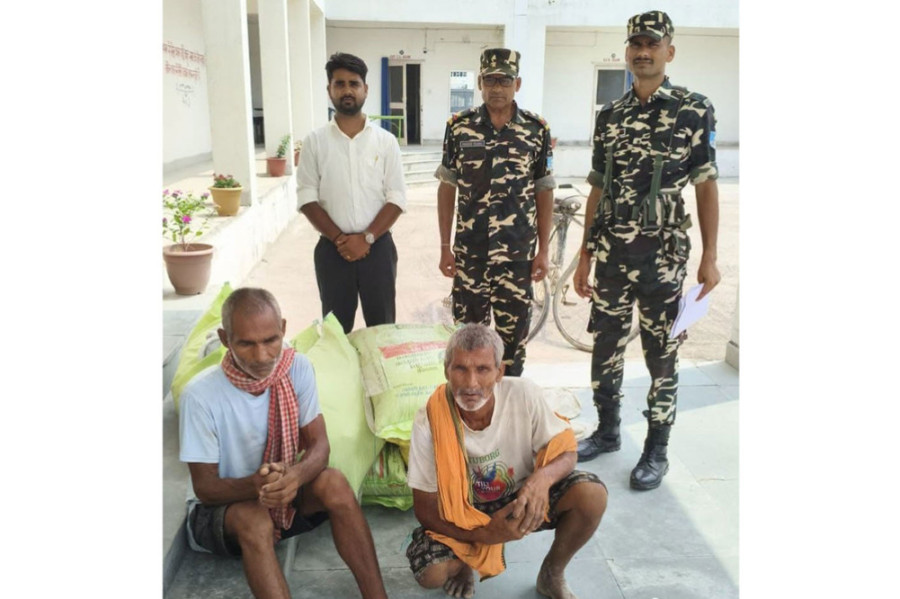
Arrested after buying fertiliser across the border, they are still awaiting bail as Nepal's chronic shortages push farmers to take risks. Sarlahi residents Nagendra Prasad Singh and Suresh Prasad Singh were arrested by India’s Sashastra Seema Bal (SSB) while returning with fertiliser from Sonbarsa in Bihar’s Sitamarhi district. File Photo via Sitamarhi Live
Two farmers from Sarlahi district have spent nearly three weeks in an Indian prison after being arrested while returning home with chemical fertiliser bought from a border market. Their arrest is the latest reminder of Nepal’s chronic fertiliser shortages, which force many farmers to buy subsidised fertiliser across the border despite the legal risks.
Suresh Prasad Singh, 55, and his elder brother Nagendra Prasad Singh, 60, of ward 5 in Balara Municipality were detained on July 1 by a joint team of India's Agriculture Department and the Sashastra Seema Bal (SSB) near Sonbarsa in Bihar. According to their family members, the brothers had purchased two sacks of urea and six sacks of diammonium phosphate (DAP).
Instead of transplanting paddy on their roughly two-and-a-half bigha (1.69 hectares) of land, as they usually would by this time of year, the brothers remain behind bars at a jail in Dumra of Sitamarhi district. Their fields have been left uncultivated as the monsoon planting season advances.
Family members insist that the fertiliser was intended solely for use on their own farm and reject allegations of smuggling.
Prabin Singh, Nagendra's son-in-law, said the legal process has moved slowly despite repeated efforts by relatives. "The court sought documents related to the case from Sonbarsa police, but the bail hearing has yet to be completed," he said. "We have been told that the judge was on leave. We hope they will be released after a hearing this week, but the delay has caused enormous anxiety for the family."
According to relatives, all necessary paperwork has already reached the court, yet procedural delays have prolonged the brothers’ detention.
The arrest has placed the family under severe financial and emotional distress. Farming is their main source of income, but the land remains uncultivated because the two brothers, who normally manage cultivation, are still in custody.
"Our neighbours have already finished planting paddy, but our land is still lying fallow," said Aditya Singh, Suresh's son. "We are waiting for them to come home so that we can begin cultivation."
District officials in Nepal say they have been coordinating with Indian authorities, although they acknowledge that the judicial process lies beyond their control.
Hom Prasad Ghimire, assistant chief district officer of Sarlahi, said local officials have remained in contact with Indian security agencies regarding the case.
"We are continuing coordination for their release and are awaiting the latest update," he said.
Chief District Officer Bijay Raj Subedi said the Home Ministry had already been informed about the arrest and that local authorities were also communicating with the SSB.
"We have ensured that the family members have been able to meet them and that they are receiving the treatment and access they are entitled to during the legal process," said Subedi. "Further initiatives are being handled at higher levels." He added that Indian officials had informally explained that subsidised fertiliser is intended exclusively for Indian farmers and that security agencies have been instructed to prevent its movement across the international border.
Under India's Fertiliser (Control) Order and the Essential Commodities Act 1955 subsidised fertiliser distributed for agricultural use cannot legally be exported or transported outside the country without authorisation. Violations may result in confiscation of both the fertiliser and the vehicle used for transportation, while offenders can face imprisonment and fines
The case has again exposed the annual fertiliser crisis that affects farmers across the country, mainly in the southern plains considered as granary of Nepal. Every planting season, long queues form outside government depots operated by the Agriculture Inputs Company and local authorities as farmers compete for limited stocks of subsidised fertiliser.
Many farmers complain that supplies often arrive late or run out before demand is met. As a result, purchasing fertiliser from nearby Indian markets and carrying it home on bicycles or on foot has become common practice in many border communities despite the legal risks involved.
Local people of Balara claim that the Singh brothers are the latest victims of a problem rooted in shortages rather than criminal intent. Neighbour Anirudh Singh said the government should intensify diplomatic and legal efforts for their release.
"They are genuine farmers, not smugglers," said Anirudh. "They crossed the border only because they couldn’t get enough fertiliser at home. The government should do everything possible to bring them back."
Mohna Ansari, former National Human Rights Commission member, described the incident as deeply troubling. "It is unfortunate that farmers searching for an essential agricultural input have ended up in a foreign prison," she said. "The government should formally seek clarification through diplomatic channels about why its citizens have been detained and ensure the case is addressed without unnecessary delay."
She said both the Home Ministry and the Ministry of Foreign Affairs should actively engage with their Indian counterparts if the brothers are detained for transporting fertiliser intended for their own farm.




 15.85°C Kathmandu