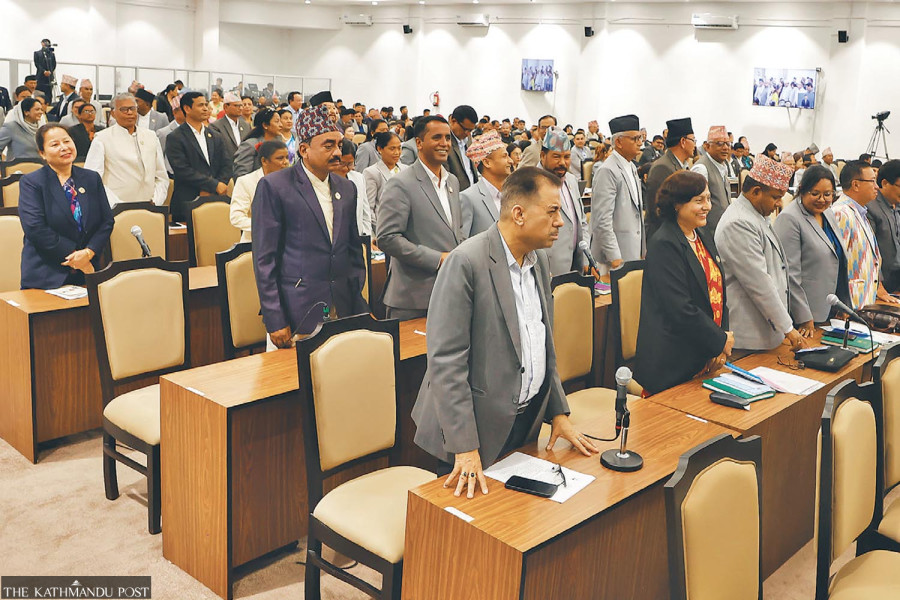
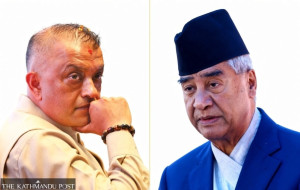
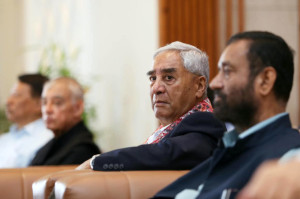
Decision revives concerns over nepotism, political patronage and misuse of public funds.The government has decided to restore personal secretaries for lawmakers after repeated complaints that the lack of professional administrative support was hampering their legislative duties. This photo, taken in May, shows lawmakers protesting prime minister’s absence from Parliament during policy discussions. Post file photo
The federal government has decided to restore personal secretaries for members of the federal parliament, a move that has reignited debates over fiscal responsibility and nepotism in public administration.
Under the decision, members of both the House of Representatives and the National Assembly will once again be allowed to appoint a personal secretary with a salary equivalent to a gazetted third class officer of Nepal government.
The Minister for Law, Justice, and Parliamentary Affairs, Sobita Gautam, confirmed that the Cabinet meeting on Tuesday approved the proposal to amend Schedule 2 of the Act Relating to Remuneration and Facilities of Office Bearers and Members of the Federal Parliament, 2016. The amendment restores the secretarial staff structure to its previous format, which also includes under-secretary-level aides for the Deputy Speaker of the House and the Vice-Chairperson of the National Assembly.
According to Gautam, the decision was prompted by repeated complaints from lawmakers that the lack of professional administrative support was hampering their legislative duties.
"Lawmakers repeatedly complained that without personal secretaries, they faced severe difficulties in conducting legislative research, drafting bills, and managing political portfolios," said Gautam. "We must give lawmakers the support they need to do their jobs effectively."
The government led by Sushila Karki, which was formed in the wake of the Gen Z movement, scrapped the personal secretary provision in October, 2025. That austerity measure had drawn swift condemnation from then Speaker Devraj Ghimire and National Assembly Chairman Narayan Prasad Dahal, who argued it undermined parliamentary independence.
While the restoration is welcomed by lawmakers, critics say the provision has a history of abuse. Following the 2022 general elections, it was revealed that at least 48 MPs had appointed immediate family members—including spouses, siblings, and cousins—to these taxpayer-funded positions. Historically, the salaries were deposited directly into the MPs’ bank accounts, leading to ‘ghost appointments’ where relatives never actually worked while lawmakers pocketed the salaries.
To prevent this unethical practice, the Parliament Secretariat later mandated that all salaries must be deposited directly into the personal secretaries’ individual bank accounts rather than the lawmakers' personal holdings.
Ekaram Giri, spokesperson for the Federal Parliament Secretariat, said that while they have not yet received the official Cabinet directive, the demand for aides is legitimate, provided they meet basic standards.
"It is the right of the members to appoint their secretarial staff," said Giri. "However, if they appoint individuals who meet the educational and professional requirements prescribed by the Public Service Commission for a section officer, the secretariat will have little reason to object. The Office of the Auditor General has repeatedly questioned the lack of defined academic qualifications for these posts in its annual reports. We are waiting for the official gazette notification to decide our next steps."
Former general secretary of the Parliament Secretariat Manohar Bhattarai echoed the need for stringent reform, suggesting an independent hiring mechanism to prevent nepotism.
"While lawmakers absolutely require assistants to conduct research, analyse policy, and participate meaningfully in parliamentary debates, the rampant abuse of this provision in the past has created deep public cynicism," said Bhattarai. "To prevent nepotism, we should explore a system where aides are recruited and deputed through an independent body, similar to regular civil servants. This would preserve the utility of the provision while eliminating personal patronage."
Minister Gautam, however, strongly urged political parties and individual federal MPs to exercise strict self-regulation. "A personal secretary is central to a lawmaker’s political secretariat, handling crucial coordination and administration work," she said. "While abuses occurred in the past, we now have a younger generation of MPs who understand the value of professional competence. Political parties must also keep a close watch on who their MPs appoint,” said Gautam. “My party, the Rastriya Swatantra Party, will actively monitor this. We expect MPs to hire highly qualified individuals."
As the government prepares to formalise this controversial decision, both the public and seasoned anti-corruption watchdogs in Kathmandu remain deeply sceptical about its systemic integrity.




 22.23°C Kathmandu