Home Minister Gurung stays in Tarai as tensions ease
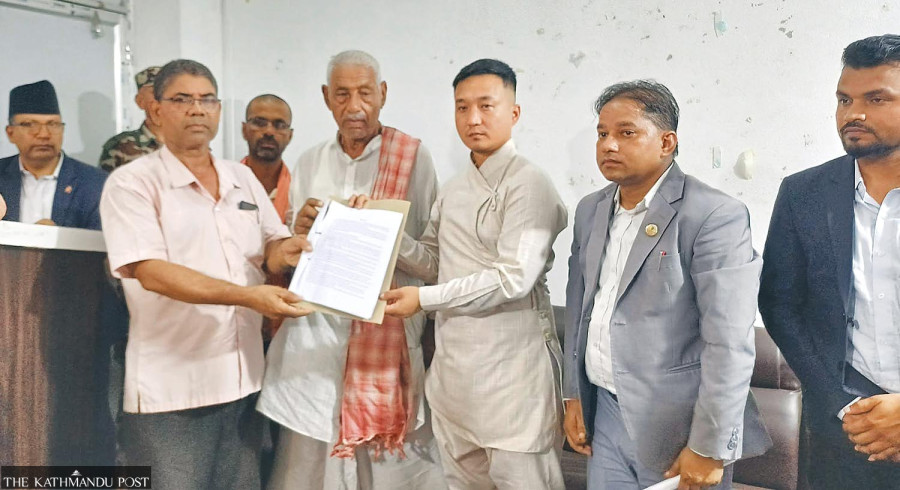
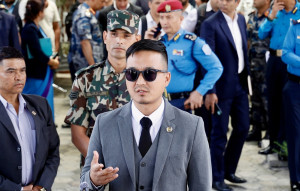
The home minister’s direct intervention marks a shift from curfews and security deployments to negotiations with victims’ families and local groups.Home Minister Sudan Gurung holds an agreement that the government signed with victims’ families in Dewanganj, Sunsari on Thursday night. Post photo
Home Minister Sudan Gurung has shifted his operational approach to manage spreading communal unrest in the Tarai-Madhesh, stepping out from Singha Durbar to personally lead ground-level negotiations across affected districts.
Vowing not to return to Kathmandu until full stability is restored, Gurung’s direct intervention marks a strategic turn away from an initial reliance on curfews, police reassignments, and security deployments that failed to contain the crisis.
The turmoil erupted on July 26 in Dewanganj Rural Municipality-4, Sunsari, where a local dispute escalated into violent confrontation. Security forces opened fire, killing 30-year-old Om Prakash Mehta and injuring nine others. A second victim, Jay Prakash Mehta, 30, later succumbed to his injuries during treatment.
Witnesses said that law enforcement used excessive force during a manageable confrontation. Jugesh Das, a local resident who witnessed the incident, recalled that security personnel fired indiscriminately while a minor dispute was still underway.
In the immediate aftermath, Minister Gurung remained in the national capital, convening high-level meetings with chiefs of the security agencies. Present at these strategy sessions were Home Secretary Raj Kumar Shrestha, Inspector General of Nepal Police Dan Bahadur Karki, Armed Police Force Chief Narayan Datta Paudel, Chief of the National Investigation Department Tekendra Karki, and Nepali Army Lieutenant General Pradeep KC. Expecting the situation to be contained through administrative measures, the ministry imposed curfews, deployed army patrols, and reshuffled local security chiefs.
However, hardline measures failed to de-escalate the situation. By the fourth day, as drone surveillance feeds monitored closed streets, unrest began spilling into neighboring districts. Experts noted that heavy-handed security tactics without political engagement often backfire in sensitive communal settings.
Former Additional Inspector General of Police Uttam Subedi said that law enforcement alone cannot substitute for trust-building measures.
“This was not merely a routine law-and-order issue; it required immediate political and civil society dialogue,” said Subedi. “Security presence alone cannot halt communal tension. Furthermore, replacing local security teams at the initial stage can disrupt operational coordination and field-level command.”
The limitations of a purely administrative response became starkly evident on July 30. Despite active curfews, demonstrations broke out in Golbazar of Siraha, where security forces opened fire, killing 17-year-old Ganesh Yadav of Aurahi Municipality-2. The death of Yadav, alongside Jay Prakash Mehta’s passing on the same day, fueled widespread public indignation. Protests intensified, social media platforms saw a surge in provocative commentary, and demonstrator groups expanded their demands.
Faced with a worsening crisis, Minister Gurung met with Prime Minister Balendra Shah on Thursday before flying to Biratnagar. Escorted by heavy security, Gurung visited the injured at Birat Nursing Home and Neuro Hospital, directing medical personnel to ensure comprehensive care at state expense. Outside the hospital, crowds gathered to chant slogans demanding the resignations of Prime Minister Shah and Home Minister Gurung, insisting that the deceased be declared martyrs and their families compensated.
Later that night, Gurung reached Kaptanganj of Dewanganj, Sunsari, to hold direct discussions with the victims’ families and local representatives. Following overnight negotiations, an agreement was signed early Friday morning. The government pledged to initiate the process to declare both Sunsari victims martyrs, provide Rs1 million in relief to each family, fund the construction of a memorial park in coordination with the local government, and offer employment opportunities to eligible family members.
The signed accord also committed to a transparent investigation and an official inquiry into the legal status of local madrasas. Following the agreement, the families received the bodies for final rites.
However, outrage remained high in Siraha over the death of Ganesh Yadav. Accompanying a delegation that included former minister Bablu Gupta and lawmakers Shiv Yadav and Purushottam Yadav, Minister Gurung arrived at the Yadav family home in Aurahi-2 late Friday night. The meeting resulted in an eight-point agreement on Saturday morning, guaranteeing a formal investigation, martyr status, financial relief, and free health and education coverage for the victim’s siblings. Former Minister Gupta confirmed that dialogue continues across various sectors.
“We are actively engaging with all sides because dialogue was the only viable solution,” said Gupta. “Everyone is currently working around the clock to restore peace across Madhesh.”
By Saturday afternoon, Minister Gurung initiated talks at the District Administration Office in Dhanusha with representatives of the Hindu Samrat Sena, a group that had organised demonstrations following the incidents. The organisation had previously been identified as a potential security concern in a confidential Armed Police Force forecast report. Joined by Rastriya Swatantra Party lawmakers Manish Jha and Raj Kishor Mahato, the government team reviewed the group’s demands, which included an investigation into a power outage that occurred prior to the police firing in Kaptaanganj, full compensation for victims, and broader political demands.
Former Additional Inspector General of Police Bhim Dhakal emphasised that administrative mechanisms must focus on prevention rather than purely reactive measures during communal friction.
“The initial phase showed how delayed political intervention can compound a crisis,” said Dhakal. “While standard criminal matters require post-event investigation, the home administration’s primary duty during communal sensitivity is prevention. Authorities must proactively identify vulnerable areas to prevent untoward incidents before they occur.”
The current unrest reflects broader challenges documented in regional news coverage. Communal flare-ups across the southern plains—including clashes in Sarlahi, Mahottari, and Dhanusha—have consistently highlighted how localised disputes can rapidly expand when public trust in local administration breaks down.
Lasting stability in the Tarai-Madhesh has historically required sustained multi-party mechanisms, joint peace rallies, and direct engagement between central authorities and local community leaders.
With peace rallies now being organised in Sunsari, Siraha, and Dhanusha, local officials report that public agitation is gradually easing as government commitments are implemented. Minister Gurung remains stationed in the region to oversee the implementation of the signed agreements and ensure local security coordination holds. “I will return to Kathmandu only after peace is completely restored in Madhesh,” said Home Minister Gurung.




 15.26°C Kathmandu