These seven Nepali startups are building technology that tackles real-world problems
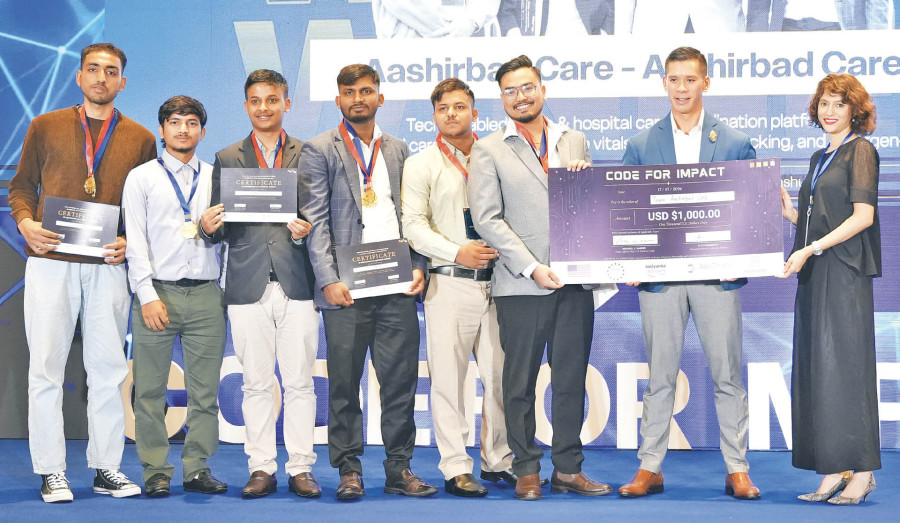
From home healthcare and Braille-to-Unicode tools to AI-powered farming and tourism, young innovators unveil practical solutions at the ‘Code for Impact’ hackathon. Members of Aashirbad Care, a startup adjudged among the top four at ‘Code for Impact’ hackathon, receive the prize at a function on Friday. Photo: Courtesy of Aadyanta Advisory
Nepali youth have unveiled seven unique digital platforms to tackle societal challenges across healthcare, education, tourism, agriculture, accessibility, and finance. These creative solutions emerged prominently during the recently concluded ‘Code for Impact’ hackathon, an intensive entrepreneurial challenge jointly organised by the United States Embassy in Nepal and Adhyanta Advisory.
The event drew 190 companies from across the country, each pitching unique technological interventions to address pressing systemic hurdles. The primary purpose behind this major national initiative was to actively connect digital infrastructure with everyday human challenges, transforming abstract programming into practical tools for social good.
Following rigorous evaluations, seven exceptional groups were declared national winners, showcasing the immense potential of homegrown technology. Among these innovators, Aashirbad Care, NepAI, Data Hiti, and Synaptic emerged at the very top, securing national titles along with substantial cash prizes to scale their operational models.
The success of these young innovators comes at a critical time for Nepal’s IT sector. The digital ecosystem faces policy ambiguities, lack of venture capital, and a continuous brain drain of software developers seeking opportunities abroad. Yet, events like ‘Code for Impact’ show that local talent remains resilient and capable of engineering world-class solutions tailored specifically to Nepal’s unique geographical and socio-economic realities.
During the award distribution ceremony, Mike Harker, public affairs chief at the US Embassy in Kathmandu who served as a member of the jury, praised the remarkable ingenuity of the participants. He said that the strategic partnership between creative Nepali youth and advanced American technological concepts could open unprecedented frontiers for local economic development.
Harker masterfully compared the difficult journey of modern entrepreneurship to climbing Mount Everest, reminding the audience that reaching the summit is merely half the battle. He said true success requires solid partnerships and thorough preparation rather than solitary efforts.
Stuti Basnyat, co-founder of Adhyanta Advisory, stated that the ultimate achievement of the entire programme lies in its direct ability to bridge the gap between advanced technology and the actual, practical difficulties faced by ordinary citizens. Adding to this, Kailash Bijayanand, president of the American Chamber of Commerce (AmCham) in Nepal, observed that the participating startups have genuinely strived to discover meaningful solutions that carry a profoundly positive and lasting impact on the daily lives of the people.
Aashirbad Care: support for senior citizens
Addressing the critical gaps within the country’s healthcare system, Aashirbad Care has formally launched an essential digital service to provide comprehensive medical treatment, rehabilitation, and compassionate caregiving directly at the doorsteps of elderly citizens.
This startup targets senior citizens who are suffering from chronic illnesses or dealing with advanced age-related frailties. Dr Rohit Rawat, co-founder of the company, explained that the platform was conceived directly in response to Nepal’s shifting demographic trends, characterised by a rapidly growing elderly population and a simultaneous rise in complex geopolitical health complications.
Dr Rawat, who simultaneously works in the clinical department of Patan Academy of Health Sciences, explained that Aashirbad Care operates fundamentally as a technology-driven care coordination platform designed entirely by a professional team of certified medical doctors. “We noticed a severe lack of structured post-hospitalisation care in Nepali households, which often leads to preventable readmissions,” said Dr Rawat.
The service fees for caregivers are carefully determined based on the specific clinical condition and personal requirements of each individual patient. To maintain operational viability, the company requires a minimum booking shift of eight hours. For standard, non-clinical companionship and basic care, the platform charges a modest fee of Rs100 per hour. However, for patients requiring specialised medical attention—such as nasogastric feeding, regular secretion suctioning, or advanced dementia management—the cost scales up to Rs150 per hour.
The startup began as a modest initiative by Dr Rawat and Pratik Gautam, who initially invested a personal sum of Rs500,000 to build the basic software infrastructure. Today, the enterprise has rapidly expanded into a robust professional team consisting of 57 dedicated individuals, including Dr Sitanshu Dhakal and Prabesh Gautam. The platform now features 50 fully trained, verified caregivers who provide round-the-clock assistance across all three districts of the Kathmandu Valley—Kathmandu, Lalitpur and Bhaktapur.
Recognising further gaps in traditional hospital settings, the organisation has recently introduced an innovative ‘Hospital Assistance Service’ to support families who are unable to stay overnight with hospitalised relatives. Dr Rawat noted that the public demand and popularity for this specific service have surged tremendously within a very short period. “It has been only about two months since we initiated this hospital assistant service, and it is becoming exceptionally popular among urban families,” shared Dr Rawat. “So far, our trained assistants have successfully provided dedicated bedside care to ten major clients across reputable institutions like the BP Smriti Hospital, the Tribhuvan University Teaching Hospital, and the Patan Hospital. For this vital assistance, we charge a reasonable rate ranging from Rs110 to Rs 120per hour.”
NepAI: Braille now in Unicode as well
The ‘Access Code’ team from Pokhara, comprising Arun Shrestha, Chhabi Ale, Rohan Raj Paudel, and Dhiraj Chaurasiya, developed ‘NepAI’ to convert Braille into Unicode text.
As Ale is visually impaired himself, the technology was built on the foundation of his personal experiences. He has been working on preparing the essential Braille datasets required for the application. “When teachers or parents cannot understand what students have written in Braille, the learning process slows down drastically,” says Ale. “We write in Braille and take our exams in Braille, but because there are no transcribers to convert those materials into standard text, we are forced to wait for weeks just to have our papers marked and to receive feedback.”
There are more than 145,000 blind people in Nepal. Banks have consistently hesitated to allow them to open bank accounts, make payments, provide signatures, or access banking applications. Given this situation, Ale expects the Braille-to-Unicode technology to make things much easier.
“This will also become an effective medium for employers who want to hire visually impaired individuals but hesitate due to communication gaps,” he said. “It will broaden our employment opportunities. Organisations like the Nepal Association of the Blind and the National Federation of the Disabled Nepal can use this institutionally for the educational and professional development of their members.” Providing paid services through Access Code is the team's business model.
Data Hiti: easing cross-border transactions
Operating in the digital payments sector, Data Hiti aims to streamline cross-border transactions. According to its co-founder Kabish Pokharel, the team had already been developing international products. However, after facing severe difficulties in receiving payments from abroad, they sought a solution, which led to the concept of the Elytra app.
“We make cross-border payments fast and efficient, and we are currently providing payment services for American companies operating in Nepal to bring their funds into the country,” said Pokharel. “Data Hiti has developed an instant-settlement technology as an alternative to the traditional banking system.” The team includes Pokharel alongside Anshu Regmi and Rij Maharjan.
According to Pokharel, the Elytra app settles cross-border transactions within a few minutes using a ‘non-custodial ABI’. He claimed this technology immediately resolves the issues of ‘pre-funding’ and the days-long delays associated with receiving remittance through traditional banking. “We are not a remittance company or a payment service provider ourselves,” Pokharel clarified. “We are simply a technology firm. We provide technical services to licensed banks and financial institutions. Our product is designed to serve existing fintech giants rather than compete with them.”
Cad Coder: from medicine search to appointments
Addressing persistent issues in the healthcare sector, a team comprising Bishal Sharma, Ritesh Raut, Prasatab Shrestha, and Samisha Yonghang from Jhapa has developed a platform called Dose. The startup integrates patients, doctors, hospitals, and pharmacies into a single network.
Bishal explained that the platform provides transparent information in a Nepali context where accessing details about medicines and healthcare services is typically cumbersome. “Health records are fragmented and inaccessible. Patients cannot easily identify authentic medicines, compare prices, or find doctors,” he said. “Dose offers users the convenience of searching for medicines, comparing prices, and booking hospital appointments all in one place.”
To prevent the haphazard use of medicines, the platform includes a prescription verification feature. Cad Coder stated that its technology utilises modern software infrastructure, including Dingo and LangChain. The startup is currently expanding its network by partnering with hospitals and pharmacies.
Neptu: original experiences for tourists
In the tourism sector, ‘Neptu’ uses artificial intelligence to help tourists discover new and overlooked destinations. This hyper-local tourism application primarily helps foreign tourists understand local experiences in Nepal and generates travel itineraries for them, according to Neptu’s business lead, Alisha Hada.
“The app does not have all its features integrated just yet, but the AI itinerary and information on local places are available,” said Hada. “In just a while, tourists will be able to book local guides directly through the app. We will arrange for local guides to show tourists around during cultural events such as Holi, jatras, or mud festivals. We also plan to package experiences like tasting local cuisine and making Bhaktapur's traditional clay pottery for tourists.”
Subodh Kathayat conceptualised Neptu in 2022. Studying at the New Jersey Institute of Technology in the US, Subodh and Alisha formed a team with Dhiraj KC and Keshav Thapa.
Synaptic: a companion for autistic children
Meanwhile, ‘Synaptic’ has created an environment for children with autism, learning difficulties, or speech delays to learn vocabulary using augmented reality (AR) technology. Developed by Kathmandu University students Arya Pathak, Himesh Dulal, Safal Narsingh Shrestha, Shoham Kayastha, and Shreyan Basti, the ‘Card AI’ app transforms physical learning cards into 3D visuals and audio through AR.
“When a physical card is scanned through our app, a 3D model of the respective animal or object appears,” said Pathak. “Additionally, voices and natural sounds are audible in both Nepali and English, allowing children to easily learn words as if they are playing with toys.”
Pathak said while Nepal lacks official and reliable government statistics on autism, indicators from the World Health Organisation and neighbouring countries suggest that around 300,000 children are affected in Nepal. To address this serious issue, the team has been collaborating with Tribhuvan University’s Cognitive Science and Psycholinguistics Lab and the Hope Care Centre for Child Development and Research Centre for the past year. Their initial prototype is currently being tested by one teacher, three parents, and six therapists.
Mithila Coder: the farmer’s advisor
Janakpur’s ‘Mithila Coder’ is providing agricultural consultancy to farmers in local languages. The ‘AgriSense’ app, developed by this startup, guides farmers like an expert from the time seeds are sown until the harvest. Amardeep Soni told Kantipur that the team designed the app to fetch soil details and weather data from the Nepal Agricultural Research Council (NARC) to offer concrete recommendations on which crops are best suited for specific plots of land.
The group consists of developers Amardeep, Purushottam Yadav, Shyam Sundar Yadav, and Satyanarayan Sah. “All four of us are developers and we are also farmers ourselves, so this was our own family problem,” said Soni. “Farmers in the Tarai still farm the traditional way and are forced to work based on guesswork, which is why we are building the AgriSense app. We aim to use technology to solve the problems farmers face due to a lack of experts.” He added that if a crop contracts a disease, farmers can simply send a photo, and the app will use AI to diagnose the issue and suggest treatments.




 26.04°C Kathmandu