Congress, UML working to petition court against House regulations
Congress and UML say key provisions on ‘obstacle removal’, constitutional amendments and the legal status of House regulations violate the constitution and undermine the bicameral legislature.Party leaders say they will possibly file the petition at Supreme Court on Thursday. Post File Photo
Major opposition parties, the Nepali Congress and the CPN-UML, are preparing to move the Supreme Court to challenge several provisions of the House of Representatives Regulations 2026, arguing that they are inconsistent with the constitution and prevailing laws. The two parties will file separate writ petitions seeking to have the disputed provisions struck down.
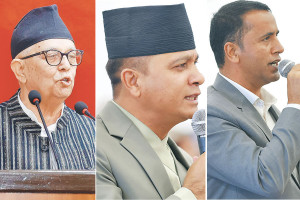
Bhishma Raj Angdembe, the Congress parliamentary party leader, said the petition was being finalised in consultation with senior advocates and would be filed possibly on Thursday. According to him, three members of the party’s National Assembly parliamentary party, along with the chief whip and a whip from its House of Representatives parliamentary party, will jointly file the petition.
The UML is also preparing a separate petition signed by members of its parliamentary parties in both houses. Ain Mahar, the UML chief whip in the House of Representatives, said senior advocate Tikaram Bhattarai has been entrusted with drafting the petition.
“Our effort was to file a joint petition with the other opposition parties. Even though the Congress is filing its own petition, the cases will eventually be heard together, so it makes little difference,” Mahar said.
The House of Representatives passed the regulations by a majority vote on May 31 despite protests from opposition lawmakers, who shouted slogans and obstructed proceedings from the rostrum.
“The regulations were pushed through solely on the strength of a majority despite our objections. Several provisions directly contradict the constitution and prevailing laws. We are approaching the Supreme Court to have those clauses annulled,” Angdembe said.
Congress president Gagan Thapa, along with other party office-bearers and senior advocates close to the party, met last Friday to discuss the legal challenge. Following consultations with senior advocates Radheshyam Adhikari, Harihar Dahal, Gopal Krishna Ghimire, Prem Bahadur Khadka, Yadu Nath Khanal, Sher Bahadur KC and Lalit Basnet, the party decided to move the court.
The draft petition challenges three key provisions of the regulations: the preamble, Rule 140 and Rule 259. It argues that the preamble expands the House’s authority beyond what is permitted by the constitution, Rule 259 improperly gives House regulations the status of federal law, and Rule 140(11) conflicts with Article 274 of the constitution governing constitutional amendments.
“Protecting the authority, dignity and constitutionally prescribed legislative process of both houses of Parliament is the constitutional duty of lawmakers,” the draft petition states. “However, the regulations passed by a majority directly affect the constitutional jurisdiction of both the House of Representatives and the National Assembly. As these provisions infringe on the constitutional role and authority of parliamentarians, intervention by the Supreme Court is necessary to safeguard the constitution and resolve this constitutional dispute.”
Dispute over the preamble
The petition’s primary challenge concerns the inclusion of the phrase “to remove difficulties that may arise” in the preamble of the regulations.
Article 104(1) of the constitution authorises the House of Representatives to frame its own rules. The constitution limits that authority to three purposes: conducting House business, maintaining order during meetings, and regulating the composition, functions and procedures of the House and its committees.
However, the regulations adopted by the House include an additional power.
“This regulation has been framed by exercising the powers conferred by Article 104, Sub-article (1) of the Constitution, to conduct the business of the House of Representatives, maintain order during meetings, regulate the constitution, functions and procedures of the House or committees, and to remove difficulties that may arise,” the preamble states.
Senior advocate Yadu Nath Khanal said introducing a power not expressly granted by the constitution was a serious constitutional flaw.
“The preamble is the soul of the legislation. If it claims powers that the constitution itself does not provide, it weakens the legal foundation of the entire regulation,” Khanal said.
Controversy over Rule 140(11)
Another major point of dispute concerns Rule 140(11), which deals with the procedure for amending the constitution.
Article 274 of the constitution requires a constitutional amendment bill to be passed separately by a two-thirds majority of both the House of Representatives and the National Assembly, giving each chamber an equal constitutional role in the amendment process.
The Congress and the UML argue that Rule 140(11) departs from this constitutional requirement by allowing the required two-thirds majority to be calculated on the basis of the combined membership of both houses, while also giving the Speaker the authority to interpret the provision.
According to the two parties, the rule not only diminishes the constitutional role of the National Assembly but also attempts to alter the constitutional procedure for amending the Constitution.
Senior advocate Tikaram Bhattarai said the House of Representatives could not change the constitutional amendment process through its internal regulations.
“The constitution clearly requires separate two-thirds majorities in each house. House regulations cannot replace that requirement with a combined calculation,” Bhattarai said.
“The regulations have been passed in a manner that is inconsistent with the constitution. Since Rule 140 conflicts with the constitutional provisions governing amendments, it should be struck down.”
Dispute over Rule 259
The second major issue raised in the writ petition concerns Rule 259, which states that the House of Representatives Regulations will apply “notwithstanding anything contained in the prevailing laws”. Opposition parties and constitutional lawyers argue that the provision effectively elevates the regulations to the status of federal law.
Rule 259 states: “Notwithstanding anything contained in the prevailing laws, this regulation shall remain in the form of a federal law in respect of the House, committees and members, and shall apply as a special law.”
Senior advocate Tikaram Bhattarai argued that internal House regulations cannot be equated with federal legislation.
“The constitution prescribes a specific process for enacting federal laws. A bill must be passed by both the House of Representatives and the National Assembly before receiving presidential approval. The House cannot, through its internal regulations, give them the force of federal law,” Bhattarai said.
Legal experts believe the provision was inserted to provide special protection to lawmakers facing criminal prosecution.
Rule 247 of the regulations governs the suspension of lawmakers. It states that if a lawmaker is arrested, the Speaker must immediately inform the House or issue a public notice if Parliament is not in session.
Another sub-rule retains the existing provision that a lawmaker is automatically suspended if they are in custody or absconding in a criminal case punishable by at least three years’ imprisonment or involving moral turpitude.
However, the regulations make no mention of lawmakers prosecuted under corruption or money laundering laws.
Under Section 22 of the Prevention of Money Laundering Act (Second Amendment) 2020, a public office holder automatically stands suspended under Section 27 once prosecuted, until the case is concluded.
According to advocate Yadu Nath Khanal, Rule 259 is directly linked to this issue.
He pointed out that Rule 259 declares the regulations to be both a special law and federal law for matters relating to the House, its committees and members.
Rule 259(2) further states that the regulations constitute the privileges of House members, while Rule 260 gives the Speaker final authority to interpret the regulations.
Khanal noted that these provisions were introduced at a time when questions have been raised over whether Rastriya Swatantra Party (RSP) chair Ravi Lamichhane should be suspended from Parliament while facing cases related to cooperatives fraud and money laundering.
The draft petition argues that Rule 259 was incorporated specifically to shield lawmakers facing criminal charges.
“Granting regulations the status of federal law without following the mandatory constitutional lawmaking process amounts to a direct encroachment upon the legislative procedure established under Parts 8 and 9 of the Constitution. Since Rule 259 is inconsistent with Articles 111 and 113, as well as the constitution's overall legislative framework, it is liable to be declared void,” the draft petition states.
It further argues that declaring the regulations to be applicable as federal law encroaches upon the constitutional authority of the National Assembly and weakens the bicameral legislative structure established by the constitution.
Khanal said the petition would ask the Supreme Court to invalidate the disputed provisions because Rule 140 diminishes the National Assembly’s constitutional role in constitutional amendments, while Rule 259 grants the regulations the status of federal law by exercising powers not conferred by the constitution.
As the provisions violate Articles 1, 104, 133 and 274 of the Constitution, the petition will ask the court to declare them void ab initio through an order of certiorari.
“The petition will also seek an interim order suspending the implementation of the disputed provisions in the preamble, Rule 140 and Rule 259 of the House of Representatives Regulations 2026 until the case is finally decided,” Khanal said.
UML chief whip Ain Mahar said seeking judicial intervention had become unavoidable after the regulations were endorsed despite repeated objections from the opposition.
“We protested inside Parliament, but the regulations were passed on the strength of the ruling majority,” Mahar said. “Now we are turning to the Supreme Court for a constitutional remedy.”




 12.67°C Kathmandu