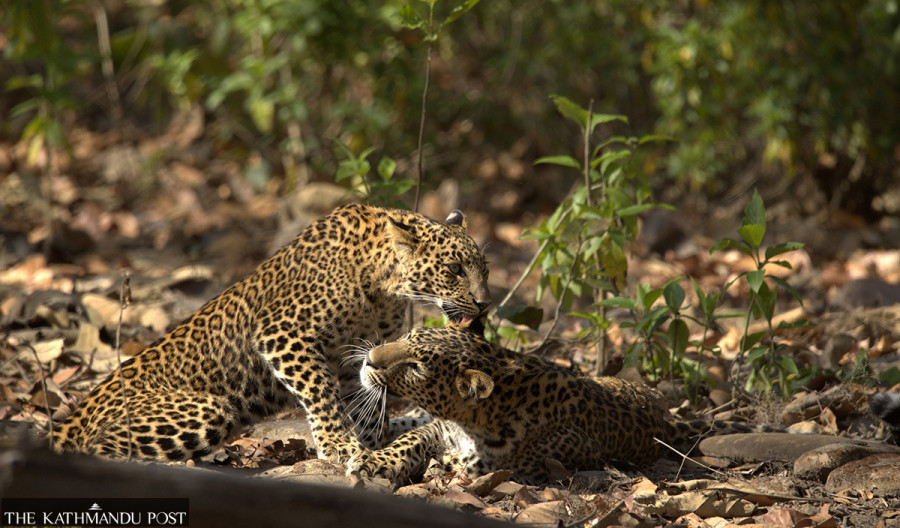
Conflicts with people are growing as expanded forest land and climate change push the creatures into human settlements. There are solutions to try. Photo via Wikimedia Commons
This story was originally published by Knowable Magazine.
In the afternoon of February 22, 67-year-old Bulal Maharjan, a farmer living on the outskirts of Kathmandu, Nepal, was sitting on his porch chopping cauliflower leaves to feed his chickens. Hearing a loud thud as a parked motorcycle toppled, he turned and watched in horror as a leopard leapt away from the fallen vehicle and lunged at him, piercing its sharp canines into his forehead, its claws lacerating his hands.
Within seconds, neighbors swarmed in, and the leopard ran into a nearby house. They eventually trapped the animal inside. After nearly two hours of panic that saw two more people injured trying to control the distressed big cat, forest division officials managed to sedate it and bring the situation under control.
Maharjan still can’t shake off memories of the attack. “For three days straight, I couldn’t even sleep. Every time I began to doze, the scene of this attack would jolt me up!” he says. “I think we should just get rid of this animal. Period.”
Bulal Maharjan, 67, narrowly escaped a harrowing encounter with a common leopard outside his home on the outskirts of Kathmandu.
Bulal Maharjan, 67, narrowly escaped a harrowing encounter with a common leopard outside his home on the outskirts of Kathmandu. Anju Dhakal
Sentiments like Maharjan’s are common across Nepal, where leopards have been responsible for significant loss of human life and livestock. Research shows that in the Himalayan nation from 2000 to 2020, conflicts between humans and four large mammals — elephants, rhinos, tigers and common leopards — claimed 887 human lives and led to the killing of 1,139 animals. Of these, common leopards — Panthera pardus— were the leading cause of human deaths at an average of 19 deaths per year, and the species most frequently killed.
To try to bring the conflict under control, Nepal and other countries with human-large predator conflicts are exploring a range of solutions.
Nepal has three ecological zones: lowland dominated by Bengal tigers, mountainous regions where snow leopards roam free, and the vast mid-hill ruled by common leopards as the top predator. While protected areas in the lowlands and mountains receive dedicated conservation funding for their charismatic predators, the mid-hills are largely managed as community forests.
The celebrated community forest program is a key reason for leopards’ thriving in the mid-hills. In the early 1990s, amid worsening floods and landslides linked to forest degradation, King Birendra handed over management of large swaths of forest to local communities so that they would have stakes in conservation, and benefit from timber and fruit harvests. Today, almost 47 percent of land in Nepal is covered by forest patches. About a third of that area belongs to community forests, most of which are run by people living in the mid-hills. “But what the communities didn’t realize was they also restored habitats so that the top carnivores could return,” said Kedar Baral, a wildlife biologist for Nepal’s Bagmati province.
In 2020, Baral’s team conducted an analysis of leopard scat collected in the mid-hills that showed that 27 percent of the animals’ diet consisted of domestic animals, while the wild ungulates that big cats typically prefer to hunt, like barking deer and wild boars, made up only 10 percent. In search of sprouting leaves, barking deer venture from the dense community forests to farmland, and “as the deer enter the farmlands, that’s where the leopard follows,” says Baral, bringing them into contact with domestic livestock.
Nepal’s hydropower and construction projects are also expanding into remote forested areas at higher elevations, disturbing habitat and bringing workers as well as a new hunting pressure against top predators, including common leopards, living there. (Common leopard pelts from illegal hunting rank among the top confiscated wildlife items in Nepal.) That forces the leopards and their prey to leave their territory, says Madhu Chetri, a wildlife ecologist at the National Trust for Nature Conservation.
Climate change might be influencing conflict patterns, too. While he was working as a district forest officer in Nepal’s western mid-hills, Baral and his team were repeatedly called to respond to common leopard attacks on local communities. Over time, he noticed a change in the pattern: Conflict incidents and human or livestock deaths were increasingly reported from higher-elevation settlements.
Reporting in 2023, Baral and colleagues investigated whether climate change was driving this shift. Using data from 343 sites across Nepal based on signs of leopard scat, animal tracks and kills, he modeled habitat preferences of leopards, considering factors such as temperature, rainfall and elevation. The results suggest that leopards prefer mid-hill conditions at around 1,000 meters with moderate temperatures and high rainfall. Warming climates are likely expanding the range of suitable habitat uphill, which could allow the leopard population to grow and, as a result, have a higher risk of conflict with humans.
Of course, it is a conservation success to be celebrated when numbers of threatened or endangered large carnivores increase — whether they be lynx, wolves, tigers or leopards — but it also presents new challenges, says Philip Nyhus, a conservation biologist at Colby College in Maine. Solutions to the problem have two parts, he adds: first, to keep wildlife separate from people and their livestock to prevent conflict to begin with, and second, to mitigate impacts when conflicts do occur. “A lot of attention has been given to the second piece,” he says. “What would be better is if we could prevent conflict from happening in the first place.”
There are international examples to draw from. In the Argentinian Dry Chaco forest, for example, small households in woody areas have faced frequent attacks by pumas on sheep and goats. Sofia Nanni, a conservation biologist at the National Scientific and Technical Research Council of Argentina, worked with locals to come up with the idea of trying spiked leather collars on livestock, an approach that had proved successful in reducing leopard attacks on cows in countries like Iran.
“We found a local artisan who made collars for dogs and we asked him if he could make collars,” Nanni says. Tracking collared goats and sheep for two years, her team found that the puma predation in uncollared animal groups was 10 times higher than that in collared groups. More important, they noticed a subtle shift in public attitude, too. Since the collars were introduced, locals were less interested in retaliating against pumas even if they had an eventual attack. “I think they started to feel more empowered because they felt that something else could be done to solve the problem,” Nanni says.
Nanni says a studded collar approach can work in countries such as Nepal that are leading in big carnivore conservation. But she stresses that interventions should be chosen in collaboration with the affected locals. “It’s really them who know what they can do and [who can understand] the cost effectiveness of the interventions. They also feel more attached to the project if they are part of it,” she says. Although Nepal hasn’t implemented studded collar projects, research suggests that predator-proof husbandry with improved fencing and safe corrals yield positive results.
Another important part of the solution is making relief funds widely accessible and simple to obtain: Research has shown that a quick and effective relief and compensation system can often curb human wildlife conflict, while slow, underfunded and inefficient relief programs can exacerbate conflict. Nepal’s wildlife relief guidelines offer up to a million rupees for loss of a human life, Rs. 60,000 for high-value livestock, and Rs. 10,000 for sheep and goats. Yet the payouts depend on forest officers’ assessments and are often lower. “Locals won’t pursue a relief payment of 5,000 rupees (about $33) for a predated goat if the process is cumbersome, takes months to prepare documents, and costs 3,000 rupees in the process. What’s the point of it?” says Shashank Poudel, a human-wildlife conflict specialist working with WWF Nepal.
Several other strategies are successfully reducing leopard and other top predator conflicts globally. In Kenya, researchers have used low-cost, solar-powered, multicolored LED arrays that flash to mimic human presence and keep leopards far from farms. In India, where leopards frequently raise cubs in sugarcane fields, conservationists partner with farmers to adjust harvest schedules and track the animals, thus mitigating possible conflict between humans and protective leopard mothers. Elsewhere, AI-backed camera traps help hundreds of villages anticipate tiger movement and prevent human–wildlife conflict. And research from South Africa suggests that playback of human voices as acoustic deterrents might help to discourage predators.
Still, changing attitudes and implementing effective interventions, as well as better compensation, can take years, while frustration among affected communities continues to grow. Maharjan, who survived a leopard attack, is still waiting to receive relief for his medical bills.
Anju Dhakal assisted with the field reporting for this article.
Saugat Bolakhe is a freelance science journalist. His work has appeared in Scientific American, Nature, New Scientist, Quanta, Eos, Discover, Knowable Magazine and other publications. He is a recipient of the national science journalism award by the government of Nepal.




 14.71°C Kathmandu