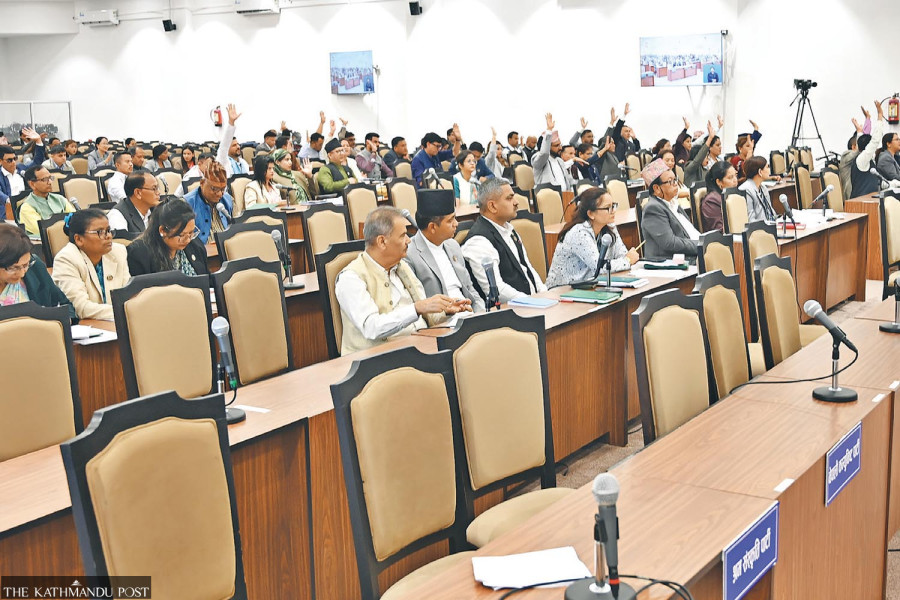
The opposition accuses the government of failing to introduce enough bills on time. Lower house resumes Thursday and upper house a day later. Photo shows lower house meeting on June 28. Post file photo
The federal parliament is set to reconvene on Thursday after a fortnight-long recess, but lawmakers are returning to an almost empty legislative agenda. Opposition parties say the government has failed to provide enough business for the legislature.
The House of Representatives will resume its meeting on Thursday, while the National Assembly is scheduled to meet a day later. However, both chambers are expected to have little legislative work, with only eight bills currently under consideration in the lower house and its committees, while the upper house has no legislation awaiting consideration.
Parliament was adjourned on July 15 after the national budget was approved. Speaker DP Aryal and National Assembly Chairman Narayan Dahal had announced a recess until July 30 for the House of Representatives and July 31 for the National Assembly, respectively, saying the break would allow lawmakers to visit their constituencies. Opposition parties, however, argue that the recess was largely forced by the government’s failure to provide enough legislative business.
According to the Parliament Secretariat, only four bills are actively pending in the 275-member House of Representatives. The Nepal Rastra Bank Act (Third Amendment) Bill is under consideration in the Finance Committee, while the Nepal Special Service Act (Revival) Bill and the Rastriya Sewa Dal (National Cadet Corps) Bill are being reviewed by the State Affairs and Good Governance Committee. Another bill to amend and repeal select financial laws is awaiting discussion on the House floor.
Four other bills, which were passed by the National Assembly and sent to the lower house, are under discussion in parliamentary committees. The National Forensic Science Laboratory Bill and the Film Bill are under review by the Education, Health, and Information Technology Committee. The Intangible Cultural Heritage (Protection) Bill and the Tourism Bill are pending before the International Relations and Tourism Committee.
The situation in the 59-member National Assembly is even more limited. The upper house has already cleared all bills sent to it and forwarded them to the lower house. As a result, it currently has no pending legislation or government business scheduled for its July 31 meeting.
Opposition parties have criticised the government over the lack of legislative activity, accusing it of using the recess as a cover for its failure to prepare bills.
“The government has failed to provide business to the House. This is a clear weakness on their part,” said Basana Thapa, chief whip of the main opposition Nepali Congress. She rejected the government’s explanation that lawmakers were given time to visit their constituencies, arguing that parliament was effectively suspended because the cabinet had no bills ready for discussion.
Thapa also warned against the practice of delaying legislation and then pushing bills through parliament without adequate discussion.
“When laws on education and health taxes were rushed through on the strength of parliamentary majority, it created public outcry and had to be rolled back later. Hasty decisions followed by late corrections only erode public trust in the government,” she said.
Yubaraj Dulal, chief whip of the opposition Nepali Communist Party, also warned that the government would face embarrassment if it failed to register new bills before the House resumed.
“The law minister assured us in the Business Advisory Committee that enough bills would be registered to keep parliament busy through September,” Dulal said. “If bills are not registered for tabling when the House opens on July 30, it will be a matter of shame for the government.”
Officials at the Parliament Secretariat acknowledged that legislative work remains limited but said the legislature is not completely without business.
Ekram Giri, spokesperson and head of the House’s Business Management Division, said that apart from the eight bills, four non-legislative motions, including two urgent public importance motions and two resolution motions, have been forwarded to the concerned ministries for discussion.
“It is not that there is an absolute lack of business, but legislative business is certainly minimal,” Giri said. “We expect some bills to be registered in the interim. The government has submitted its list of priority legislation, and coordination with ministries is ongoing.”
Before the adjournment on July 15, Speaker DP Aryal reminded lawmakers that the government had declared the current fiscal year as the ‘Year of Lawmaking and Reform’. He urged MPs to use the recess to collect public feedback on policy implementation and government service delivery.
The government, however, has defended its preparations, saying a number of bills are in the pipeline and will be introduced soon.
Minister for Law, Justice, and Parliamentary Affairs Sobita Gautam said there would be no shortage of legislative work once parliament resumes. She said delays in registering bills were largely due to the government’s immediate focus on passing the national budget after taking office.
“Eight to 10 bills are in the pipeline and will be registered in both Houses before the upcoming sittings,” Gautam told reporters.
She said the government has set an ambitious target of passing 166 bills during the current fiscal year, which began in mid-July. The priority list of legislation has already been submitted to Speaker Aryal and National Assembly Chairperson Dahal.
“Bills will now be registered simultaneously in both the House of Representatives and the National Assembly to ensure both chambers have sufficient business at the same time,” she said.
The government’s ability to meet its legislative target will now depend on how quickly ministries prepare and register new bills, as lawmakers return to a parliament where the immediate workload remains thin.




 20.83°C Kathmandu