Bhanubhakta beyond Ramayan: The other side of Nepal’s most revered poet
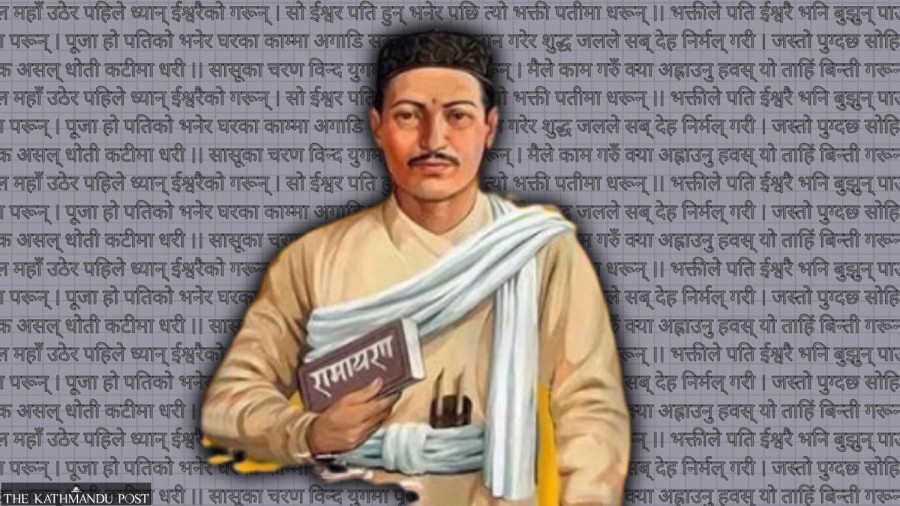
As Nepal honours Adikavi Bhanubhakta Acharya, experts revisit ‘Badhu Siksha’, arguing that its prescription for women deserves critical reading for its patriarchal worldview.Post Illustration
This year’s Bhanu Jayanti came and went, as it does every year, without much controversy. The day saw celebratory poem-recitation competitions, extended morning assemblies in schools, and the general commemorations expected on the day.
Students, teachers and public figures alike spoke about Bhanubhakta’s translation of the Ramayan into Nepali and his general contributions to the language.
But 'Badhu Siksha’, Acharya’s prescriptive poem for the education of women, did not receive broad attention. In one stanza of the poem, Acharya instructs women to follow a life of devotion and service to their husbands, whom he says are no less than the gods. In another part, he warns that a woman who laughs risks becoming a beshya, a prostitute, and if not that, then risks at the least letting her house fall into disarray.
Ram Chandra Paudel, an associate professor of Nepali language and literature, who has been teaching for 25 years in Kathmandu University, shared that the poem was aimed at the wife and daughter-in-law of one of Bhanubhakta’s close friends, Tarapati. After witnessing the conflict-stricken state of Tarapati’s family affairs, he is said to have written the poem. Paudel also said that the poem is considered to be among Bhanubhakta’s minor works.
Bhushita Vasistha, a writer and researcher of Nepali and Sanskrit who recited Acharya’s ‘Badhu Sikshya’ with Nepalaya’s ‘Paleti’ in 2023, was the harshest in her criticism of the poem.
“I think the poem is degrading to women. The treatment of women in the poem is akin to that of livestock. Women are asked to contain their jealousy if their husband brings home another wife. There is no space for individuation and self-actualisation for women,” she said.
“Viewed from a modern feminist lens, there is definitely space to be critical of the poem. Nepal has always been a patriarchal society, one that is not critical of its men. Acharya does not comment on what his friend, Tarapati, himself could do better. If his house is in disarray, he must be part of the reason why, but he is not told what to do,” said Shiva Gopal Risal, an eminent professor of Nepali language and literature and author of 115 books. He was affiliated, for most of his career, with Padma Kanya Campus. Risal was among the first cohort of students to study Nepali at Tribhuvan University when it was established.
“Bhanu Bhakta’s poem is an example of the sort of education that women were given in his time. In particular, it is aimed at daughters-in-law. The prescriptions in the poem align with what many women's lives were like at the time. Even today, women might face similar expectations. Women at the time were, obviously, not going to school. They would get married off by their fathers into unfamiliar homes. At a time like that, when daughter-in-laws would have been beholden to their families, it was the only way to get by,” he added.
None of the experts were in favour of banning the work.
“People are not sheep. We need to have the courage to let people speak their mind. The sovereignty of the individual is the most important thing. We need to protect everybody’s freedom of speech,” Vasistha says.
“The poem is instructive. The mother-in-law is not the enemy of the daughter-in-law. She does not have to be cruel and suppressive, yet many mother-in-laws are. If the daughter-in-law does not protest, conflict is avoided. If she is of a nature where she won’t just take everything coming her way, there are problems. The poem is just as important today as it was when it was written. Ultimately, it teaches that women are not each other’s enemies, that they must learn to understand each other's problems,” Paudel said.
Experts also spoke of the value the poem carries.
“It is important because it is an archaeological history. It gives us rare insight into the society of the time. For example, the poem mentions Sati pratha; we learn then that Sati pratha was part of that society.” Additionally, Vasistha also praised the poem’s elegant use of meter.
“Like I said before, the poem is a living history in some ways. We are hearing the predominant opinion on these matters from a person of prominence and education in his time. Whatever one's views on the poem, it is important because it conveys some facts about society,” Risal said.
For example, in one part, the poem speaks of treating the members of the family to raisins, cashews and almonds. In another part, the poem speaks of how servants are to be dealt with. These lines tell readers that Tarapati would have been a rich man, that he had servants in his household and that people of his social class would have considered raisins, cashews and almonds to be special treats.
“The reason for this is the same as why Nepal’s bureaucracy has so many problems. People respect authority beyond reason. Acharya is a canonised figure in Nepal. People are not comfortable with criticising someone with the moniker of Adikavi”, Vasistha said.
Paudel shared that many of his students were unaware of who Bhanubhakta was, let alone be familiar with a minor work of his like ‘Badhu Sikshya’. Of readers who were familiar, he shared that readers were both respectful of his contributions and, in their place, critical of the poem for the same reasons that he was.
“With time, older ideas are challenged and fall out of fashion, the same thing is happening with ‘Badhu Sikshya', and it will continue to happen. This is not an extraordinary matter,” said Risal.
Rivash Rijal is a culture and lifestyle intern at the post. He is also a rising senior at St John's College in Santa Fe, NM. He will be graduating from the class of 2027 with a BA in Philosophy, Literature and Natural Sciences.




 14.81°C Kathmandu