New rules outlaw forced haircuts at schools, but schools aren’t convinced
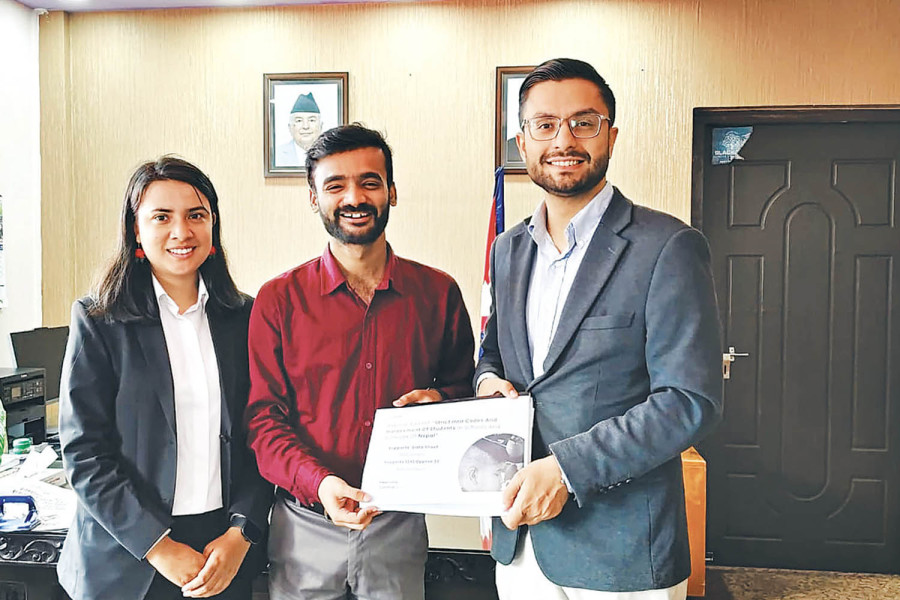
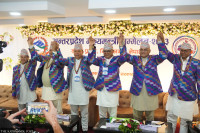
A student-led campaign changed the law, but has reignited debate over personal freedom, school discipline, and how far the state should regulate schools.Sahara Bhandari and Prince Shah Chaudhary from the Speakup Nepal campaign submit a petition against forced haircuts to Minister for Education Sasmit Pokharel (right) in May. Photo: Courtesy of Speakup Nepal
Sambriddha Karki, 18, had barely finished six months of his grade 11 when he experienced the forced haircut. Every three to four weeks, teachers and discipline in-charges at his school in Kathmandu would line students up and check their hair. If it was too long, the punishments varied: a phone call home, a class he wasn’t allowed to enter, sometimes his identity card was taken away.
“They were giving me a lot of mental harassment for getting my hair cut,” said Karki. The reason given, he said, was always the same that students needed a “professional look.” He didn’t buy it. “Whether you cut your hair or not doesn’t change anything. It doesn’t make your studies better or worse.”
So he did what he’d watched a civic platform called SpeakUp Nepal do with other complaints. Take a small, local grievance and push it forward. He filed a petition. In the first month. It drew 250 signatures.
That’s roughly the threshold that turns an ordinary complaint into a campaign, according to Kritika Ghimire, project manager at SpeakUp Nepal—one of just three people, alongside Prince Shah and Sahara Bhandari, who run the platform. “We don’t decide which petitions deserve attention. That’s decided by the public,” she said. Under the platform’s policy, any petition that garners 250 verified supporters is automatically forwarded to the relevant government authority. When Karki’s petition crossed that threshold within its first month, Ghimire said, “That was the moment we realised this wasn’t just one student’s experience as hundreds of people were saying, ‘This matters to us.’”
From there, the petition moved institution to institution over roughly 19 months, the Kathmandu Education Office, the Centre for Education and Human Resource Development, and eventually the Ministry of Education and Sports, building into the tenth amendment to the education regulations on July 3.
The amendment bars schools and colleges from forcibly cutting students' hair without their consent. It also broadens protections for students' personal appearance by prohibiting discrimination or harassment over hairstyles, body image or makeup, and outlaws physical and mental harassment carried out in the name of school discipline. It is the first legal provision explicitly stating a student’s appearance belongs to the student, not the institution.
Karki said many schools and colleges around Kathmandu haven’t stopped the practice, weeks after the amendment’s passage. “Many schools are still not following it,” he said. “Only one or two colleges have stopped it, but unofficially, they are still compelling students.”
For Ariana, a student at Budhanilkantha School, who the Post is identifying with a pseudonym to protect her privacy, the amendment’s focus on hair doesn’t touch the unequal freedoms and expectations she says still shape daily life at her school. Her school has no formal rulebook on appearance, she said, but teachers expect girls to keep their hair tied, wear no makeup, and skip mehendi. She likes wearing light makeup which includes mascara, lip gloss and said there’s no organised “shaming environment” around it, but female teachers have called her out in front of other students when they notice it. “Makeup is about feeling good about yourself,” she said. “It shouldn’t be such a big deal.”
Bharat Prasai, 39, the father of a nine-year-old, said policing students' appearance has persisted across generations. And the real problem is that there’s never been a clear, consistent standard in the first place. He recalled his own school days, when teachers measured hair length by pulling it.
Looking at it now as a parent rather than a student, he doesn’t see the harm in hair falling below the neck or over the forehead or girls just putting makeup on. “I don’t think it should be a problem,” he said, adding that he doesn’t believe teachers should have the authority to police it either way.
The campaign’s biggest early obstacle, Ghimire said, wasn’t any single institution. It was persuading people that the issue deserved policy attention in the first place. “For many, it had simply been accepted as a normal part of school discipline for years,” she said. “We spent a lot of time explaining that this wasn’t about hairstyles or challenging school discipline, it was about whether forced haircuts were an appropriate disciplinary practice.”
Once that shifted, the campaign still had to work its way through the ordinary friction of policymaking—legal reviews and inter-agency coordination, which Ghimire said resulted in long stretches when progress seemed to stall. She said neither SpeakUp Nepal nor the original petitioner faced significant pushback or ridicule over the 19 months, describing most engagement with schools, officials and parents as respectful, even where opinions differed.
Ghimire said, “Petitions are escalated automatically once they cross the public-support threshold, regardless of the topic or who is in government.” She said the amendment is not the finish line. SpeakUp Nepal’s next goal is to see the same protection enshrined in the Education Act rather than left to regulations alone. The organisation is working with the ministry and CEHRD to build a formal complaint and reporting mechanism, an acknowledgment, she said, that “no law is complete without effective implementation.”
“Success won’t simply be measured by a policy change,” she said. “It will be measured by whether students across Nepal genuinely experience that change in their daily school lives.”
Not everyone in the school system agrees the law should exist at all. Navraj Bhatta, the president of PABSON district chapter Kathmandu, argued that hair, dress and grooming should remain a matter between school and parents, not something legislated by the state.
“The government should not entertain this or make hair a prestige issue,” Bhatta said. “An institution must make its own rules and regulations.” He said PABSON’s official position, clarified at a recent press conference with three other umbrella organisations representing Nepal's private education sector—HISSAN, APEN and NPABSON—is that the government overstepped: “It’s not right for the government to interfere in this matter.”
Bhatta acknowledged that compliance has been uneven since the ban. “Just the other day in my school, students hadn’t got their hair cut,” he said. “When I told them to cut it, the students took to social media saying it was against the rules.” He argued that the change has emboldened students rather than resolving the issue. “It encourages students to be defiant. Since it’s banned, it will cause behavioral issues.”
Kalpana Oli Sitaula, school incharge of Pathibhara Academy in Bhaktapur, offered a different perspective on the same discomfort. She framed appearance rules as part of a broader disciplinary structure schools rely on, especially as class sizes shrink and children arrive with less experience of being told “no” at home.
“In a mass setting, we can’t always say ‘yes’ to everything,” she said, adding that individual counselling is increasingly replacing the blanket rules schools used to rely on. She did not defend forced haircuts outright, but described the shift as something schools would need time to absorb. “These issues will continue to arise for a year or two,” she said. “We have been following one system, and moving to another will naturally involve a transitional period.”
Sitaula said she doesn’t think the change should be resisted simply because it’s new. “If it becomes law, we must obey it,” she said. “We teachers also need to change along with the students.” At the same time, she cautioned against treating hair as disconnected from everything else a school monitors. She said, “Hair doesn’t determine everything, but we have to watch what else is added to it, like behavioural activities.”
The education ministry maintains that the change is neither optional nor temporary. Shiva Kumar Sapkota, spokesperson at the ministry, rejected the idea that a regulation amendment as opposed to an Act promulgated by the parliament leaves the protection vulnerable to reversal. “Any legal provision made for student well-being, student rights, student freedom, and creating a proper learning atmosphere is permanent,” he said.
Asked how the ministry intends to enforce the rule against schools like the ones Karki and Bhatta described, Sapkota said violations now carry legal consequences. “Once it becomes a legal provision, any violation is punishable,” he said. “If someone does not enforce it, a case can be filed in court or administrative action can be taken.” He said monitoring will largely sit with local governments, much as Kathmandu Metropolitan City already runs a dedicated helpline, and that no grace period had been built in for schools to adjust. “There is no need for a timeline,” he said. “From the day it was published in the Nepal Gazette, it has been in force.”
Raju Ghimire, a child activist and deputy director at Voice of Children, said the legal foundation is weaker than it looks as it came as a Cabinet-approved regulation rather than legislation passed by parliament. As a result, he said, it carries less legal weight. “Since it’s not an Act, it might not be as binding, although it is supposed to be,” Ghimire said.
He is also critical of how the policy came together. “The government should have consulted organisations like us first,” he said, calling the process one-sided. “If policymaking is one-sided, you get these reactions.” He echoed Kritika Ghimire’s emphasis on implementation, saying awareness, rather than more rules, is the immediate need. “Awareness of the rules is the first step towards effective implementation,” he said.
Aarya Chand is a reporter at The Kathmandu Post covering social issues. Before moving to the social beat, Chand was an intern covering culture and lifestyle for the Post.




 14.4°C Kathmandu