How will Nepal verify those missing after the Bhotekoshi floods?
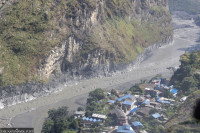
The government has begun compiling an official list of people missing in the August 26 disaster. The process will determine who can be declared dead and whose families qualify for relief. File Photo/Nepal Photo Library
Nepal’s disaster authority has begun collecting official details of people missing in the August 26 Bhotekoshi floods, a move that will allow the government to declare the missing dead and provide relief to their families.
The process began on October 9, following a decision by the executive committee of the National Disaster Risk Reduction and Management Authority (NDRRMA). Applications must be verified by the disaster management committee of the local government where the missing person was permanently resident before being forwarded to the relevant district committee.
The authority has established separate procedures for Nepali and foreign nationals. Who can apply, what happens if an entire family is missing, and what relief will families receive? Here are five key questions answered.
1. Who can apply and what documents are required?
For Nepali citizens, the relevant ward office must publish a public notice giving a period of up to five days to identify people reported missing.
Based on the notice, a member of the missing person’s immediate household must submit an application to the ward office, along with documents establishing the person’s name, surname, address and age. Government-issued identification or other documents that establish the person’s identity must be submitted.
Applicants must also provide documents proving their relationship to the missing person and a self-declaration stating that the person went missing in the Bhotekoshi floods.
Applications will be reviewed by the ward committee, which must recommend verified cases to the local disaster management committee. The local committee will then establish the official list of missing people.
Once verified, the local government must publish the list for public information and objections, allowing three days for claims or disputes. Any objections must be investigated within three days. After the process is complete, the final list must be sent to the relevant ward office and district administration office.
2. Is there a deadline for applications?
No deadline has been set for applications, according to Ram Bahadur KC, an undersecretary and spokesperson for the NDRRMA. “We have not set a deadline. For foreign nationals, we have already written to the Ministry of Foreign Affairs. The ministry will contact the relevant embassies, which will verify the details and send them back to us. Once we receive them, we will declare the missing people dead,” KC said.
For Nepali citizens, the authority has sent letters to all 753 local units and all districts, and has also held a virtual meeting to explain the procedure.
Although the process is underway, the authority has yet to determine when the collection and verification of details will be completed.
3. What happens if an entire family is missing?
The procedure makes special provision for cases in which no immediate family member is available to file an application.
In such cases, the ward chair must verify the disappearance in the presence of the ward secretary and local police. The ward chair can file the application, with the secretary and a police representative conducting an on-site inquiry and preparing a record of the circumstances.
“The ward would know if an entire household had gone missing. The ward chair can file the application, and the ward secretary and police can verify the case through an on-site inquiry,” KC said.
The resulting report will be submitted to the ward office. The ward committee will examine the details before recommending the case to the local disaster management committee for verification.
The verified list must then be made public for three days to allow members of the public to raise objections or submit claims. Any objections must be examined before the final details are forwarded to the relevant authorities.
4. What happens once someone is officially listed as missing?
People included in the official list will be treated as dead once the necessary declaration process is completed. Their families will then qualify for government relief of Rs200,000 per deceased person, KC said. “Once a missing person is declared dead, the family receives Rs200,000 for each deceased person. That is the assistance available for now,” he said.
The government requires applicants to declare that the person went missing specifically in the Bhotekoshi floods, rather than for some other reason.
The official list is also subject to public scrutiny. If objections are raised, the local government must investigate them within three days before finalising the details.
The process is particularly important in Rasuwa, Nuwakot, Dhading and Gorkha, where the disaster affected not only residents but also hundreds of people who had travelled there from other districts.
5. How will the government verify missing foreign nationals?
The verification process for foreign nationals will be conducted through diplomatic channels.
The NDRRMA will send details of missing or uncontactable foreign citizens to the Ministry of Home Affairs, which will forward them to the Ministry of Foreign Affairs. The foreign ministry will then contact the relevant embassies and diplomatic missions to verify the information.
Once verified, the details will be sent back to the NDRRMA through the home ministry.
The authority will submit the cases to its executive committee. Based on the committee’s decision, it will recommend to the home ministry that the missing individuals be declared dead.
KC said the foreign ministry had already been contacted to initiate the process.
6. How many people are dead or missing, and who are they?
According to NDRRMA, more than 1,400 people have died, and over 5,200 remain missing following the Bhote Koshi disaster.
Authorities have collected DNA samples from more than 1,300 bodies and human remains recovered from different locations, as well as from over 2,000 relatives, to help identify the dead.
Government figures show that 636 foreign nationals are among those missing. More than 2,400 Nepalis who travelled to Rasuwa and Nuwakot from other districts are also unaccounted for, alongside around 2,300 residents.
Some districts have already started compiling the details, while the authority is still receiving information from Sindhupalchok, Dolakha and other districts, NDRRMA spokesperson KC said.




 16.84°C Kathmandu