Draft House rule easing charter amendment decried as unconstitutional
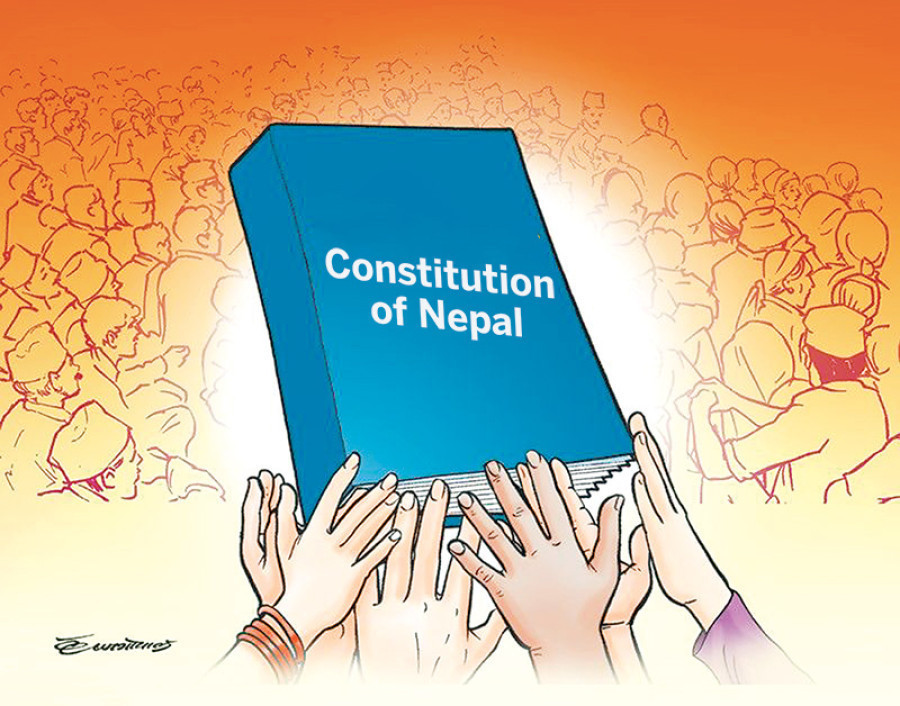
Proposed rule permits combined two-thirds parliamentary vote for amendments instead of requiring two-thirds in each House separately. Post file illustration
A provision in draft regulations prepared by the House of Representatives Rules Drafting Committee has triggered controversy after constitutional experts and opposition lawmakers argued that it contradicts Nepal’s constitution on the procedure for amending the supreme law.
The dispute centres on Rule 140(11) of the proposed House regulations, which says that a constitutional amendment bill will be forwarded to the President by the Speaker for authentication if the total votes supporting the proposal in both houses together amount to at least a two-thirds majority of the total existing membership of the federal parliament.
Critics argue that the constitution clearly requires separate two-thirds approval in both houses, not a combined tally.
Article 274(8) of the constitution states that a constitutional amendment bill 'must be passed by at least two-thirds majority of the total existing members of both houses of the Federal Parliament.' Constitutional experts say the wording establishes two independent thresholds for the House of Representatives and the National Assembly.
Senior advocate Bhimarjun Acharya said the constitutional language leaves little room for alternative interpretation. “The constitution requires constitutional amendment bills to be passed separately by a two-thirds majority in each chamber,” said Acharya. “You cannot compensate for a shortfall in one House by adding votes from the other.”
The controversy has emerged amid growing debate over constitutional amendment and parliamentary arithmetic. The ruling Rastriya Swatantra Party (RSP) lacks representation in the National Assembly and also falls short of the two-thirds majority required in the House of Representatives.
The federal parliament has 334 members in total—275 in the House of Representatives and 59 in the National Assembly. A combined two-thirds majority would require 223 lawmakers. However, under prevailing constitutional interpretation, amendment bills must secure support from at least 184 House members and 40 National Assembly members separately.
The RSP has 181 lawmakers in the House of Representatives, excluding Speaker DP Aryal. Even if independent lawmaker Mahabir Pun—who was elected with the party’s support—is counted alongside them, the party still falls short of the 184 seats required for a two-thirds majority in the lower house.
Ganesh Parajuli, chair of the rules drafting committee and deputy leader of the RSP parliamentary party, defended the proposal, insisting that the regulations cannot override the constitution.
“Constitutional amendments will happen only according to the constitution,” said Parajuli. “We have merely tried to align the language of the regulations with Article 274 (8). If the wording creates confusion, we are prepared to revise it in a constitutionally compatible manner.”
But constitutional scholar Bipin Adhikari said the draft appeared designed to ease the governing side’s political constraints.
“The constitution clearly says amendments require a two-thirds majority in both houses,” said Adhikari. “Constitution amendment is a sovereign process. The regulations cannot reinterpret constitutional provisions for political convenience.”
He argued that the National Assembly was intentionally granted an equal role in constitutional amendment despite the lower house’s dominance in ordinary lawmaking. “In legislative matters, the House of Representatives is stronger,” said Adhikari. “But on constitutional amendment, the upper house has equal standing. That is the spirit of the constitution.”
The provision proposed in the draft regulations has itself raised questions. It states that once a constitutional amendment bill passed by the House of Representatives and sent to the National Assembly is returned with a message, the Speaker may authenticate and forward it to the President for certification if the total votes cast in favour of the proposal in both houses together amount to at least a two-thirds majority of the total existing members of the federal parliament.
Constitutional experts, however, say the provision should instead state that after a constitutional amendment bill passed by the House and sent to the National Assembly is returned with a message confirming that it has been endorsed by at least a two-thirds majority of the National Assembly’s total existing members, the Speaker should authenticate it and forward it to the President for certification.
Opposition lawmakers on the drafting committee said the disputed provision was passed by majority vote despite their objections.
Ain Bahadur Mahar, chief whip of the CPN-UML and a committee member, accused the ruling party of attempting to pursue partisan interests through procedural changes.
“The regulations are trying to undermine the constitution,” said Mahar. “This is undemocratic and unconstitutional. Parliamentary regulations should facilitate the functioning of the House, not serve partisan interests.”
RSP lawmaker and advocate Yagyamani Neupane rejected the criticism, arguing that the draft merely sought to implement Article 274. “There is no provision beyond the constitution,” said Neupane. “The regulations are based on the same constitutional spirit.”
The debate has revived broader questions about the balance of power between Nepal’s two parliamentary chambers. Earlier constitutional amendments, including the 2016 amendment on proportional inclusion and the 2020 amendment incorporating the updated national map into the national emblem, were endorsed separately by two-thirds majorities in both houses.
There have been repeated disputes over constitutional amendment procedures, especially whenever ruling parties seek numerical advantages in parliament. Constitutional lawyers have consistently argued that Nepal’s upper house cannot be bypassed in matters involving amendments to the charter because it represents provinces and local governments within the federal structure.
Legal experts say the disputed wording could create a constitutional crisis if a future Speaker attempted to authenticate an amendment bill rejected by the National Assembly but backed by enough combined votes from both houses.
Under the draft provision, critics argue, the Speaker could theoretically add votes cast in favour of the amendment in the lower house to supportive votes in the upper chamber and claim the overall federal parliament had crossed the required threshold.
Such a scenario would become particularly relevant if the ruling alliance secured an overwhelming majority in the House of Representatives but remained weak in the National Assembly, where members are elected through a different system and serve staggered terms. Nepal’s constitution deliberately created the upper house as a check within the federal structure, constitutional lawyers say.
Adhikari argued that the phrase 'both houses' must be understood in the context of bicameral parliamentary practice. “If the constitution intended a combined vote, it would have explicitly referred to the joint membership of parliament,” he said. “Instead, it recognises the separate constitutional identity of each chamber.”
The constitution does allow joint sittings of parliament in limited circumstances, including discussions related to government policies and programmes. However, constitutional experts point out that no such joint mechanism has been provided for amendment bills. They say that omission itself demonstrates the framers’ intention to require independent approval from both chambers.
The controversy has also drawn attention to the composition of the drafting committee. Besides Parajuli, the panel included RSP lawmakers Ojashwi Sherchan, Khagendra Sunar, Gajala Samim Mikrani, Tapeshwar Yadav, Nisha Dangi, Madhu Kumar Chaulagain, Sulav Kharel and Yagyamani Neupane. The committee also included Nepali Congress lawmakers Nishkal Rai and Rekha Kumari Yadav, UML lawmaker Mahar, Nepali Communist Party lawmaker Balawati Sharma, Shram Sanskriti lawmaker Dhrubaraj Rai and the Rastriya Prajatantra Party member Khushbu Oli.




 16.46°C Kathmandu