Nepal is growing more rice but losing indigenous varieties
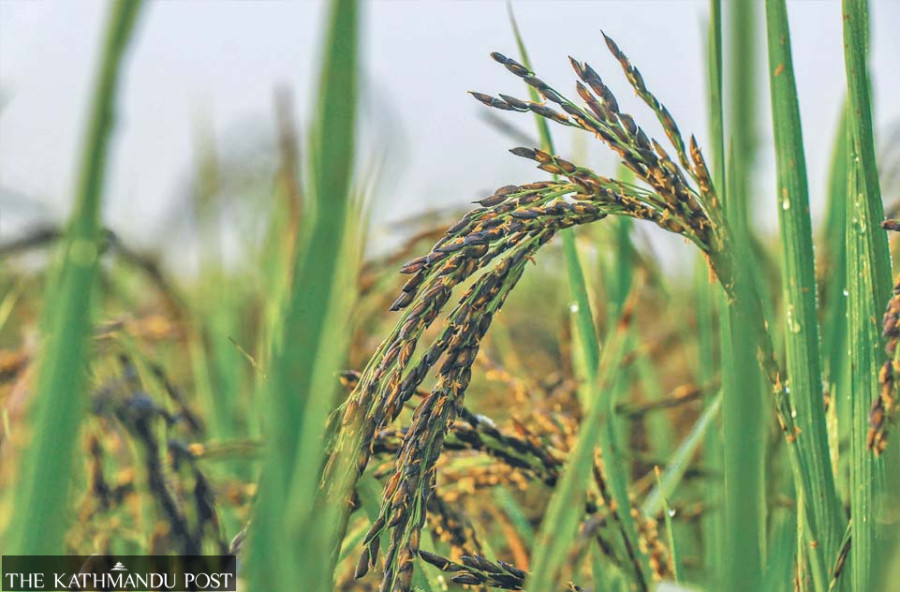
Farmers are abandoning indigenous rice for higher-yielding hybrids, putting at risk varieties that carry distinctive genetic traits, cultural traditions and centuries of agricultural history.Kalanamak rice panicles sway in the fields of Lamatiya, in Kapilvastu district, in this recent photo. The ancient variety is famed for its softtexture, distinctive fragrance, and delicate flavour. A Buddhist monk claims that Kalanamak has a history dating back to the Buddha era. Manoj Paudel/TKP
Until a decade ago, the paddies of Nepal’s Tarai were dominated by rice varieties whose names were deeply woven into the region’s farming culture: Sona Mansuli, Soni, Katarni, Savitri, Ram Dhan, Radha-4, Sawadhan and Swarna, also known as Ardinath.
By this time of year, the fields would already be green with these familiar varieties, their cultivation tied to generations of farming knowledge and the agricultural rhythms of the plains.
These were more than traditional crops. They were adapted to the Tarai’s soil and climate and had long formed the backbone of farming communities in what is considered Nepal’s food basket.
Today, many of these varieties are disappearing.
Across the Tarai, and particularly in Madhesh province, farmers are steadily replacing indigenous rice with imported hybrid varieties. Some traditional varieties have become so rare that they are now at risk of disappearing altogether. Others survive only because a handful of farmers continue to grow them, sometimes despite government restrictions.
The shift is largely driven by economics.
Traditional rice varieties generally take longer to mature, produce lower yields and are increasingly vulnerable to disease. Hybrid varieties, by contrast, promise farmers higher yields in a shorter period, allowing them to harvest rice earlier and prepare their fields for another crop.
“The disappearance of traditional rice varieties is unfortunate,” said Surendra Prasad Kurmi, chief of the Agriculture Knowledge Centre in Rautahat district in south-central Nepal. “Disease outbreaks around harvest time have also been a major reason. Farmers have been abandoning these varieties for about a decade.”
Sabitri, Ram Dhan and Radha-4 can take 140 to 160 days to mature and typically produce three to four tonnes per hectare. Hybrid varieties mature in 120 to 130 days and can produce six to eight tonnes.
For farmers working on increasingly tight margins, the difference is difficult to ignore.
In Rautahat, farmers now grow hybrid varieties such as Gorkhanath and Loknath, whose seeds are imported from India or China. Their popularity reflects a broader transformation in the Tarai’s rice fields, where the pressure to produce more food in less time is steadily reshaping what farmers plant.
Even Sona Mansuli, once among the country’s most popular varieties, has become a complicated part of this transition.
The government banned its cultivation five years ago after repeated outbreaks of blast disease. Yet the variety remains popular with farmers, who continue to plant it despite the restriction.
“Farmers are still secretly growing Sona Mansuli,” Kurmi said.
Seeds of Soni, Katarni and Ram Dhan are also being brought in from India.
Nepal has 69 documented indigenous rice varieties, Kurmi said. But most are now struggling to survive.
“Most of them are on the verge of disappearing,” he said. “Only about 5 percent are still being cultivated.”
Among the varieties whose cultivation has declined are Baspate, Kankajira, Ratuwa, Sugandha, Pahadi Anadi, Madheshi Masino, Eklo Pahele, Sawa, Ram Dhan, Sabitri, Radha-4, Sawadhan, Ardinath-1 and Sukha-2 and Sukha-4.
The decline of these varieties is not simply a story of farmers choosing one seed over another. It reflects a much broader change in the way agriculture is being practised in the Tarai, as farmers respond to rising costs, changing weather and the need to make the most of increasingly limited land and time.
Changing weather patterns are making traditional farming harder. Erratic rainfall, prolonged dry spells and the spread of new diseases are adding to the risks.
Agricultural experts say traditional varieties are also losing their natural resistance to diseases such as blast, sheath blight and bacterial leaf blight. At the same time, the cost of fertiliser, ploughing, labour and irrigation continues to rise, leaving farmers with little room to experiment with varieties that may offer lower returns.
For farmers such as Rudhal Chaudhary of Simra Bhawanipur, the calculation is straightforward.
“Until 10 years ago, farmers would go out of their way to plant Sona Mansuli,” he said. “Even though the government has banned it, farmers still prefer it.”
The timing of the harvest matters almost as much as the yield.
A rice variety that matures early gives farmers time to plant mustard, lentils or wheat during the winter season. Traditional varieties can take weeks longer to mature, making it harder to fit a second crop into the agricultural calendar.
For farmers trying to maximise the use of their land throughout the year, that delay can translate directly into lost income.
It has further reduced the appeal of traditional varieties.
But the disappearance of indigenous rice carries costs that may not be immediately visible in a farmer’s field.
As farmers switch to higher-yielding varieties, Nepal is also losing genetic diversity built up over generations. Indigenous varieties developed through years of cultivation were often naturally suited to particular soils, weather conditions and local farming practices.
Radha-4, for example, can tolerate dry conditions, while other local varieties are better adapted to flooding. Such characteristics may become increasingly important as Nepal’s climate becomes more unpredictable.
Once a variety disappears from farmers’ fields, the genetic traits it carries can also be lost permanently.
That is what worries farmers and agricultural experts who see the transition not simply as a change in farming preferences but as a potential threat to agricultural biodiversity and, ultimately, food security.
Jagendra Sahani, an old farmer in the district, worries that commercialisation could come at a high cost.
“It is natural for agriculture in Madhesh to become more commercial, but the complete disappearance of traditional varieties is a serious concern for food security and agricultural biodiversity,” he said. “Unless farmers are encouraged and supported to preserve indigenous seeds, varieties such as Sabitri, Ram Dhan and Radha-4 could soon exist only in agricultural textbooks and history.”
The dilemma facing farmers is therefore not simply whether to grow traditional rice or hybrids. Farmers need varieties that can provide sufficient yields, withstand disease and changing weather, mature within a workable agricultural calendar and generate enough income to sustain their households.
For many, hybrid varieties currently offer the most practical answer.
About 98 percent of the district’s rice planting has been completed this year. Rice covers around 34,000 hectares in Rautahat, according to the Agriculture Knowledge Centre.
Much of that land is now being planted with varieties that promise farmers more rice in less time.
The slow disappearance of Kalanamak
The story is particularly striking in Kapilvastu, where another traditional variety is fading from the landscape.
Kalanamak rice is soft and flavourful, with a distinctive fragrance. Until two decades ago, it was a familiar presence in local kitchens and was often served to guests as a mark of hospitality.
Today, fields of Kalanamak are increasingly difficult to find.
The variety was once a source of pride and a defining part of Kapilvastu’s agricultural identity. It was grown across parts of Kapilvastu, Rupandehi and southern parts of West Nawalparasi.
But Kalanamak is demanding.
It takes longer to mature than most other varieties, needs more water and requires greater care. It is also vulnerable to disease, pests and other crop stresses. The cost of growing it has risen while the returns have remained comparatively low.
Post Photo
“It is delicious, but expensive to produce and takes longer to mature,” said Rakesh Ojha, chief of the programme implementation unit of the National Agriculture Modernisation Programme. “That is why farmers choose improved varieties.”
The decline has been dramatic.
About 15 years ago, Kalanamak was grown on 4,000 to 5,000 hectares in Kapilvastu. Today, cultivation has fallen to barely 75 hectares, according to Ghanashyam Chaudhary, chief of the district’s Agriculture Knowledge Centre.
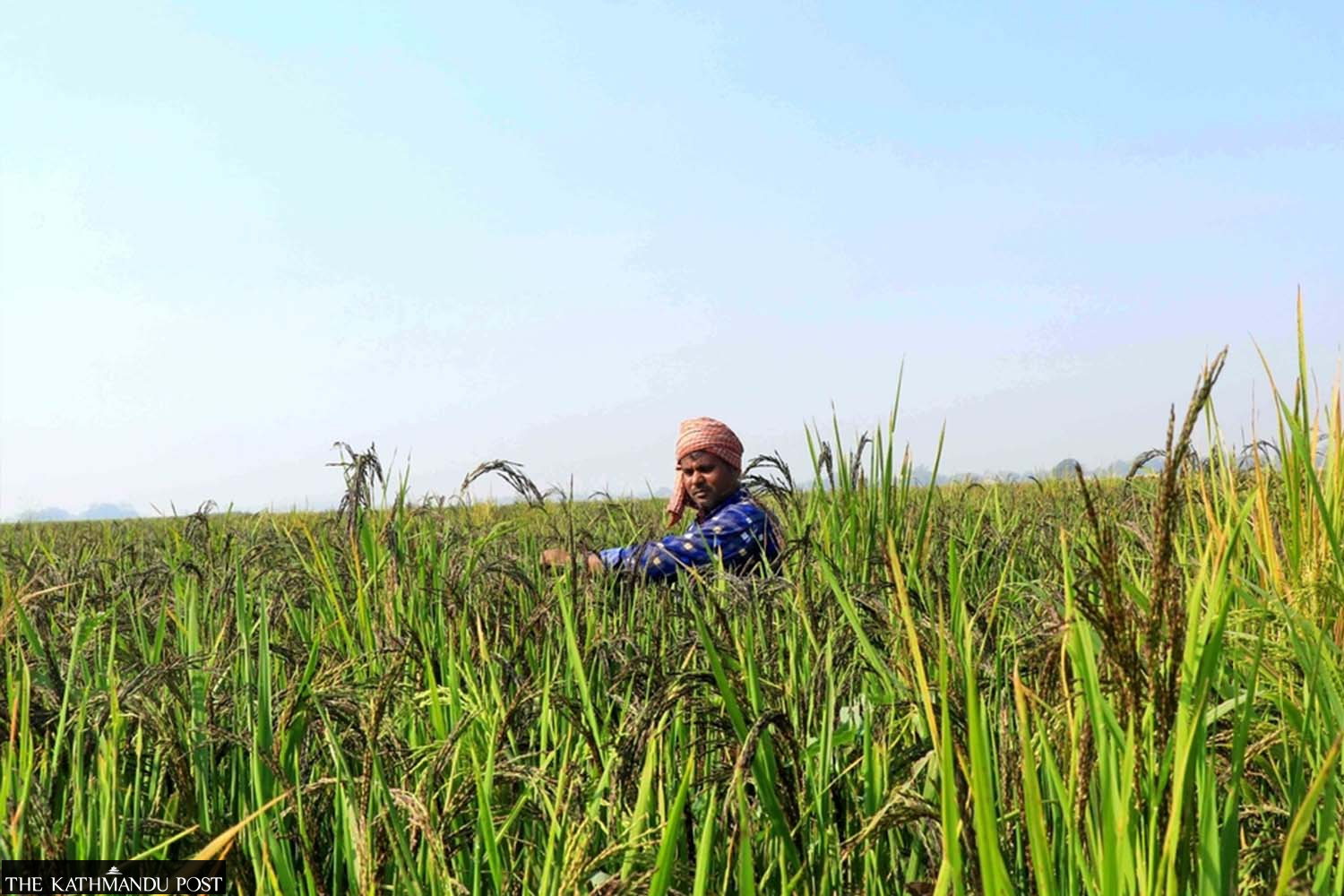
The change can be seen in the fields themselves. The dark Kalanamak panicles that once appeared across the landscape have become rare, replaced by the yellow-gold heads of newer varieties.
For Khursed Ahmed Khan, an agricultural expert, the disappearance of Kalanamak is not simply a loss for farmers. It is also the erosion of a part of Kapilvastu’s heritage, he says, yet local and provincial authorities have done little to preserve it.
“It is a grain with a history going back centuries,” he said. “But no one seems interested in protecting it.”
The rice is also distinctive in appearance. Farmers say its dark colour is what gave it the name Kalanamak, literally referring to its dark appearance.
Its history, however, reaches much further back.
Bhikkhu Siri Vajira, an assistant professor at Lumbini Buddhist University, claims Kalanamak has links to the Buddha era.
According to the tradition he recounts, about 2,600 years ago, when Gautam Buddha was preparing to leave Baishali, local people asked him for a keepsake. Buddha had little with him except his alms bowl.
“He took a handful of rice from his alms bowl and gave it to them,” Vajira said. “He told them to plant it in a marshy area. He said it would become fragrant and asked them to remember him when they smelled its aroma.”
During the Buddha era, a rice festival was held on the full moon of the Nepali month of Ashadh (June-July) outside the royal palace at Tilaurakot. Kalanamak was planted there, and rice made from the harvest was served in the royal palace, according to Vajira.
“This rice is very old,” he said. “But it has gradually disappeared.”
For those who see the rice as part of the cultural heritage of the Lumbini region, its decline also represents a missed economic opportunity.
Lilamani Sharma, president of the Lumbini Hotel Association, says Kalanamak’s historical association with the Buddhist era could be turned into an economic opportunity by developing it as a distinctive brand.
He believes the rice could be grown around Lumbini and marketed under the “Saras” brand, named after the sarus crane, another species associated with the region’s Buddhist heritage. Hotels in Lumbini and Kapilvastu could then serve Kalanamak rice to tourists as part of a campaign to preserve the traditional crop while creating a market for it.
Kalanamak is widely regarded as an organically grown rice variety, and Sharma says it could be promoted as rice dating back to the time of Buddha.
The rice also has an unusual connection with the sarus crane, one of the world’s rarest cranes. Farmers say the birds favour Kalanamak fields and often build their nests among the rice plants. Linking the rice with the crane could therefore give the variety a distinctive identity, Sharma said. The sarus crane itself is also associated with stories and traditions from the Buddhist era.
Barmeli and Jarneli also disappearing
The decline of traditional rice is not confined to the Tarai. Indigenous varieties have also been disappearing from Nepal’s hill districts, including Palpa.
Until about two decades ago, farmers in the hills commonly grew indigenous varieties. Today, seeds of some of those varieties survive only in a handful of places.
Farmers say they abandoned them because they produce less, are more labour-intensive, require plenty of water and take longer to mature.
Gopal Kafle of Lamdikhola in ward 9 of Rampur Municipality still remembers growing traditional rice. He says finding seeds of many of the varieties once grown in the area has now become increasingly difficult.
“Varieties such as Chhote, Barmeli, Anadi, Jarneli, Batisaro, Thapachini, Basmati, Kalo Jhinuwa, Jhinuwa and Aamjhotte, which were traditionally planted here, are now very difficult to find,” he said, recalling the old varieties. “The importance of traditional rice is disappearing in the villages. There are hardly any farmers left who grow them. More people are planting seeds bought from the market.”
Some members of the younger generation have never even heard of the varieties, Kafle said. The problem is no longer simply that farmers have stopped growing them. Their seeds are disappearing as well.
Once farmers stop maintaining a traditional variety, its seed can become increasingly difficult to obtain. Over time, the variety may disappear not only from the fields but also from the local knowledge and seed networks that sustained it.
Some varieties are already considered endangered, said Krishna Prasad Aryal, a farmer from ward 6 of Rampur Municipality.
Farmers have increasingly turned to commercially available seeds because they produce higher yields and require less water, he said.
“People want rice that can produce more from a smaller area, which is one reason the old varieties are becoming so difficult to find,” Aryal said. “In many cases, the seeds themselves are beginning to disappear. You might still find them in remote villages, but elsewhere they are very hard to come by.”
The transition is also being accelerated by changes in rural labour and farming technology.
Farmers have moved away from traditional rice because newer varieties produce more grain, have shorter stalks and are easier to manage, said Narayan Prasad Gaire, head of the agriculture section at Rampur Municipality.
Hybrid and improved varieties produce significantly higher yields than traditional rice. Modern machinery has also made harvesting and threshing easier, while the migration of young people from villages to work abroad has reduced the availability of farm labour.
“People may also be moving away from traditional varieties because they want more production with less effort,” Gaire said. “Traditional rice tends to be tastier and more filling, but the younger generation is no longer paying much attention to it.”
Some farmers now grow traditional varieties only for festivals and special occasions, he said.
Although rice from the old varieties is considered tastier, their lower yields, higher water requirements, long stalks and tendency to fall over before ripening have pushed farmers towards hybrid varieties.
According to the Directorate of Agriculture Development under the Ministry of Land Management, Cooperatives, Federal Affairs and General Administration, 7,287 hectares of land in the district is suitable for rice cultivation.




 14.1°C Kathmandu