Midnight matches put Nepal’s World Cup business boom in doubt
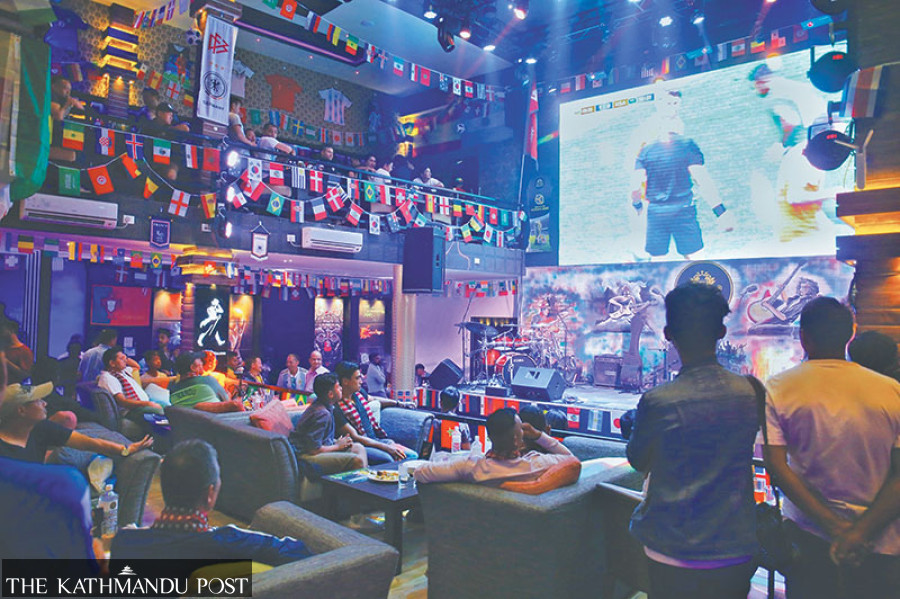
The timing of the 2026 tournament has presented a unique challenge. Many restaurateurs in Kathmandu say they are up for it, even if business prospects remain uncertain.Nepali football fans watch the opening match of the 2018 FIFA World Cup between hosts Russia and Saudi Arbaia at a restaurant in Kathmandu on June 14, 2018. Post file photo
As anticipation builds for FIFA World Cup 2026, Nepal’s hospitality industry finds itself caught between excitement and uncertainty.
The world’s biggest football spectacle has traditionally been a boon for restaurants, pubs, sports bars and nightlife venues, drawing crowds eager to watch matches with friends over food and drinks. But this year, a challenging fixture schedule has tempered expectations among business owners, with most matches set to kick off after midnight and continue into the early hours of the morning.
For decades, the FIFA World Cup has been more than a sporting event. It has been a major economic opportunity for businesses linked to hospitality, entertainment, transportation and retail.
Across Nepal, football fans routinely fill restaurants and bars during the month-long tournament, creating a festive atmosphere that benefits everyone from jersey sellers and beverage companies to taxi operators and hoteliers.
Yet the timing of the 2026 tournament, jointly hosted by Canada, Mexico and the United States, has presented a unique challenge.
The competition, expanded to 48 teams for the first time, will run from June 11 to July 19. The opening match between Mexico and South Africa will be played at the iconic Estadio Azteca in Mexico City. For Nepali viewers, however, the action will unfold largely between 12:45 am and 6:45 am, and in some cases from 1:45 am to 8:45 am.
Those hours have prompted many hospitality operators to question whether fans will be willing to sacrifice sleep on working days.
“Due to the timing, we are not expecting a huge business,” said Sudarshan Paudel, chief executive officer and founder of Lavie Hospitality Group, which operates several restaurants, hotels and food-and-beverage outlets across the Kathmandu Valley.
“Except for students, most people have to go to work the next day. Late-night matches will be challenging for them.”
Paudel believes attendance may improve during the tournament's latter stages when stakes are higher and fan interest peaks. The quarter-finals, scheduled for July 9 to 11, are expected to draw larger crowds regardless of the hour.
Businesses are making preparations.
Areas such as Durbar Marg, Thamel, Paknajol, Tahachal, Baneshwar, Sanepa, Jhamsikhel and Jawalakhel are expected to become gathering points for football enthusiasts throughout the tournament.
Many operators are also pinning hopes on Nepal’s two-day weekend, believing fans may be more willing to stay out late on Friday and Saturday nights.
Among the businesses betting on football fever is Burger House, one of the country’s most recognisable restaurant chains. The company plans to operate its Airport, Baluwatar and Thamel outlets around the clock during the tournament.
“We expect customer numbers to increase by 30 to 40 percent despite the timing,” said owner Basanta Lama.
“Football is loved across the world, and Nepalis are passionate football followers. Even during the Champions League, customer turnout remained strong.”
Burger House is also preparing promotional offers on beverages to attract fans during match nights.
Trisara Restaurant is similarly optimistic. Owner Shovan Malakar expects business to grow by around 20 percent compared with normal periods, citing Nepal’s growing sports culture and changing dining habits.
“We have a large number of young people who follow football passionately,” Malakar said. “At the same time, dining out has become increasingly popular across all age groups. It's no longer just a youth activity.”
Malakar said he expects another surge in beer consumption during the World Cup.
“Beer consumption has increased by around 40 percent in the past year, and we anticipate a sharp rise during the tournament,” he said.
One factor likely to encourage spending is that restaurants have largely refrained from increasing menu prices despite rising costs triggered by global supply disruptions and tensions in West Asia.
“We have no plans to raise menu prices,” Malakar said.
Lord of Drinks (LOD), one of the most popular clubs in the town located in Thamel, is all set to screen the World Cup this year.
“Looking at the enthusiasm and crowd of the last world cup, we will be screening the matches this year too,” said Sahadev Sedai, a front desk officer at LOD. “We expect to grow the business compared to last time as we open at 8pm to 5am and most matches are happening during that time.”
At Lavie Hospitality Group, football and sports screenings have become a core part of the business model. According to Paudel, sporting events involving Nepali athletes often generate exceptional turnout.
He cited the popularity of Nepali fighter Rabindra Dhant in the Ultimate Fighting Championship and matches in the Nepal Premier League as examples of events that attracted large crowds.
“The demand becomes so high that we often need to add more than 20 tables,” he said.
The popularity of sports viewing has also led to the emergence of dedicated sports-themed dining venues, particularly among younger consumers seeking a communal viewing experience.
“Even people who don’t usually go out want to gather with friends and enjoy the atmosphere during major sporting events,” Paudel said.
To adapt to the unusual schedule, Lavie Hospitality Group plans to introduce breakfast offerings alongside live match screenings at selected outlets. Lavie Garden and Jigri Sekuwa in Thamel will remain open for early-morning matches, while outlets in Jhamsikhel, Baluwatar and Imadol will focus on high-profile knockout fixtures.
Not every business, however, sees a viable opportunity.
For many family-oriented restaurants, staying open until dawn makes little commercial sense.
“We close at 10:30 pm and are more of a family dining restaurant than a sports bar,” said Aakash Poudel, owner of Wallnut Bistro.
“Since most matches begin after midnight, we have decided not to organise live screenings this year.”
Others are adopting a wait-and-see approach.
Subash Rokka, manager of Moksh in Jhamsikhel, said the venue currently closes before most matches begin.
“If there is enough demand, we can arrange additional staff and remain open for 1 am matches,” he said. “But we are still unsure whether enough customers will actually come.”
A key factor influencing business decisions is government policy.
In Thamel, businesses are allowed to operate around the clock. But elsewhere, most restaurants and bars are generally required to close between 10 pm and 11 pm. Hospitality operators are awaiting guidance from authorities on whether temporary exemptions might be granted during the tournament.
SSP Ramesh Thapa, chief of Kathmandu District Police, said the matter would be discussed at the District Security Committee, led by the chief district officer.
“No decision has been made yet,” he said.
For now, Nepal's hospitality industry is preparing for one of sport's grandest stages with cautious optimism—football or footfall, the hope is for both.
Krishana Prasain is a business reporter for The Kathmandu Post covering markets. Before joining The Kathmandu Post in 2018, she spent 3 years in New Business Age magazine covering business.




 17.37°C Kathmandu