Parliament consumed by controversies as public issues take a back seat
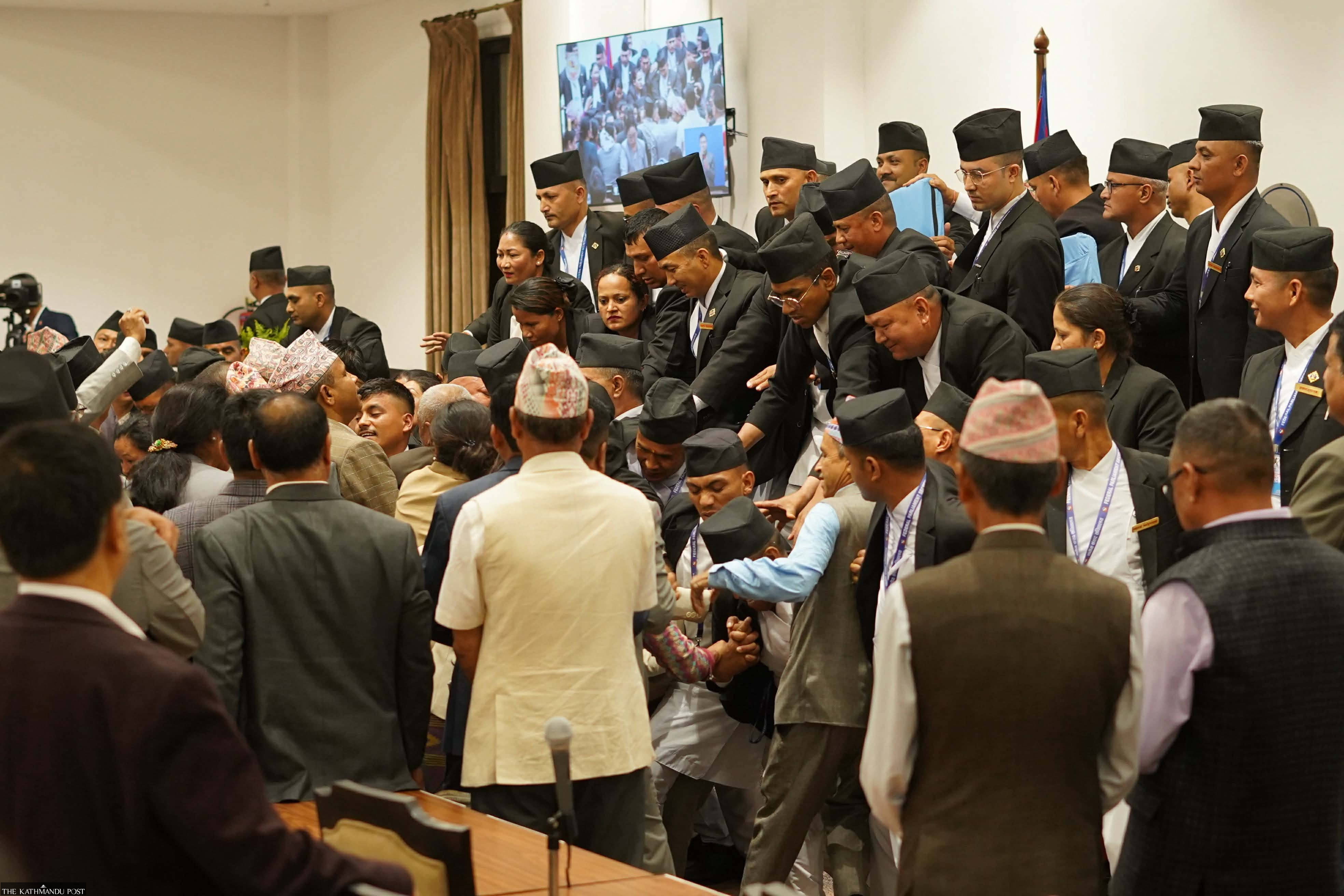
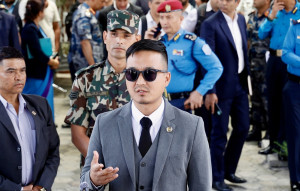
Prime Minister Shah’s border-related remarks and procedural disputes have repeatedly disrupted the budget session amid opposition protests and boycotts. Opposition lawmakers protest in the House of Representatives on Sunday. Angad Dhakal/TKP
Nepal’s federal parliament, constitutionally mandated to serve as the country’s chief forum for debating national issues, is increasingly being overshadowed by political disputes, raising concerns that pressing public agendas are being sidelined.
Proceedings of the current session, which commenced on May 11, have been repeatedly disrupted by controversies, leaving little room for substantive debate on important issues.
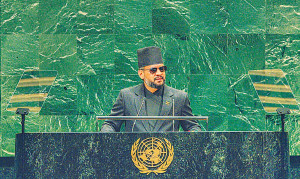
The session began with President Ramchandra Paudel presenting the government's policy and programme for the fiscal year 2026-27 before a joint sitting of both houses of Parliament. However, controversy erupted when Prime Minister Balendra Shah left the chamber mid-speech as the President was delivering the address.
The incident quickly became the focus of a Parliamentary debate. Opposition lawmakers criticised the prime minister for what they described as a breach of parliamentary decorum.
Further controversy followed over Shah's attire at the session. He attended wearing white sneakers, a black T-shirt and a dark suit, prompting criticism from several lawmakers who argued that his appearance reflected a lack of respect for Parliament.
Discussion of the government's policy agenda was overshadowed by arguments over the prime minister's conduct. Opposition parties also objected when Finance Minister Swarnim Wagle, rather than Shah himself, tabled the motion on the government’s policies and programmes. They further criticised the prime minister for failing to respond to questions raised by lawmakers.
As tensions escalated, opposition parties staged protests, boycotts and demonstrations inside the chamber. The disruptions meant that neither lawmakers nor ministers could engage in detailed discussion of the government's policy priorities.
A similar pattern followed on May 14, when the finance minister presented the principles and priorities of the new budget. Debate on the substance of the budget remained limited, with parliamentary attention again focussed on procedural disputes and disagreements involving the prime minister.
On May 21, opposition parties again obstructed proceedings, demanding that Shah participate in a scheduled question-and-answer session with lawmakers. Parliamentary rules require the prime minister to answer questions from members during the first week of each Nepali month, and opposition lawmakers accused the government of failing to comply.
The latest and most serious disruption began on Sunday after Shah made remarks concerning Nepal's longstanding border dispute with India while responding to a question from lawmaker Aren Rai of the Shram Sanskriti Party. During his response, however, he said something that sparked immediate political backlash.
“You might find it strange, but I also learned only recently—after becoming prime minister—that it’s not just India, Nepal too has encroached upon Indian territory in many places,” Shah said.
The statement triggered protests across both chambers of Parliament, preventing lawmakers from taking up the scheduled agenda on Monday. Proceedings in the National Assembly were also disrupted.
Speaking in the House on Monday, UML chief whip Ain Bahadur Mahar broadened the criticism beyond the border remarks, accusing Shah of repeatedly undermining the dignity of Parliament.
"This is Parliament, not a football ground and not a fashion show," Mahar said. "The institution has its own dignity and prestige. He wears traditional Nepali attire when attending Nepali Army events. However, he dresses like a football player in Parliament. What does that say about his attitude towards the legislature?”
Angad Dhakal/TKP
Rastriya Swatantra Party (RSP) lawmaker Bipin Acharya warned that Parliament risked losing sight of its broader responsibilities.
“The gravity of Parliament is much greater than the controversies that currently dominate it,” Acharya said, arguing that lawmakers must focus on addressing citizens’ concerns rather than partisan point-scoring.
He said Parliament should be judged not by whether the government or opposition prevails politically, but by whether citizens ultimately benefit from its work.
“The country's problems are already well known,” he said. “The question is whether Parliament is actually offering solutions.”
Speaker DP Aryal said he was attempting to facilitate dialogue between the government and opposition and deliberately refrained from advancing Monday's agenda to allow space for negotiations.
“I am making every effort to ensure Parliament functions properly,” Aryal told Kantipur. “Parliament must focus on public issues. Laws need to be passed, and citizens’ concerns need to be addressed. Otherwise, people will ask what makes this Parliament any different from previous ones.”
Journalist Hari Bahadur Thapa, who has extensively covered parliamentary affairs, warned that the continuing confrontation between the ruling and opposition parties risked pushing broader public concerns out of the national conversation.
“The ruling side appears determined to push ahead forcefully, while the opposition is relying on obstruction as its primary tool of resistance,” Thapa said. “Public frustration with Parliament could deepen if this continues.”
He cautioned that citizens might increasingly look outside Parliament for solutions if lawmakers fail to represent their concerns effectively.
“People could begin to feel that political change is shaped more on the streets than in Parliament,” he said.
Surya Kiran Gurung, former general secretary of Parliament, said deadlocks had generally been resolved through active mediation by the Speaker and argued that similar efforts were needed now.
“The Speaker should bring all parties together and seek consensus,” Gurung said.
He also criticised both sides for contributing to the impasse, saying governments should not use their majority to force decisions through Parliament while opposition parties should avoid conduct that undermines parliamentary norms.
The dispute has also revived debate over the House of Representatives regulations. Critics argue that opposition concerns were not adequately addressed before the new rules were approved, further deepening mistrust between the two sides.
“A parliamentary majority does not mean unlimited authority,” Thapa said. “Democratic procedures must be respected. If decisions are imposed without sufficient consultation, they can create even greater problems.”
Thapa said the Speaker’s role in Parliament is similar to that of a referee—preventing undue government influence over Parliament and its committees, ensuring accountability, and safeguarding procedures.
Nepali Communist Party lawmaker and former finance minister Barshaman Pun echoed concerns about the Speaker’s role, arguing that opposition parties had cooperated on legislation in the National Assembly but faced a less accommodating approach in the lower house.
“The speaker must act according to the dignity of the office,” Pun said. “Trying to override the opposition at every stage is not the right approach.”
RSP chief whip Prakash Chandra Pariyar rejected claims that the government was acting unilaterally, and said his party was attempting to balance the government’s desire to move quickly with adherence to parliamentary procedures.
“We respect the concerns of the opposition,” Pariyar said. “But we also expect them to act responsibly.”
Observers note that disputes over the neutrality of speakers are not new in Nepal. Successive speakers since the restoration of democracy in 1990 have faced accusations of favouring either government or opposition parties.
“At times, the Speaker appears less like an impartial referee and more like a political actor,” Thapa said.
He added that the controversy surrounding Prime Minister Shah’s recent parliamentary appearance also reflected broader procedural shortcomings. While prime ministers have the right to address Parliament, he said, established parliamentary practices require advance coordination and adherence to formal question-and-answer procedures.
“If the prime minister wanted to participate in a question session, lawmakers’ questions should have been collected in advance,” Thapa said. “Ignoring established procedures ultimately placed the prime minister himself in an uncomfortable position.”
As Parliament remains locked in confrontation, concerns are growing that lawmakers are devoting more attention to disputes over personalities and procedural disputes than on the country’s economic and social challenges. Critics warn that public confidence in the institution itself could become the next casualty.




 14.4°C Kathmandu