An unusually rainy spring, a drier monsoon ahead: What’s happening to Nepal’s weather?
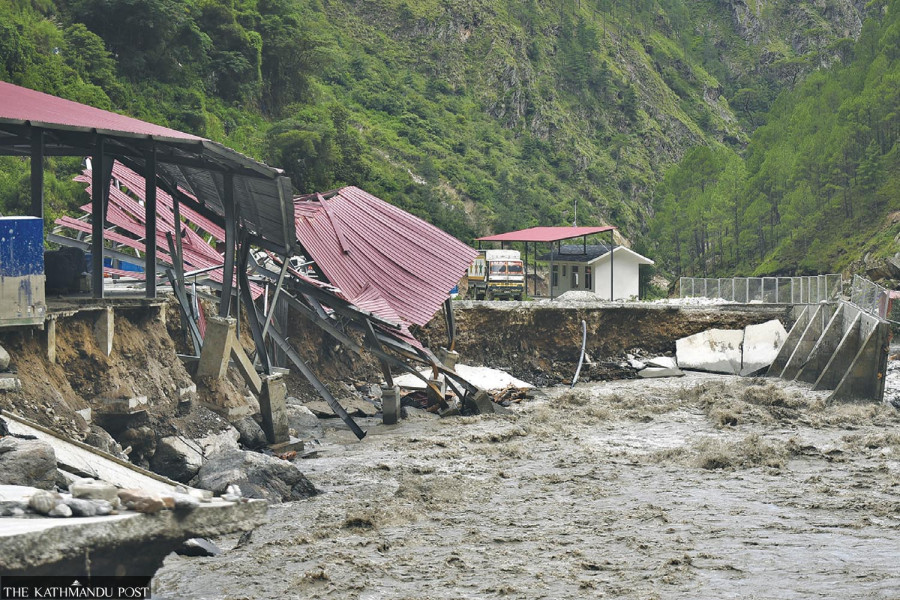
Experts cite local and global climate drivers, including El Niño and a weakening Atlantic circulation, behind Nepal’s increasingly erratic rainfall. Flood devastation in Rasuwa last year. Although total monsoon rainfall in 2025 was below normal, intense late-season downpours triggered deadly floods and landslides. Post file photo
Frequent rainfall, thunderstorms and cloudy skies have marked an unusually active pre-monsoon season across much of Nepal. Climate experts say this weather pattern is being driven by a combination of local atmospheric conditions and global climate systems.
The pre-monsoon season, which spans from March to May, is typically characterised by dry conditions, rising temperatures, dust storms and occasional localised rainfall, according to Mohan Chand, a glaciologist and environmental science professor at Kathmandu University and National Geographic explorer. “However, this year, many areas have had rainfall and thunderstorms nearly every day,” Chand said.
These irregularities are largely shaped by wide-reaching climate patterns, including the El Niño-Southern Oscillation (ENSO). According to the World Bank, ENSO is the most important driver of interannual natural climate variability on a global scale, alternating between El Niño (the warm phase) and La Niña (the cool phase) roughly every three to seven years. Climate conditions are currently trending towards El Niño.
Normally, steady winds blow across the Pacific Ocean from east to west, pushing warm water towards Asia and allowing deeper, cold water to rise up to the surface near South America. But during El Niño, the winds weaken, or even reverse. As a result, warm water flows back towards South America. In mid-May, NASA’s Sentinel-6 satellite observed a large pool of warm water expanding across the Pacific Ocean near South America, a key indicator of El Niño formation.
The increased rain this spring has brought with it some positive effects, including reduced air pollution and increased groundwater recharge. But it has also raised the risks of lightning, hailstorms, landslides and flash floods.
And while rainfall has increased during the pre-monsoon period, it is forecast to be unusually low in the upcoming monsoon season. According to the Department of Hydrology and Meteorology (DHM) seasonal outlook, Nepal is likely to have below-average rainfall in many areas during the June to September season, with the Madhesh, Lumbini, Karnali and Koshi provinces expected to receive the least rainfall.
“There is likely to be rainfall for a short time and then no rainfall for a long time,” said Chand.
Meteorologist Ashok Bakhrel explains that ENSO tends to have a stronger impact in western Nepal than eastern Nepal. Western river basins like Karnali, Bheri and Mahakali are more vulnerable to below-normal streamflows and drought stress during El Niño years.
During visits to villages across western Nepal, environmental engineer Saksham Shrestha spoke with residents about the increasingly visible effects of climate change on their communities. “They talked about how rainfall patterns have shifted drastically,” he said. Villagers described monsoons that brought either too little rain or short, intense downpours, increasing the risk of both drought and flash floods in rural areas.
The possibility of major disasters during an otherwise drier monsoon season is “perhaps the most important and counter-intuitive point,” according to Bakhrel. Last year offers a glimpse of what that could look like. Although total monsoon rainfall in 2025 was below normal, intense late-season downpours triggered deadly floods and landslides.
While rainfall fluctuations are the best-documented effect of El Niño, there are other impacts on the monsoon period as well. Officials say humidity, heat waves, and drought-like conditions may occur, with temperatures this summer projected to be above normal. This is consistent with past El Niño monsoon seasons, during which Nepal has seen above-normal temperatures and hotter conditions in both the hills and the Terai regions. Bakhrel added that a decrease in rainfall midway through the season is also likely.
But El Niño is not the only large-scale climate system influencing Nepal's weather. Scientists are also watching the Atlantic Meridional Overturning Circulation (AMOC), a critical component of global ocean circulation. AMOC transports warm upper-ocean water northwards and cold, lower-ocean water southwards.
According to the Intergovernmental Panel on Climate Change (IPCC), AMOC has weakened since the 1850s, largely because rising global temperatures interfere with the ocean circulation system that depends on cold, salty water sinking in the North Atlantic. As ocean waters warm and melting ice sheets add increasing amounts of freshwater, surface waters become less dense and less likely to sink. Together, these changes weaken the “pump” that helps drive AMOC.
“AMOC is far from Nepal in the Atlantic, but because it is a global circulation system, it could hit Nepal hard,” said Chand.
Looking ahead, AMOC is strongly projected to weaken over the 21st century, though an abrupt collapse before 2100 is unlikely. But Chand says a substantial slowdown of AMOC is possible and could have consequences around the world. One of those impacts is the weakening of Nepal’s summer monsoon.
“An AMOC slowdown, together with El Niño, could increase climate variability in Nepal by affecting the strength, timing, and reliability of the South Asian monsoon,” said Chand. Monsoon rainfall would be reduced, dry spells would increase and precipitation would become irregular, with shorter but more intense rainfall events.
Kathmandu University environmental science professor Rijan Bhakta Kayastha explains that rising temperatures are also reducing glacier cover and snowfall in Nepal's river basins and impacting water availability during dry periods. “It is affecting hydropower production and making less water available for agricultural activities in Nepal,” he said. Many farmers depend on natural rainfall cycles, whereas irrigation systems require a reliable water source.
A prolonged drought can damage crops and undermine livelihoods, Chand explained. “Farmers may not have many options to survive,” he said. Meanwhile, intense rainfall and flooding can endanger communities in the plains region and make travel through Nepal’s mountainous terrain increasingly hazardous.
According to the International Energy Agency (IEA), approximately 99 percent of Nepal's generated electricity comes from hydropower. Shrestha said this sector will certainly be impacted by erratic rainfall. “Hydropower draws from the river, and the river is fed by springs, rainfall and glacial melt,” he explained. “If there is a shift in rainfall, it will definitely have a larger impact on the hydropower infrastructure.”
Another key climate driver is the Indian Ocean Dipole (IOD), a natural climate pattern where sea surface temperatures in the Indian Ocean see-saw back and forth. Bakhrel says the IOD is currently neutral but shifting towards the positive phase. A positive IOD means warmer-than-average sea surface temperatures in the western Indian Ocean, a shift that can strengthen monsoon winds and bring more moisture towards South Asia, increasing the likelihood of rainfall.
While below-normal rainfall is the most probable outcome for this year’s monsoon season, Bakhrel says that forecasts are not guarantees. Historical DHM data show that eight of nine El Niño years were associated with reduced rainfall, but one year produced above-average precipitation. This year, the IOD could prove particularly important. If it turns positive, as some projections suggest, it could partially offset El Niño's effects. “A late-season partial recovery of rainfall remains possible,” said Bakhrel.
Scientists caution that no single climate system determines Nepal's monsoon. Factors ranging from ENSO and AMOC to aerosols and land-use changes all play a role.
“Climate knows no boundary,” Shrestha said. “It doesn’t say this is India, this is Nepal, this is China. But while climate change affects everyone, the burden is not shared equally, especially in countries like Nepal.”




 14.1°C Kathmandu