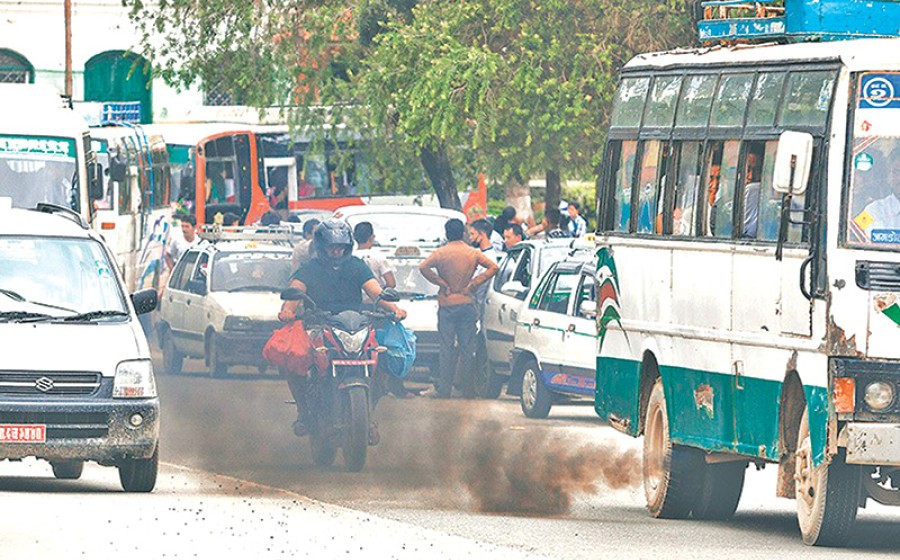
The Kathmandu Metropolitan City (KMC) has resumed random emission testing of vehicles since Wednesday, and early results show that around 75 percent of diesel-fuelled vehicles—buses, micro-buses and pick-up trucks—are emitting black smoke beyond permissible levels.
According to KMC’s Environment Department, of the 42 diesel vehicles on which random testing was carried out on Friday, 31 failed. This is over 75 percent. On Thursday, testing was carried out on 26 vehicles and of them, 18 failed. So far, testing has been carried out on 100 petrol vehicles, and only seven failed, meaning that 93 percent petrol vehicles meet the emission standards set by the government.
“The problem is not much with petrol vehicles. Diesel vehicles, especially public vehicles, are major contributors to the air pollution in the city,” said Jagatman Shresta, traffic adviser to the acting mayor, Sunita Dangol. “We have resumed emission testing with the help of the traffic police. Vehicles that fail the test are being fined.”
The city office started carrying out emission testing from January last year in coordination with the traffic police and the federal Department of Environment and the Department of Transport Management. However, the testing could not continue after July due to staffing issues, but has now resumed.
“Now, we have hired a new engineer and will continue testing in the coming days,” said Shrestha.
Random on-the-spot emission testing of vehicles has for long figured in the metropolis’ roster of plans to tackle growing air pollution in the Kathmandu Valley.
Nepal’s air quality reaches hazardous levels several times a year, and the capital city often becomes the world’s most polluted metropolis. However, premonsoon rains in the Valley have helped clear the air in recent days.
Metropolis officials say the crackdown on polluting vehicles had shifted vehicle owners’ attitudes towards engine maintenance in the past. After repeated warnings and fines, the percentage of polluting diesel vehicles had dropped to 60 percent.
Although vehicle emission testing is mainly the responsibility of federal agencies, the constitution also mandates local governments to take measures to reduce pollution.
The metropolis has developed pollution control guidelines as per the KMC Environment and Natural Resources Protection Act-2021.
Metropolis officials say more problems have been found in vehicles older than 20 years. The government has announced several times its intention to ban vehicles older than 20 years throughout the country to reduce traffic congestion, air pollution, and road accidents caused by old vehicles. However, the decision has not yet been implemented.
The major sources of air pollution in the Valley also include emissions from vehicles, industries, brick kilns, road upgrade drives, and construction sectors. Geographical factors, too, play a role, experts say.
Arjun Poudel is a health reporter for The Kathmandu Post. Before joining the Post, he worked for Sagarmatha Television, Naya Patrika, Republica and The Himalayan Times.




 14.83°C Kathmandu