India rejects ‘third-party involvement’ in boundary talks with Nepal
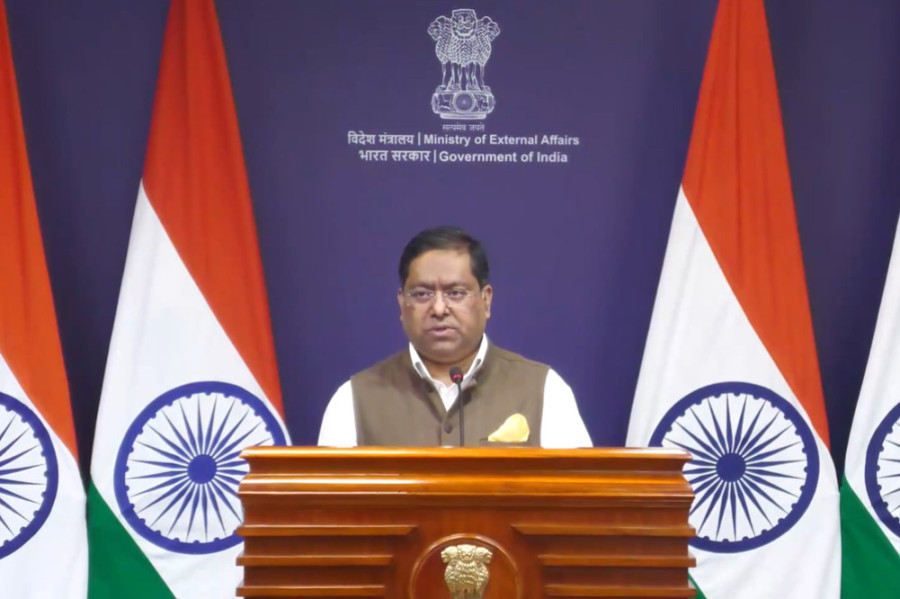
Immediate past Nepali ambassador to India says New Delhi has been denying neighbours’ proposals for third-party mediation.India's Ministry of External Affairs spokesperson Randhir Jaiswal speaking at a press conference in New Delhi on Tuesday. Photo: Courtesy of Ministry of External Affairs, India
The Nepal-India boundary dispute has taken a new twist after Prime Minister Balendra Shah, in his address to the House of Representatives, said that England (the United Kingdom) should also take an interest in the issue, given its historical link to the 1816 Sugauli Treaty.
Answering the lawmakers’ queries on Sunday, Shah said, “Our view is that England [UK] should also take an interest, as the issue dates back to the period when the British ruled India. He further said such disputes should ultimately be resolved through dialogue and diplomatic negotiations.
India on Tuesday firmly rejected any idea of third-party involvement in boundary discussions with Nepal, reiterating that all outstanding issues are being handled strictly through established bilateral mechanisms.
“We have seen the remarks of the prime minister of Nepal concerning the India-Nepal boundary as well as the subsequent statement issued by the Nepali foreign ministry on this matter,” said Randhir Jaiswal, spokesperson for India’s Ministry of External Affairs, during a regular press briefing in New Delhi. He said that although nearly 98 percent of the boundary has already been demarcated, a few segments remain unresolved due to historical and geographical complexities.
“There are some unresolved segments, and the shifting course of the Gandak river has contributed to this situation,” he said. “We have established bilateral mechanisms to deal with all aspects of boundary matters. It should be clear to all concerned that there is no role for any third parties in a bilateral matter between India and Nepal.”
This is the second time since the formation of the new government led by the Rastriya Swatantra Party that the Nepal–India boundary dispute has surfaced. Earlier, Nepal sent separate diplomatic notes to both India and China protesting India’s decision to resume the pilgrimage via Lipulek, a pass close to Mansarovar, a sacred site for Hindus.
India, on May 3, had reacted to Nepal’s objection, saying, “Lipulekh Pass has been a longstanding route for the Kailash Manasarovar Yatra since 1954, and the Yatra through this route has been going on for decades. This is not a new development.”
Shah’s statement in the lower house on the border dispute triggered uproar at home and drew remarks from the southern neighbour.
Replying to a query about the dispute in Lipulekh, Limpiyadhura and Kalapani area, Shah had said, “You might find it strange, but I also learned only recently, after becoming prime minister, that it’s not just India; Nepal too has encroached upon Indian territory in many places.”
Shah’s remarks met with criticism from different quarters. Both houses of the federal parliament remain obstructed as the opposition demands an apology from Shah and the expungement of his statement from the records.
His remarks about English interests were made during the same question-and-answer session, in which he referred to the 1816 Treaty of Sugauli.
After the treaty, British India ruled the region until 1947, and the Survey of British India prepared a series of official maps over several decades, including in 1819, 1827, 1834, 1835, 1837, 1846, 1850, 1856, 1860 and 1879.
Some of these historical maps are cited by Nepal as supporting its claims over disputed areas such as Limpiyadhura, Kalapani and Lipulekh, although interpretations of these records remain contested between the two sides.
In 2007, Nepal and India had prepared 182 sets of maps using the global positioning system for the entire boundary, except for Susta and Kalapani. As per the strip maps prepared by the joint technical committee, another technical committee, called the Boundary Working Group, is now working to resolve outstanding boundary rows between Nepal and India, in addition to Susta and Kalapani.
“In addition, there are cases of cross-border occupation and encroachment of no-man’s land in demarcated segments of the boundary which are currently being mapped jointly,” Jaisawal added.
To resolve the boundary row, the Nepali side needs historical maps, evidence, and facts during negotiations. In this context, some aides to the prime minister had spoken with the British Ambassador to Nepal Rob Fenn and discussed how the United Kingdom could help resolve the dispute as the boundary row in the Kalapani region began after the 1816 Treaty of Sugauli between the East India Company and Nepal.
The discussion with the British side was communicated to the Indian side, an official familiar with the matter said. “We have communicated to them our conversation and meeting with the British envoy, so it should not be a matter to point out again and again.”
A senior foreign ministry official told the Post that Nepal has never considered seeking third-party involvement in the boundary dispute with India.
“At the height of the boundary tension in 2020, when we released the new map, we did not seek any third country meditation. So there is no question of third-party mediation over this issue, as we are also clear that it is a bilateral matter between Nepal and India,” the official added.
Former Nepali ambassador to India, Shankar Sharma, said it is understood that India will not involve any third party in resolving the boundary dispute with Nepal. Some other countries had also offered to mediate between Nepal and India in the past, but Indian officials rejected them outright, said Sharma, who returned from New Delhi only last month, so India’s policy is consistent in this matter.
“The demarcation of the boundary continues as per the strip map we had prepared. Instead of seeking third-party involvement, which we also do not intend to bring in, we should initiate informal consultations with the Indian side and prepare our position,” said Sharma. The boundary working group, which had been inactive, resumed its meetings last year. Sharma said plans are afoot to complete the boundary works by 2028.
As the row over Shah’s remarks escalates, government spokesperson Sasmit Pokharel on Tuesday claimed that the prime minister’s remarks had been misinterpreted.
The prime minister meant, Pokharel clarified, that some areas currently being administered by India could fall within Nepal’s territory, while some areas being administered by Nepal could fall within India’s territory.
Speaking on behalf of the ruling Rastriya Swatantra Party, Kabindra Burlakoti, its general secretary, said: “The party’s position is clear. We must not allow our territory to be encroached upon. The party’s position is that diplomatic initiatives should be undertaken to reclaim those territories.”
Anil Giri is a Chief Sub Editor covering diplomacy, international relations and national politics for The Kathmandu Post. Giri has been working as a journalist for more than two decades, contributing to numerous national and international media outlets.




 14.7°C Kathmandu