Rejected at border, former Bhutanese political prisoners return after 18 years in jail
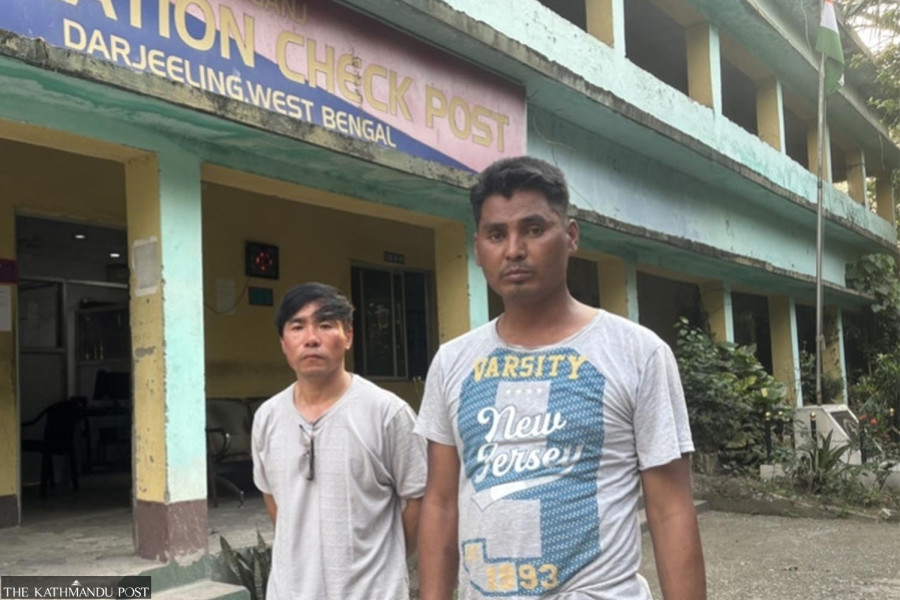
Denied entry into Nepal for lacking identification documents, Chatur Man Tamang and Hasta Bahadur Rai head back towards Bhutan with nowhere else to go. Chatur Man Tamang and Hasta Bahadur Rai, before heading for Bhutan on Tuesday evening. Partbat Portel/TKP
After spending more than 18 years as political prisoners in a Bhutanese jail, Chatur Man Tamang and Hasta Bahadur Rai began their journey back towards Bhutan on Tuesday evening, exhausted and disheartened after being denied entry into Nepal.
The two men, who were among the Nepali-speaking Bhutanese expelled from Bhutan in the early 1990s, had hoped to return to the refugee camps in eastern Nepal where they spent their childhood. Instead, they found themselves stranded at the Nepal-India border without any identification documents and with no country willing to accept them.
Tamang was about six years old and Rai around eight when they were forced out of Bhutan in 1992. More than three decades later, their memories of that journey have largely faded.
“I remember a little,” Rai said. “Indian vehicles dropped us near the Mechi River.”
Tamang remembers even less.
After being expelled from Bhutan, their families were initially sheltered near the Mai Khola before being relocated to refugee camps in Jhapa and Morang districts, including Timai, Khudunabari, Beldangi and Pathari-Sanischare.
Having lived in the same camp area, Tamang and Rai grew up together and attended school in the refugee camps. Their studies, however, were cut short as they became involved in the refugee movement and campaigns advocating repatriation to Bhutan.
Around 2008, determined to return to what they considered their ancestral homeland, the two crossed into Bhutan after reportedly evading personnel of India’s Sashastra Seema Bal (SSB) stationed along the border.
Their attempt ended shortly after they entered Bhutan. They were arrested by Bhutanese security forces at a place called Samjong and later sent to Chamgang Central Jail.
They remained imprisoned there for 18 years and three months.
During the early years of their imprisonment, family members occasionally visited them. According to the two men, those visits stopped after 2016. Since then, they have had little contact with their relatives.
Over the years, they learned that their family members had left the refugee camps and resettled abroad under third-country resettlement programmes. Most of their relatives now live in Australia and the United States.
Rai’s elder and younger sisters are in Australia. Through relatives, he had received family photographs over the years. Carrying those photographs and a few personal belongings, he had hoped to return to Beldangi refugee camp. Instead, he found himself turning back from Panitanki, just short of the Nepal border.
The two men were released from prison on Monday.
According to them, they had no idea where they would go after their release. Around 1 pm, Bhutanese police instructed them to get into a vehicle.
“We simply got in,” they said.
The vehicle drove towards the Indian border town of Jaigaon. After dropping them there, Bhutanese security personnel warned them not to return.
“They told us never to come back to Bhutan,” Rai said. “They said that if we returned, even by mistake, we would be sent back to prison.”
With no other option, the two boarded a vehicle heading towards the Nepal border. They travelled as far as the Bagdogra area on Monday night and spent the night at a local hotel.
On Tuesday morning, carrying their few belongings, they arrived at Panitanki, the Indian border town adjoining Nepal.
Their journey came to a halt there.
Personnel from the SSB refused to allow them to cross into Nepal because they did not possess any official identification documents.
Cross-border movement through the border point requires identity verification and supporting documents.
After being turned back, the two approached the immigration office at Raniganj in Panitanki, hoping officials would find a way to facilitate their entry into Nepal.
They spent the day waiting outside the office.
However, Gautam Biswas, chief of the Panitanki immigration office, said there was little he could do for people who could not establish their nationality through official documents.
The two men also contacted Sanchahang Subba, secretary of the Beldangi refugee camp in Jhapa, seeking assistance and requesting permission to return to the camp where they once lived.
Subba told them that camp authorities could not accept individuals without documentation.
“He told us that if we could bring proof of our release from the Bhutanese prison, he would personally come to receive us,” Rai said.
Without such documents, however, no arrangement could be made.
The situation became even more difficult after Nepali authorities also made clear that entry would not be possible without proper travel documents.
Anjan Neupane, assistant chief district officer of Jhapa, said Bhutanese citizens could not enter Nepal without completing immigration formalities.
“They cannot enter Nepal without passports and the required immigration procedures,” Neupane said.
Faced with closed doors on both sides of the border, Tamang and Rai eventually decided to head back towards Bhutan on Tuesday evening.
Before leaving, they submitted a written application to the Panitanki immigration office.
In the application addressed to immigration chief Biswas, they wrote: “Since we do not have any documents, we could not go to Nepal. We are now returning to Bhutan. If we survive, we may come back again.”
The note reflected the uncertainty surrounding their future.
By evening, the two men had abandoned their efforts to enter Nepal and started the journey back towards a country that had warned them never to return.
“The Bhutanese police told us not to come back,” said Tamang, who suffers from diabetes. “But we have nowhere else to go. Even if we die, we will return to Bhutan.”




 14.69°C Kathmandu