Ganesh Nepali was fined 1,000 rupees. It cost him his life
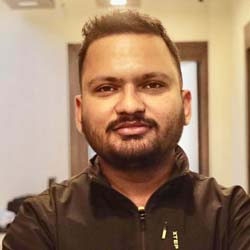
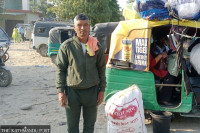
The ride-hailing driver’s death from self-immolation has forced the government to confront a warning it gave itself years ago — as opposition lawmakers quote Balendra Shah’s own past words on state failure back to him in parliament. Photo: Courtesy of Ganesh Nepali’s Family
Two Cabinet ministers visited his hospital bed. The prime minister’s secretariat sent staff to reassure his family that they wouldn’t have to worry about treatment costs. Nepal’s Civil Aviation Authority kept an aircraft on standby overnight, ready to fly him to New Delhi the moment doctors cleared it. But none of it could save Ganesh Nepali.
The 25-year-old ride-hail driver died at Bir Hospital on Friday morning, roughly 22 hours after he set himself on fire outside the Department of Passports in Tripureshwar following a dispute with municipal police over his wheel-locked motorcycle. What began as a fine over illegal parking has become something the state’s emergency response cannot resolve: a public reckoning, now playing out in Parliament, over what it costs to be poor and out of options in Kathmandu—and over whether the people running the city have already said so themselves.
Three years ago, before he was prime minister, Balendra Shah—then mayor of Kathmandu—wrote after a similar self-immolation outside the New Baneshwar parliament complex that the state had failed at every stage of the victim’s life. Opposition lawmakers read that post back into the parliamentary record on Friday, hours after Nepali’s death was announced.
Doctors pronounced Nepali dead at 11:19 am. “The wounds were so severe, burns covered over 55 percent of his body,” said Dr Peeyush Dahal, chief of the Burns and Plastic Surgery Unit at Bir Hospital. “In a resource-limited country like ours, the chances of survival drop sharply once burns stretch over 40 percent.”
He had been moved onto a ventilator on Thursday as his condition worsened, and a critical care team performed CPR early Friday morning, briefly reviving him before he died. A government-arranged air ambulance—a Shree Airlines CRJ-200, crewed and cleared with airport authorities on standby through the night—was set to fly him to the All India Institute of Medical Sciences in New Delhi, but the plan was shelved when doctors determined he was too unstable to survive the transfer.
Nepali had moved to Kathmandu from Jamaldhara in Mugu district, and was living in Bhaktapur's Kamalbinayak area. His brother Madan said he had mortgaged family land in Mugu three months earlier to buy the motorcycle on instalments. He had studied agriculture, his brother said, but “there's no work for poor people with that degree, so he bought a bike and started riding for Pathao.”
According to police records, Nepali dropped off a passenger near Gate 2 of the Department of Passports around 11 am Thursday and stopped nearby to wait for his next ride request. A municipal police officer approached and told him to move, shortly after which a dispute followed after her phone was apparently damaged in the confrontation. Nepali then rode to Gate 3, where a municipal police team wheel-locked his motorcycle. CCTV footage reviewed by Kantipur shows an argument between Nepali and the officer, with Nepali objecting that he had been targeted while parked and the officer accusing him of breaking her phone as he tried to leave.
Roughly two hours after the wheel-lock was placed—after he told officers he would not pay the fine and they could take the motorcycle wherever they wanted—Nepali set himself on fire. Municipal police officers searched for something to douse the flames but found nothing. Officers considered using a floor mat from their vehicle before deciding it risked spreading the fire further. After eventually extinguishing the flames, he was taken to Bir Hospital, first by taxi and then transferred with Nepal Police’s involvement. A separate video circulating on social media, taken after the fire was put out, shows him being held by the arms and walking several metres to a vehicle rather than being carried—footage that has drawn wide criticism online over how a severely burned patient was handled in the critical minutes afterwards.
Doctors say the pattern is familiar. “A few years ago, a gas cylinder exploded at Shandar Mo:Mo restaurant and 11 workers were hurt,” said Dr Kiran Nakarmi, director at Kirtipur Burns Hospital. “They were brought in on trucks normally used to haul meat.” Nakarmi said bystanders at Thursday’s scene had phones in their hands but that no one called 102, the ambulance line.
Kathmandu district police have questioned three municipal police staff who were present, and a five-member investigation team led by DIG Govinda Thapaliya has been formed to establish the sequence of events, including a review of CCTV footage from multiple angles.
The case has also exposed an inconsistency city officials have quietly lived with for years: municipal police fine unauthorised parking at Rs1,000 under the 2023 Metropolitan Police Act, while traffic police fine the same violation at Rs500 under the 1993 Vehicle and Transport Management Act—two different agencies using two different penalties for the same offence. Retired Additional Inspector General Bhim Prasad Dhakal, a former head of the Valley Traffic Police Office, called the discrepancy “not right in itself”, though he noted both agencies have enforced it that way for a long time.
As of Friday night, Nepali’s family had not accepted his body. They demanded that he be declared a martyr, that his wife be given a government job, that his daughter’s education be funded by the state, and that the family receive compensation before they proceed. Nepali is survived by his wife and a daughter.
Protests demanding justice for Nepali continued through the day at Bir Hospital, drawing relatives, political party figures and civil society representatives, with heavy security deployment at the hospital. A separate demonstration was held at Maitighar Mandala, where a student coalition also protested broader mistreatment of ordinary citizens and the urban poor.
Nepali’s death has also revived comparisons to the 2023 self-immolation of 37-year-old Prem Prasad Acharya of Ilam, outside the parliament building. At the time, Shah, during his term as Kathmandu’s mayor, wrote on Facebook that while there could be many explanations, the biggest cause was the state itself.
“The most terrifying signal is the state’s total failure,” Shah wrote on Facebook. “In his livelihood, his despair, his plea for help, his safety, his rescue—the state failed him at every stage. Every layer, every agency, every organ of the state has failed.”
His post from 2023 was quoted back in Friday’s session of the House of Representatives by Congress chief whip Basana Thapa and Nepali Communist Party leader Barshaman Pun. Former RSP leader Sumana Shrestha said the case forces the country to confront “the deep, silent side of the despair this system produces” beyond ordinary political mudslinging.
“When a citizen finds it easier to set his own body on fire than to keep fighting the dysfunction around him, that isn’t just an impulsive act of anger,” she said. “It’s the final, terrifying form of what psychology calls learned helplessness—a state in which a person makes an honest effort to survive but feels defeated every time.”
Opposition leader Gagan Thapa, of the Nepali Congress, called the death a painful moment that should shake society, the state and “our collective conscience”.
“This isn’t a matter for political debate or blame,” Thapa said. “It’s about one citizen’s life, one family’s unbearable pain, and our basic human conscience. Rather than arguing over who’s at fault, past or present, let this become an occasion for collective self-reflection on how we run the state.”
RSP lawmaker Ganesh Karki was more blunt. “If someone asks whether you'd choose the rule or the person, that’s a foolish question—but if I have to answer, I choose the person. What would you choose?” he said. “To the supporters of RSP and of the government: let’s not make arguments heavier than a human life just to protect a government or a party.”
Arjun Poudel is a health reporter for The Kathmandu Post. Before joining the Post, he worked for Sagarmatha Television, Naya Patrika, Republica and The Himalayan Times.




 26.18°C Kathmandu