58.07% turnout in peaceful polls as Nepal seeks stability after political upheaval
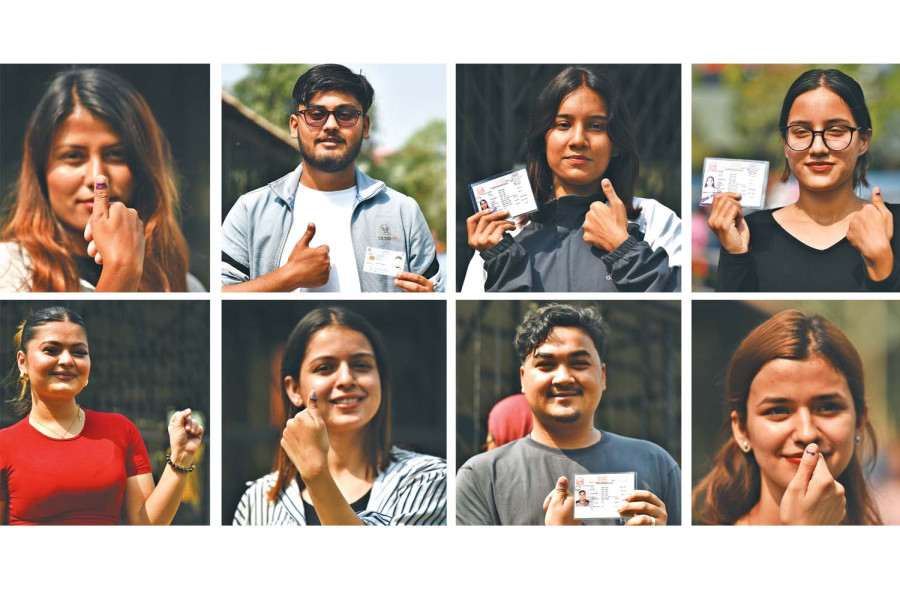
Voter turnout, as per the preliminary report, is the lowest since the 1991 democratic elections. First-time voters pictured at the Dipini Basic School polling station in Jhapa Constituency-5 on Thursday. Angad Dhakal/TKP
Over 58 percent of eligible voters cast their ballots in the House of Representatives elections that concluded largely peacefully across the country.
Except for a few incidents of clashes and disputes in some hilly and Madhesh districts, millions of voters exercised their franchise in the first elections following the September Gen Z movement.
“Holding the elections on the scheduled date under exceptional circumstances and ensuring their enthusiastic completion was itself a challenge,” said Ram Prasad Bhandari, acting chief election commissioner. “We successfully completed the job.”
As Bhandari claims, there were only some minor scuffles in Dolakha, Sarlahi, and Rautahat districts. At Malu polling centre in ward 4 of Tamakoshi Rural Municipality in Dolakha, the police had to fire warning shots after clashes between cadres from different parties. Voting resumed in the evening. Voting in Balara, Sarlahi, was also deferred by a couple of hours due to disputes.
“The elections met international benchmarks,” said Gopal Krishna Siwakoti, chair of the National Election Observation Committee. The commission said no repolling was required anywhere in Nepal, a rarity in the country’s electoral history.
Issuing a preliminary election monitoring report, the National Human Rights Commission also said the polls were concluded peacefully.
“Elections, as an important exercise of democracy, are a positive step from the perspective of human rights, as they allow the public mandate to be expressed. The election was found to have been conducted in a free and peaceful manner due to heightened security vigilance and effective management of polling stations. From a human rights perspective, the voting process appeared satisfactory,” said the commission.
Asian Network for Elections, an international poll observation committee, also concluded that the elections were conducted in a peaceful and orderly manner. “Overall, election day in Nepal was peaceful and administered efficiently, reflecting the continued commitment of Nepali voters and the
electoral situation to democratic participation,” reads the statement.
Even as only sporadic incidents of the violence were reported, the voter turnout, as per the preliminary report, is the lowest since the 1991 democratic elections.
The average voter turnout since the 2008 Constituent Assembly elections stands at 69.4 percent, with the highest (78.3 percent) seen in the 2013 second Constituent Assembly elections, and the lowest (61.4 percent) in the 2022 elections.
“I was expecting a higher turnout, but it ended at 58.07 percent,” said Bhojraj Pokharel, former chief election commissioner. “Yet the number is not very low.” Pokharel points out three major reasons for the lower turnout. There were disgruntlements within some parties, mainly in the Nepali Congress, and their traditional backers did not turn up.
Millions of Nepalis who live in various countries missed the vote. Likewise, hundreds of thousands who are living in Kathmandu and other cities did not return home. “Also, globally, turnout declines as a democracy matures,” said Pokharel.
Poll observers claim that they found people to be election-fatigued. “There was also fear of violence among some sections, which kept them from voting,” said Siwakoti.
People boycotted elections at some polling centres in Dang, Okhaldhunga, Darchula and Dolakha as a protest against the government’s indifference to their demands. “This has nothing to do with the commission. The boycott was a manifestation of their rage against the government,” said Bhandari of the Election Commission.
A total of 18,903,689 voters were eligible to cast their votes to elect the 275 members for the lower house. The total number of eligible voters increased by 915,119, compared to the 2022 election tally. Of them, 10,977,711 cast their votes.
As many as 6,541 party and independent candidates were in the race. Among them, 3,406 were candidates in the first-past-the-post system and the remaining in the proportional representation system.
Under the FPTP, 65 parties fielded 2,263 candidates for 165 seats, and 1,143 were running as independents. Of the total candidates contesting direct elections, 3,017 were male and 388 female. Only one was from the sexual and gender minority community.
Talking to the press after the elections, Bhandari said the vote count will begin immediately after the ballot boxes are collected from the respective constituencies. The commission plans to announce the results within 24 hours of collecting the ballot boxes.
Narayan Prasad Bhattarai, spokesperson at the commission, said the collection of ballot boxes in the mountainous districts will be completed by Friday noon.
Binod Ghimire covers parliamentary affairs and human rights for The Kathmandu Post. Since joining the Post in 2010, he has reported primarily on social issues, focusing on education and transitional justice.




 21.76°C Kathmandu