Hundreds of thousands of Congress cadres not bothered to renew membership
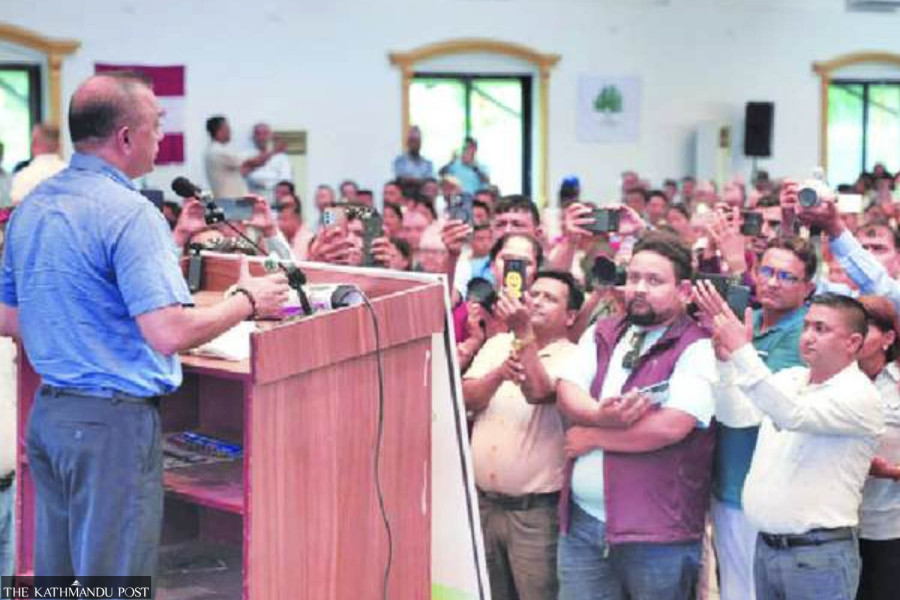
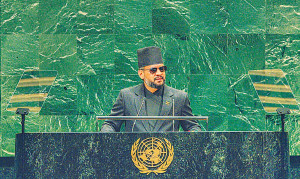
During the 14th General Convention, the Congress had around 850,000 active members. Now that number has dropped drastically. Congress President Gagan Thapa speaks at a cadres’ meeting on Monday. Kulchandra Neupane/TKP
Jatashankar Sahani, a 40-year-old politician from Bara, was once a Mahasamiti member of the Nepali Congress. Today, his name is missing from the party’s digital membership update records. Sahani crossed over to the Rastriya Swatantra Party (RSP) ahead of the House of Representatives election held on March 5. For him, leaving the Congress was not a difficult decision.
“It became increasingly difficult to find opportunities within the Congress,” said Sahani. “There were too many opponents inside the party itself. Even if someone managed to secure a poll ticket, there was always the risk of sabotage from within. That is why I left the party.”
His story is one among thousands that help explain why the Congress’s ambitious digital membership update campaign, which ends on Thursday, has revealed a nosedive in active party membership.
The campaign, launched on April 14 as part of the party’s digital transformation drive, was intended to create a reliable database of active members before the 15th General Convention. Instead, it has exposed deep divisions within the country’s oldest democratic party and highlighted growing disillusionment among many of its cadres.
During the 14th General Convention, the Congress had around 850,000 active members. But party leaders acknowledge that the number of members who have completed the latest update process is significantly lower. The final figure was still being compiled on Thursday evening, but officials admit that hundreds of thousands of members remain outside the updated database.
Many of them have left the party. Others have migrated abroad, become inactive, joined rival political forces or simply chosen not to disclose their political affiliation. A large section of members linked to former party president Sher Bahadur Deuba and senior leader Shekhar Koirala have also stayed away from the update campaign due to an ongoing factional dispute within the party.
Basanta Basnet of Bara is another example. He has not renewed his active membership since the 14th General Convention. He recently resigned as district vice-president Nepal Press Union, a media organization close to the Nepali Congress. He is now seeking to become district president of the RSP.
Party leaders say such cases are no longer isolated. Sarita Prasai, a Congress leader from Jhapa who is close to the Koirala camp, said she intentionally refused to update her membership because the party leadership had failed to create an environment of unity.
“I have not updated my membership because I want the leadership to feel pressure,” said Prasai.
The leadership is trying to bring people from other parties into the Congress but is not serious about uniting leaders already inside the party, she alleged. “The current leadership must take the initiative for unity. Once unity is achieved, the membership issue will be resolved automatically.”
Her position reflects broader dissatisfaction among leaders and cadres who opposed the special convention held in January. Many remain unwilling to fully align themselves with the Central Working Committee led by party president Gagan Thapa.
Tanahun’s Dambar Adhikari said he also refused to update his membership to send a political message. “The leadership that emerged from the special convention has not shown that it can unite the Congress. All groups that remain outside the current structure should be accommodated. I did not update my membership for that reason,” he said.
Congress General Secretary Pradeep Paudel argues that the update campaign became necessary after the party discovered serious weaknesses in its membership records. According to him, the March 5 elections provided evidence that many registered members were no longer actively supporting the party.
“In 17 electoral constituencies, the Congress received fewer votes than the number of active members recorded there. In Jhapa-5, we had around 7,900 active members but received only about 1,800 votes. In Saptari-2, we had around 7,100 members but received only around 2,400 votes,” said Paudel.
He said the party could not determine exactly who had become inactive or who had stopped supporting Congress candidates. The digital update campaign was therefore designed to renew members’ commitment and create a more accurate database.
The decline in membership, however, predates the current campaign.
Ahead of the 15th General Convention, the Congress had already conducted a membership renewal and expansion drive. By December 25 last year, around 450,000 old memberships had been renewed and approximately 150,000 new memberships distributed. That meant active membership had already fallen by roughly 266,000 compared with the 14th General Convention.
Paudel, who is also the coordinator of the digital update campaign, said around 600,000 members were included in the party’s membership system five months ago. He estimates that around 400,000 active members will update their memberships by Thursday mid-night.
“My estimate is that about half of them stayed away because of political disputes, while the remaining half could not participate because of limited digital access,” said Paudel. “We still need to decide whether to extend the deadline or leave those records out of the system.”
However, he said the party would not adopt an overly rigid approach towards members who missed the deadline.
The situation is particularly dire in Madhesh Province. Congress leaders say the earlier renewal campaign was incomplete in 24 constituencies there, while 29 constituencies had not distributed new memberships at all. The party says those districts may be given another opportunity to complete the process.
The Congress has also opened applications for new active memberships since June 1, although no deadline has been fixed.
Congress leader Nain Singh Mahar believes declining public support for the party has also affected membership growth. “The Congress did not achieve the election results people expected. Apart from traditional leaders and activists, the party failed to attract many new supporters. Internal disputes remain the biggest problem,” said Mahar. Even so, he expressed confidence that membership numbers could recover before ward-level conventions begin by settling internal disputes of the party.
The issue carries enormous significance because active members form the foundation of the Congress electoral structure. They elect representatives from ward level upwards, and those representatives ultimately choose the party president and central working committee.
That is why the digital update campaign has become one of the most contentious issues in Congress politics.
Leaders from the Deuba-Koirala camp argue that memberships renewed earlier for the 15th general convention should remain valid. They suspect that requiring another update only five months later could influence convention outcomes.
Former acting president Purna Bahadur Khadka, senior leader Shekhar Koirala, and former office-bearers Prakash Man Singh, Bijay Kumar Gachchhadar, Bimalendra Nidhi, Shashank Koirala, Krishna Prasad Sitaula, Prakash Sharan Mahat, Dhan Raj Gurung, Badri Pandey, Mahalakshmi Upadhyaya ‘Dina’, NP Saud, Bir Bahadur Balayar and Min Bishwakarma, among other leaders aligned with the Deuba and Koirala camps, have yet to update their party membership.
Senior leader Koirala has repeatedly urged the leadership not to make digital updating mandatory. He argues that digitisation can continue after the convention and that the gathering should proceed on the basis of membership already renewed and distributed.
Prakash Sharan Mahat, another leader from the rival camp, says the key demand is a convention process that guarantees fair representation for all factions.
The dispute has also intensified pressure on President Gagan Kumar Thapa. In recent weeks, he has attempted to reach out to Koirala and former acting president Purna Bahadur Khadka in a bid to forge party unity before the convention scheduled in October.
For now, however, the digital membership campaign has laid bare the Congress’s central challenge. While party leaders present the exercise as a necessary step towards modernisation, the shrinking membership rolls reveal a deeper problem: a party struggling to keep its own members united as it approaches one of the most important conventions in its recent history.




 12.67°C Kathmandu