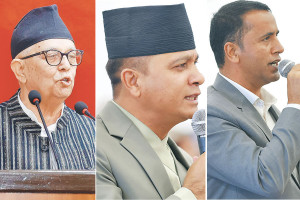
The Rastriya Prajatantra Party (RPP) formally split on Thursday after senior leaders led by General Secretary Dhawal Shumsher Rana announced to quit the party and unveiled plans to establish a new political party.
The latest schism marks the seventh split in 35 years and comes after years of internal conflict between Rana and party chair Rajendra Lingden. The break-up is expected to reshape the monarchist camp at a time when royalist forces are attempting to regroup amid public dissatisfaction with mainstream political parties.
Addressing a press conference in Kathmandu, Rana said he and his supporters had decided to quit the party after concluding that their political ideals could no longer be realised within the RPP.
“With great sadness, we have reached a point where we must leave our own home. When you realise that the values and principles you carry can no longer be fulfilled within the house you live in, you must have the courage to leave and build another one,” said Rana.
He compared the party to a structure that had become too damaged to repair. “If a house or a vehicle has become worn out and no longer serves its purpose, one must gather the courage to build something new,” he said. Rana announced that a new political party would be formed soon by bringing together various nationalist and monarchist groups.
“We will establish a new nationalist force. It will support democracy with the monarchy and seek to unite royalists, nationalists, Hindu groups, organisations and individuals under a broader platform,” he said. He also confirmed that discussions were underway with controversial businessman Durga Prasai regarding the formation of the new party.
According to leaders involved in the split, 183 individuals, including senior leaders, central committee members and provincial office-bearers, have resigned from the RPP.
Those leaving the party include vice-chair Mukunda Shyam Giri, former minister Dil Nath Giri, leader Keshav Raj Shrestha, executive committee member Narayan Prasad Koirala and Sagun Sundar Lawati, who had previously been removed from his role as party spokesperson.
RPP chair Lingden, however, rejected suggestions that the party had formally split.
“A party split requires at least 40 percent support either in the Central Committee or the parliamentary party,” said Lingden. “Dhawalji and his colleagues have quit voluntarily.”
He accused Rana and his allies of working against the party’s interests and claimed they had shown little commitment to strengthening the organisation.
“Dhawalji and his group had effectively launched a campaign to prevent the RPP from becoming a strong national force during the March 5 election. They had already made up their minds not to remain in the party,” he said.
The dispute between the two camps has simmered for nearly four years. According to leaders close to the party establishment, tensions intensified because Rana favoured a more active political role for the monarchy, while the RPP officially advocates constitutional monarchy. The Lingden camp has repeatedly accused Rana of weakening party structures and acting contrary to official policy.
Rana’s supporters, meanwhile, have accused the chairman of running the party in an authoritarian manner and using disciplinary measures to silence dissenting voices.
Speaking on Thursday, Rana said repeated appeals for an early general convention had been ignored by the leadership.
“We asked for a convention so that party members could elect a new leadership, but our concerns were not heard. That is why we decided to quit,” he said.
The latest confrontation can be traced back to March, when a gathering led by Rana in Kathmandu demanded that the party announce the date of its general convention within a week. The group submitted a three-point memorandum to Lingden, calling for an impartial organising committee, a convention date and an investigation into actions they claimed violated party rules.
The establishment faction rejected those demands.
Lingden insisted that Rana had never been punished simply for holding a different opinion. “Despite his absence during the recent election campaign and disagreements over party policy, we entrusted Dhawalji with the responsibility of preparing the convention roadmap,” said Lingden. “He shirked that responsibility.”
The party has now called a central committee meeting for June 11 and 12 to finalise the date of its general convention.
The conflict has frequently spilled into public view. In August 2025, supporters of the two factions clashed during a Kathmandu district conference of the party’s youth organisation before the event had even begun. Earlier, in October 2024, Lingden removed Rana from the head of the party’s organisation department and appointed senior leader Buddhiman Tamang in his place, further widening the divide.
Tensions escalated again in March 2025 when former king Gyanendra returned from Pokhara. Disagreements over welcoming Shah at Kathmandu airport exposed growing competition among monarchist leaders. Rana, senior vice-chair Rabindra Mishra, Nabaraj Subedi and Durga Prasai emerged prominently during the event, fuelling friction within the RPP.
The split comes months after royalist groups attempted to capitalise on public frustration with mainstream political parties by launching a campaign for the restoration of the monarchy. However, the movement lost momentum after violent clashes erupted during a royalist protest in Kathmandu’s Tinkune area in March last year, exposing divisions among monarchist forces.
The RPP’s history has been marked by repeated splits. The party first split in 1990 into rival factions led by Surya Bahadur Thapa and Lokendra Bahadur Chand. Further divisions followed in 1996, 2005, 2006-07, 2017 and again in 2021, when Kamal Thapa revived RPP-Nepal after losing the party leadership race.




 24.79°C Kathmandu