An ordinance meant to speed up constitutional appointments has changed little
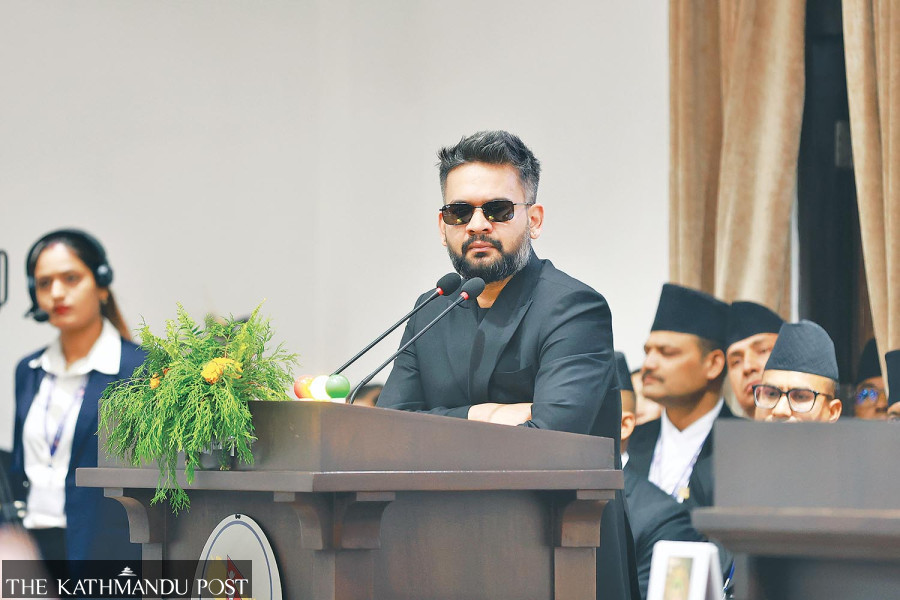
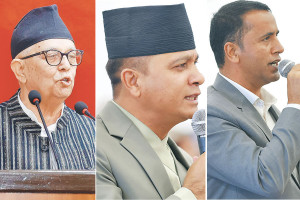
Despite relaxed quorum rules, the Constitutional Council has not moved to fill 19 vacant posts across key commissions. Prime Minister Balendra Shah speaks in Parliament, on Sunday. Post File Photo
The Constitutional Council has remained inactive since its last meeting, even after a new ordinance was issued to ease quorum requirements and simplify decision-making.
The continued inaction has left key positions in constitutional bodies vacant for months, forcing several commissions to operate under acting leadership and raising concerns about their effectiveness.
The ordinance on the Constitutional Council (Functions, Duties, Powers and Procedures), authenticated by President Ramchandra Paudel, allows council meetings with at least four members and decisions by a majority of those present. It was introduced to facilitate meetings even without opposition support and to speed up appointments to constitutional bodies.
The council last met on May 5, when Prime Minister Balendra Shah convened a meeting following the issuance of the ordinance. That meeting recommended a chief justice. Since then, no further meeting has been held.
The six-member council is chaired by the prime minister and comprises the Speaker, the chief justice, the chairperson of the National Assembly, the deputy Speaker and the leader of the opposition.
The amendment also reduced the quorum requirement further, allowing meetings with at least three members, including the chairperson, and enabled decisions with the support of at least three members even if five are present. Opposition parties, constitutional experts and civil society groups have criticised the provision, arguing it weakens consensus-based appointments and concentrates power in the executive.
Despite these changes, the council has not moved forward on appointments to constitutional bodies, where at least 19 positions remain vacant across multiple commissions.
The Election Commission has two vacancies, including the chief election commissioner. The National Natural Resources and Fiscal Commission has four, including its chairperson. The Muslim Commission, Tharu Commission, Madhesi Commission and National Inclusion Commission each have two vacant posts, including their respective chairs.
One post each is vacant in the Commission for the Investigation of Abuse of Authority, the National Human Rights Commission and the National Women Commission. The National Dalit Commission has two vacant member positions.
Each constitutional commission is mandated to have five members, including a chairperson.
Several of these institutions continue to function under acting leadership. The Election Commission, despite two vacant posts, including its chief, conducted the House of Representatives election on March 5. Election management and preparation fall under its core responsibilities, yet it proceeded with the polls without full leadership.
Acting Chief Election Commissioner Ram Prasad Bhandari said the vacancies had not affected the commission’s performance.
“We demonstrated that the vacancies did not hamper our work by successfully conducting the March 5 election,” he said. “In fact, the Election Commission does not require more than three commissioners. We have already proposed a similar provision to the government task force working on constitutional amendments.”
The National Natural Resources and Fiscal Commission, one of the most significant bodies under Nepal’s federal structure, has been functioning with only one member since mid-April. Four posts, including the chairperson, remain vacant.
The commission is responsible for recommending the equitable distribution of revenue and fiscal resources among federal, provincial and local governments. It determines the framework for revenue sharing from the federal consolidated fund, recommends fiscal equalisation and conditional grants, and assesses the expenditure responsibilities and revenue capacity of subnational governments.
It also recommends borrowing limits for all levels of government, sets principles for sharing benefits from natural resources, and advises on dispute resolution related to resource distribution.
Acting Chairperson Bipin Raj Niraula said the vacancies had not obstructed decision-making, as existing laws allow the commission to function. However, he acknowledged that effectiveness had been affected.
“The recommendations on fiscal equalisation and conditional grants had already been completed in March–April, so our core work has not been affected,” he said. “A bigger challenge is the frequent transfer of technical staff, which has a greater impact on the commission’s performance.”
Former National Inclusion Commission chair Ram Krishna Timilsina said vacancies in bodies such as the National Human Rights Commission, Madhesi Commission, Tharu Commission and Muslim Commission have weakened oversight functions and policy recommendations.
He said commissions established under the 2015 constitution have not received the same political priority as older constitutional bodies.
“The government immediately pays attention to long-established institutions such as the Public Service Commission or the anti-graft commission,” he said. “But the commissions created under the new constitution have not been given the same priority. There is a perception that they were products of political compromise during constitution-making rather than institutions whose expertise should be utilised. That mindset has contributed to delays in appointments.”
The continued vacancies have raised questions over the government’s commitment to completing appointments, particularly after the chief justice recommendation was made. Critics have questioned why the process stalled if the ordinance was intended to address this problem precisely.
Nepali Congress parliamentary party leader Bishma Raj Angdembe, a member of the council, said he had not received any information about the next meeting.
“Even when the ordinance was introduced, I suspected it might be intended solely to appoint the chief justice,” he said. “Since the meeting that recommended the chief justice, there has not even been any discussion about holding another meeting. I have had no conversation with the prime minister on the matter.”
Prime Minister Shah’s press and research expert Deepa Dahal said the government has been focused on governance reforms and has not yet concentrated on filling the vacancies.
“No decision has been made regarding the next council meeting,” she said. “The government is currently focused on a range of governance-related priorities. It is aware of the need to appoint office-bearers to constitutional commissions and plans to move ahead accordingly.”
National Assembly Chairperson Narayan Dahal is affiliated with the Nepali Communist Party (NCP), while Deputy Speaker Rubi Kumari Thakur was elected from the Shram Sanskriti Party, which is in opposition. However, she supported the prime minister’s proposal to recommend Manoj Kumar Sharma as chief justice. Dahal and opposition leader Angdembe opposed the recommendation.
The appointment of the chief justice has made it numerically easier for the prime minister to convene meetings and secure decisions under the revised rules.
Previously, the council required the presence of at least four members, including the chairperson, to meet. The ordinance lowered the quorum requirement and reshaped decision-making thresholds, allowing the prime minister and two allies to form a majority even in the presence of dissenting members.
Opposition parties, constitutional experts and civil society groups have strongly criticised the amendment, arguing it undermines consensus-based constitutional appointments and concentrates authority within a small group around the executive.
Major opposition parties have registered motions in both houses of Parliament seeking to reject all eight ordinances issued by the government, including the Constitutional Council ordinance. They argue that appointments to constitutional bodies require broad political consensus and cannot be decided by a slim majority.
Under the constitution, ordinances must be endorsed by both houses before replacement bills can proceed.
Although the ruling coalition commands a strong majority in the House of Representatives, the National Assembly is expected to play a decisive role in determining the ordinance's fate.
Opposition leaders say the process has not advanced because the government has not prioritised it.
Jhakku Prasad Subedi, NCP’s parliamentary party leader in the National Assembly, said the matter had not advanced because it was not a government priority.
“The government decides which business is brought before Parliament,” Subedi said. “Since this has not been prioritised, the process of either approving or rejecting the ordinance has not moved ahead. Whenever the government is ready, the opposition will formulate a common position.”




 15.26°C Kathmandu